


This professional guide provides an in-depth analysis of 100G QSFP28 modules to assist network engineers in procurement. Selecting the correct 100G QSFP28 module requires evaluating transmission distance, power consumption, and optical interface compatibility to ensure peak data center performance.
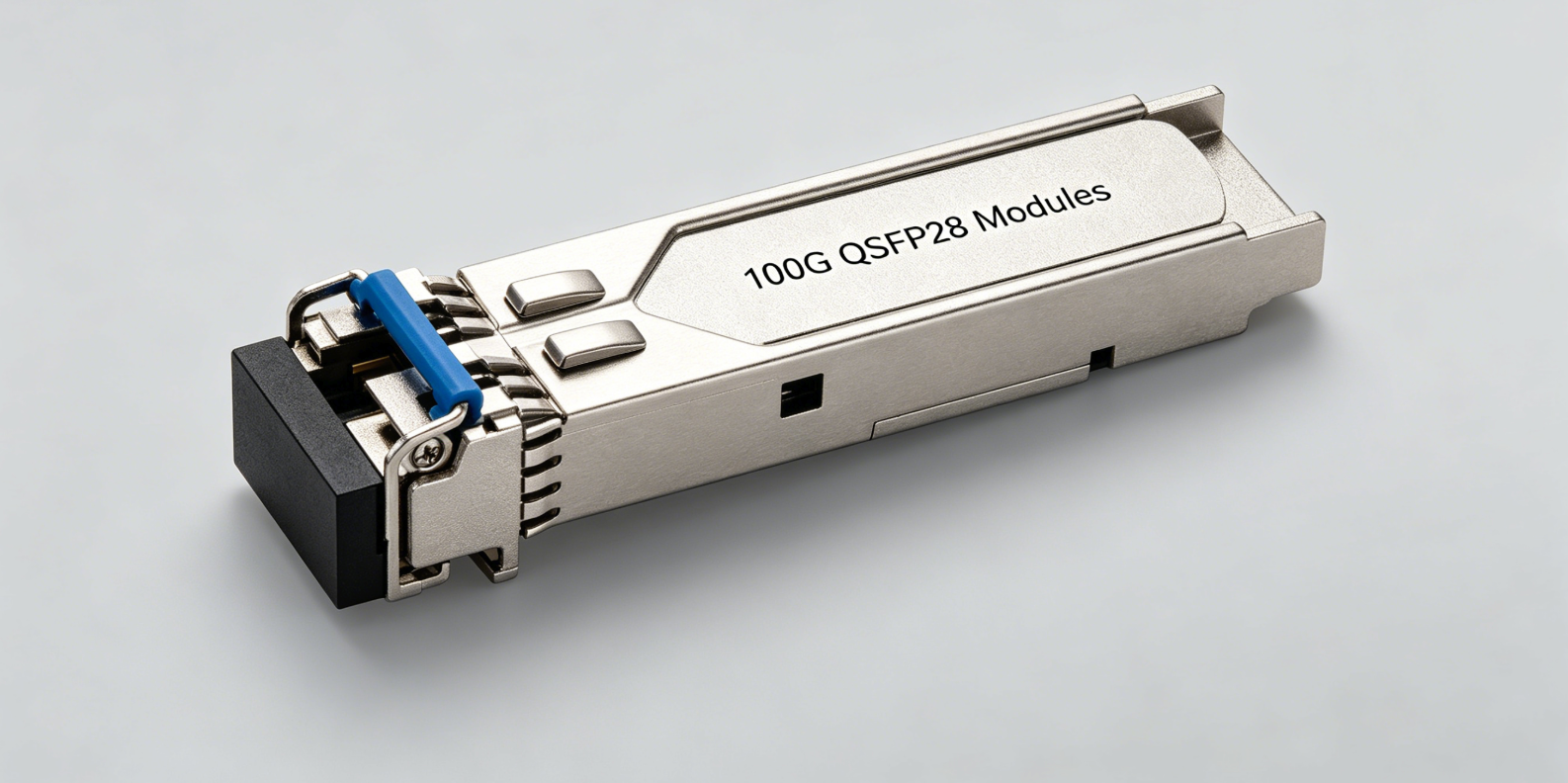
1. Transmission Distance and Fiber Type Compatibility
The primary specification for any 100G QSFP28 module is its rated transmission distance over specific fiber media. 100G Ethernet deployments typically utilize either Multi-Mode Fiber (MMF) for short-reach connections or Single-Mode Fiber (SMF) for long-haul spans. Selecting a module that exceeds or falls short of the required distance can lead to excessive signal attenuation or unnecessary capital expenditure.
Short-range modules, such as the SR4, typically cover up to 100 meters over OM4 Fiber Patch Cords. In contrast, long-reach modules like the LR4 or ER4 utilize Wavelength Division Multiplexing (WDM) to transmit signals over 10km to 40km. According to IEEE 802.3bm standards, signal integrity at 100G is highly sensitive to chromatic dispersion over these longer distances.
Key Distance Specifications for 100G Modules:
- SR4 (Short Reach): Up to 100m via MPO/MTP OM4 fiber.
- PSM4 (Parallel Single Mode): Up to 500m using parallel SMF.
- CWDM4 (Coarse WDM): Up to 2km via duplex SMF.
- LR4 (Long Reach): Up to 10km via duplex SMF.
- ER4 (Extended Reach): Up to 40km with specialized amplification.
2. Optical Interface and Connector Requirements
The optical interface determines the physical cabling infrastructure required for the 100G QSFP28 transceiver. Most 100G modules utilize either MPO-12 connectors or Duplex LC connectors. Misalignment between the transceiver interface and the existing MPO/MTP Solution can result in costly retrofitting or the need for additional conversion cables.
SR4 and PSM4 modules utilize MPO-12 interfaces, which transmit data across eight of the twelve available fibers (four for transmitting, four for receiving). This parallel transmission approach is cost-effective for high-density environments. Conversely, modules like the LR4 multiplex four wavelengths onto a single pair of fibers, necessitating a Duplex LC connector. This reduces the total fiber count required but increases the internal complexity of the transceiver.
| Module Type | Connector Type | Fiber Count | Primary Application |
|---|---|---|---|
| QSFP28 SR4 | MPO-12 (Male) | 8 Fibers | Intra-rack connectivity |
| QSFP28 PSM4 | MPO-12 (Male) | 8 Fibers | Mid-range data center links |
| QSFP28 CWDM4 | Duplex LC | 2 Fibers | Enterprise campus backbones |
| QSFP28 LR4 | Duplex LC | 2 Fibers | Long-distance carrier links |
3. Power Consumption and Thermal Management
Power efficiency is a critical specification for high-density data centers where thermal loads impact operational costs. Most standard 100G QSFP28 modules consume between 3.5W and 4.5W. However, higher-performance modules designed for extended distances may exceed these values. Excessive heat generation can degrade the laser component, reducing the Mean Time Between Failures (MTBF).
Modern green data center initiatives prioritize “Low Power” versions of 100G transceivers. Reducing power consumption by even 0.5W per module can result in significant energy savings when scaled across thousands of ports. Efficient thermal dissipation is often managed by the module’s integrated heat sink and the airflow provided by the Fiber Ethernet Switch.
4. Wavelength and Modulation Format
Understanding the wavelength (nm) and modulation format is essential for ensuring interoperability between different hardware vendors. Most 100G QSFP28 modules utilize either 850nm (for MMF) or the 1310nm window (for SMF). The 100G standard typically employs NRZ (Non-Return-to-Zero) modulation, though newer 400G-ready infrastructures may involve PAM4 (Pulse Amplitude Modulation).
For CWDM4 and LR4 modules, the device uses four distinct wavelengths centered around 1310nm. These wavelengths are combined using an internal optical multiplexer. According to the CWDM4 MSA (Multi-Source Agreement), precise wavelength stability is required to prevent “crosstalk” between channels, which would otherwise increase the Bit Error Rate (BER).
5. DDM/DOM Functional Support
Digital Diagnostics Monitoring (DDM), also known as Digital Optical Monitoring (DOM), is a crucial specification for real-time network health assessments. A 100G QSFP28 module with DDM support allows administrators to monitor parameters such as laser output power, input optical power, temperature, and supply voltage.
Without DDM, troubleshooting a failing link becomes a reactive process involving manual testing. With DDM enabled, the system can trigger alarms before a total link failure occurs. This is especially vital when connecting to Industrial Media Converters in harsh environments where temperature fluctuations are common.
Checklist for QSFP28 Procurement:
- Verify the exact distance required (do not overestimate).
- Confirm connector compatibility (LC vs. MPO).
- Review the power budget of the host switch.
- Ensure the module supports DDM/DOM for proactive monitoring.
- Check for MSA compliance to ensure multi-vendor interoperability.
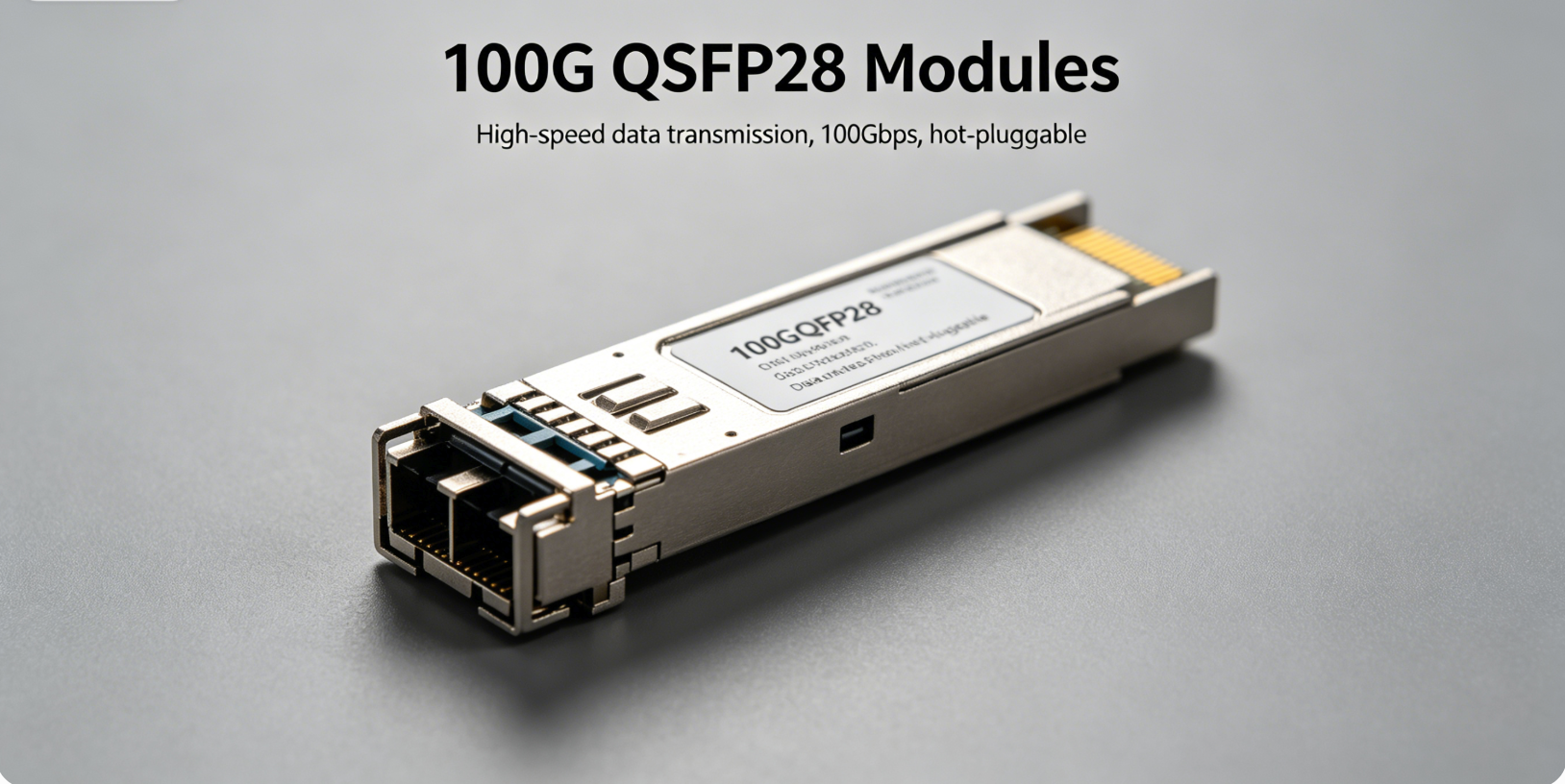
Summary Table: QSFP28 Selection Matrix
This table summarizes the trade-offs between the most common 100G module specifications.
| Specification | Short Reach (SR4) | Intermediate (CWDM4) | Long Reach (LR4) |
|---|---|---|---|
| Max Distance | 100m (OM4) | 2km (SMF) | 10km (SMF) |
| Typical Power | < 3.5W | < 3.5W | < 4.5W |
| Cost Basis | Lowest | Medium | High |
| Fiber Requirement | High (8 fibers) | Low (2 fibers) | Low (2 fibers) |
Conclusion
Selecting a 100G QSFP28 module involves balancing technical performance with infrastructure constraints. By prioritizing distance, interface type, and power efficiency, organizations can build scalable and reliable 100G networks. Always consult official datasheets from the SFF Committee to ensure your chosen hardware meets the latest industry standards for 2026 deployments.
Frequently Asked Questions
1. Can I use a 100G QSFP28 SR4 module with Single-Mode Fiber?
No, the 100G QSFP28 SR4 is designed specifically for Multi-Mode Fiber (MMF) using 850nm lasers. Using it with Single-Mode Fiber (SMF) will result in extreme signal loss because the core diameter of SMF is significantly smaller than that of MMF, preventing light from coupling effectively.
2. What is the difference between QSFP28 and QSFP+ modules?
While both share the same physical form factor, QSFP+ supports 40G speeds (4x10G), whereas QSFP28 is designed for 100G speeds (4x25G). QSFP28 modules utilize higher-frequency electrical interfaces and more advanced processing to handle the increased data throughput required for modern high-speed networking.
3. Why is power consumption important for 100G QSFP28 transceivers?
High power consumption leads to increased heat generation within the switch chassis. In high-density deployments, this can exceed the cooling capacity of the data center, leading to thermal throttling or hardware failure. Energy-efficient modules help lower the total cost of ownership (TCO) and improve system reliability.
4. Is MPO-12 or MPO-24 better for 100G SR4 connections?
For 100G QSFP28 SR4, the MPO-12 connector is the industry standard. It uses 8 of the 12 fibers to create four 25Gbps lanes. While MPO-24 can be used with adapters, it adds unnecessary complexity and potential insertion loss to the fiber link without providing additional performance benefits.
5. Does a 100G LR4 module require FEC (Forward Error Correction)?
Yes, most 100G QSFP28 modules, including the LR4, rely on Host-FEC (RS-FEC) as defined in IEEE 802.3bj. FEC helps correct bit errors caused by signal degradation over long distances. Ensure your switch port supports and has FEC enabled to achieve the full 10km transmission distance.