


Fiber optic infrastructure efficiency depends on strict adherence to international testing protocols that govern signal loss, dispersion, and connector cleanliness. As data centers migrate toward 800G and 1.6T speeds, missing a single testing parameter can lead to catastrophic network failure. Operators must implement standardized verification to guarantee that high-density MPO/MTP solution architectures meet the rigorous performance demands of 2026.
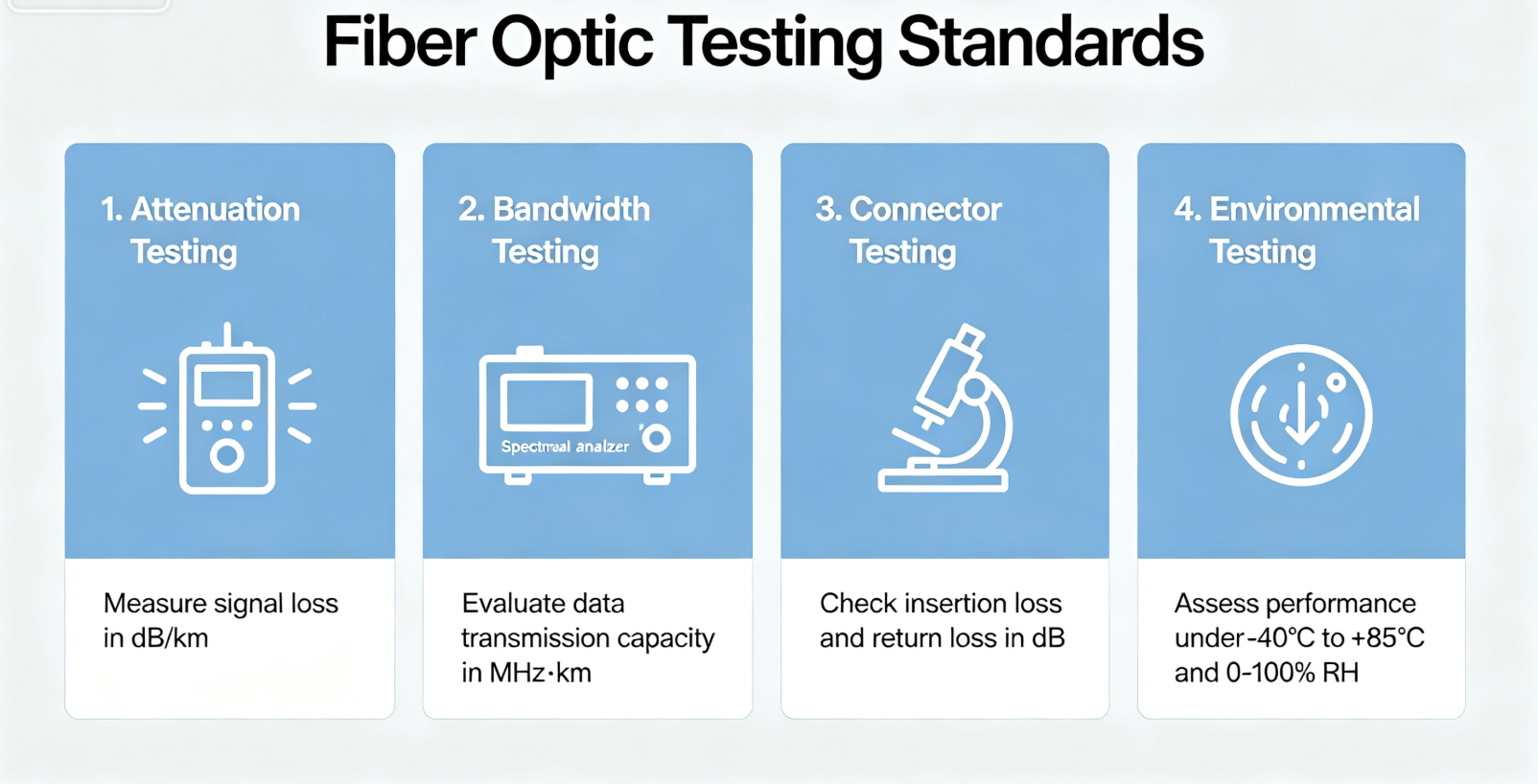
The Distinction Between Tier 1 and Tier 2 Testing
Standardized testing is generally categorized into two tiers to ensure both basic connectivity and advanced signal integrity. Tier 1 testing focuses on total insertion loss, length, and polarity, providing a “Pass/Fail” result based on link budgets. Tier 2 testing incorporates Optical Time Domain Reflectometry (OTDR) to analyze specific events like splices and connectors. Integrating high-quality fiber patch cord & pigtail assemblies requires Tier 1 verification at a minimum to confirm baseline attenuation limits.
1. TIA-568.3-E: Optical Fiber Cabling and Components Standard
The TIA-568.3-E standard is the primary authority for structured cabling in North American enterprise environments. It defines the minimum performance requirements for various fiber types, including OM3, OM4, and OS2. In 2026, this standard emphasizes stricter polarity requirements for multi-fiber arrays. Using a certified fiber optic distribution panel ensures that cabling layouts remain compliant with TIA-568.3-E polarity mapping.
2. IEC 61280-4-1/2: Installed Cabling Plant Attenuation
The International Electrotechnical Commission (IEC) provides the global framework for measuring attenuation in installed fiber plants. IEC 61280-4-1 covers multimode fiber using the Encircled Flux (EF) method, while 61280-4-2 addresses singlemode links. According to IEC official documentation, EF compliance is mandatory to reduce measurement uncertainty in high-speed links. Proper attenuation testing often involves utilizing a fiber optic attenuator to simulate real-world signal conditions during lab verification.
3. IEC 61300-3-35: End-Face Inspection and Automated Analysis
Connector contamination remains the leading cause of optical network failure, making IEC 61300-3-35 a critical standard for 2026. This standard provides a quantitative criteria for fiber end-face quality, distinguishing between the core, cladding, and adhesive zones. Automated inspection tools must be used to eliminate human subjectivity. Technicians should always use a specialized fiber cleaning tool before any mating cycle to maintain compliance with these stringent cleanliness zones.
4. IEEE 802.3ck: Electrical Signaling for 100/200/400/800 Gb/s
As optical transceivers evolve, the IEEE 802.3ck standard governs the physical layer specifications for ultra-high-speed Ethernet. This standard is vital for engineers deploying a fiber optic transceiver module in top-of-rack switches. It defines the Bit Error Rate (BER) thresholds and Forward Error Correction (FEC) requirements necessary to maintain 800Gbps throughput over short and long-reach fibers.
Comparative Table: Testing Tier Requirements
| Standard | Test Focus | Primary Metric | Required Tooling |
|---|---|---|---|
| TIA-568.3-E | Component Limits | Insertion Loss (dB) | Power Meter / Light Source |
| IEC 61300-3-35 | Surface Quality | Scratches/Pits (Count) | Video Inspection Probe |
| ITU-T G.657 | Bend Sensitivity | Macro-bend Loss (dB) | OTDR (1625nm) |
| IEEE 802.3ck | Data Integrity | Bit Error Rate (BER) | Protocol Analyzer |
5. TIA-526-14-C: Optical Power Loss Measurement (Multimode)
This standard specifically addresses the measurement of optical power loss in installed multimode fiber cable plants. It is highly relevant for campus networks and indoor backbones. The 2026 updates to this protocol suggest narrower tolerances for “One-Cord” reference methods to improve accuracy. For high-density deployments, using a PLC splitter requires careful power budget calculations following TIA-526-14-C to avoid excessive signal degradation at the edge.

6. ITU-T G.652 & G.657: The Geometry of Transmission
The International Telecommunication Union (ITU) defines the physical characteristics of singlemode fiber. G.652 is the standard for conventional singlemode, while G.657 defines bend-insensitive fiber (BIF). In FTTH applications, G.657 compliance is non-negotiable due to the tight radii found in residential installations. According to ITU-T standards, maintaining a low macro-bending loss is essential for signal stability in the L-band.
7. IEC 60793-1-40: Attenuation Measurement Methods
This methodology standard describes how to measure attenuation via the cut-back technique, backscattering (OTDR), and phase shift methods. It provides the technical basis for all secondary fiber tests. In 2026, the backscattering method is preferred for long-haul links to identify point defects. When installing fiber optic cable across long distances, OTDR traces according to IEC 60793-1-40 are required for final certification and warranty validation.
8. ANSI/TIA-598-D: Optical Fiber Color Coding
While often overlooked, color coding is a safety and management standard that prevents cross-connection errors. ANSI/TIA-598-D defines the 12 colors used for fibers and buffer tubes. Proper identification is critical when managing high-fiber-count trunks. Following this standard ensures that even complex multi-vendor environments remain navigable for future maintenance and troubleshooting.
Summary of Recommended Testing Values for 2026
- Max Connector Loss: 0.75 dB (per TIA), though 0.25 dB is the industry target for high-performance links.
- Max Splice Loss: 0.30 dB for singlemode; 0.10 dB is preferred for premium installations.
- Return Loss: >35 dB (Multimode), >55 dB (Singlemode APC).
Frequently Asked Questions (FAQ)
Q1: Why is Encircled Flux (EF) testing mandatory for multimode fiber in 2026? Encircled Flux testing standardizes the launch conditions of the light source, ensuring that the measurement is not overly optimistic or pessimistic. It reduces variation between different test equipment manufacturers, providing a reliable and repeatable measurement of insertion loss in high-speed 40G/100G/400G multimode networks.
Q2: Can I rely solely on Tier 1 testing for data center certification? While Tier 1 testing confirms overall loss and length, it cannot identify specific “hidden” issues like a stressed bend or a poor-quality splice. For 2026 high-density environments, Tier 2 testing (OTDR) is highly recommended to provide a complete “birth certificate” for the fiber link and simplify future troubleshooting.
Q3: How does IEC 61300-3-35 affect the use of MPO connectors? MPO connectors have a larger surface area and multiple fibers, making them more susceptible to contamination. IEC 61300-3-35 provides specific automated templates for MPO end-faces, ensuring that all 12 or 24 fibers meet the required cleanliness standard simultaneously before the link is commissioned.
Q4: What is the impact of ITU-T G.657 on fiber optic testing in 2026? ITU-T G.657 fiber is designed to handle tighter bends without significant signal loss. Testing this fiber requires an OTDR capable of measuring at higher wavelengths (like 1625nm), where bend-induced loss is most visible. Standard testing ensures that the “bend-insensitive” property is actually functioning as specified.
Q5: Are these testing standards applicable to all fiber optic transceivers? Yes, standards like IEEE 802.3ck and TIA-568.3-E provide the physical and logical requirements that transceivers must meet. Following these testing standards ensures that the cabling plant provides an environment where transceivers can operate at their rated speeds without excessive bit errors or signal failures.