


Why MPO Trunk Cable Upgrades Matter for 2026 AI Infrastructure
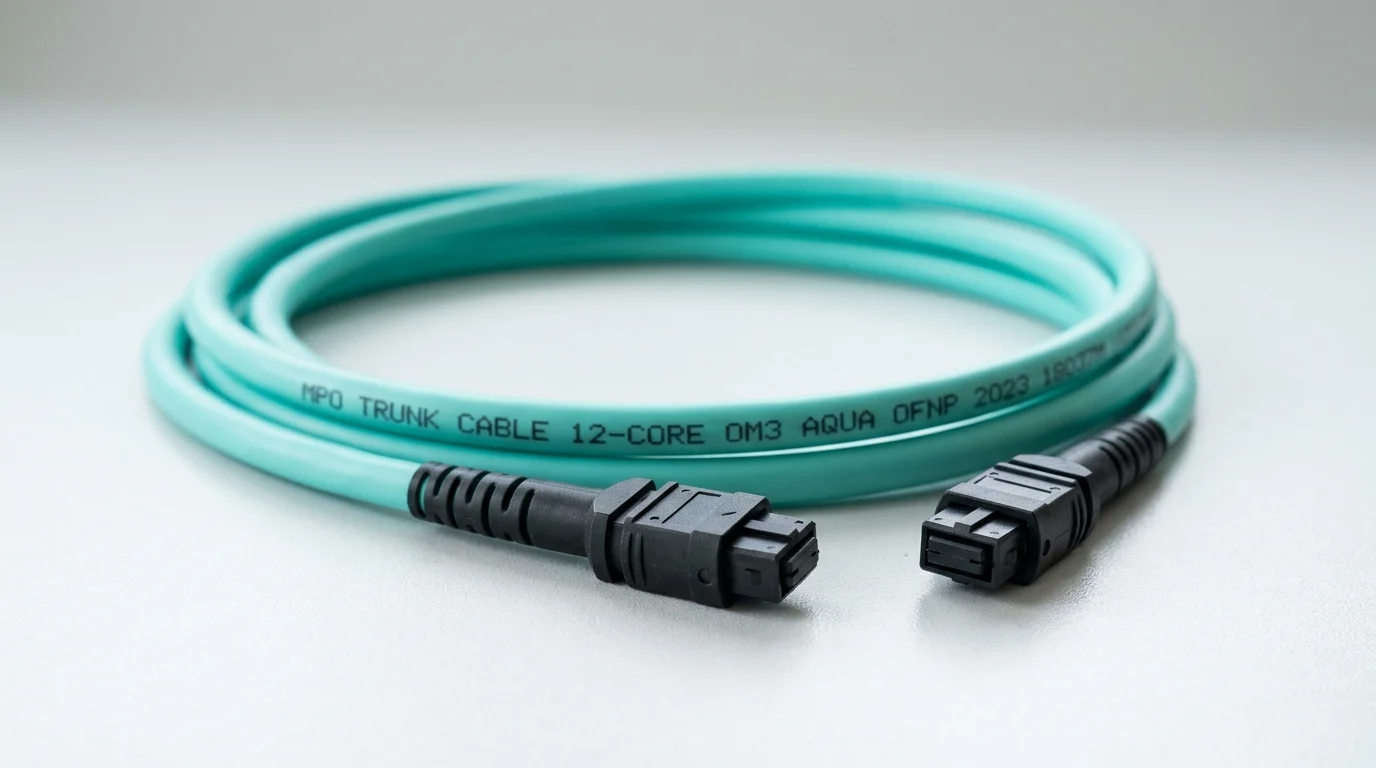
The transition toward 800G and 1.6T network architectures for 2026 AI data centers fundamentally changes the physical layer requirements. To support massive parallel processing and low-latency data transport, legacy duplex cabling is rapidly being replaced by multi-fiber push-on solutions. As computing pods scale to incorporate thousands of interconnected GPUs, the reliance on an MPO Trunk Cable becomes absolute for maintaining critical data throughput without exhausting pathway space.
AI cluster density and leaf-spine growth
AI workloads rely heavily on robust, non-blocking leaf-spine architectures. A modern AI cluster requires massive east-west traffic capabilities. Scaling from 400G to 800G and beyond demands higher core counts per link. Where traditional setups utilized 12-fiber MPO connections, 2026 deployments increasingly dictate 16-fiber and 32-fiber configurations to maximize switch port utilization. The density multiplier is stark: a 1U switch panel can now accommodate up to 144 or 288 fibers using high-density MPO cassettes, drastically reducing the physical footprint of the cabling plant while supporting bandwidths exceeding 25.6 Tbps per switch ASIC.
Buyer priorities for MPO trunk upgrades
Procurement teams must evaluate High Density Fiber Optic Cabling through a total cost of ownership (TCO) lens rather than simple component pricing. Key priorities include maximizing pathway lifespan, minimizing installation time, and ensuring future compatibility with upcoming transceivers, such as OSFP and QSFP-DD800. Buyers are setting strict operational metrics: targeting less than 0.35 dB insertion loss per mated pair to preserve tight optical budgets, and demanding scalable solutions that reduce rack-level cabling volume by at least 40% compared to legacy LC duplex systems.
Key MPO Trunk Cable Specifications for High-Density AI
Selecting the correct physical specifications is critical to preventing optical budget failures in hyperscale environments. The technical parameters of an MTP Trunk Cable dictate not only immediate performance but also the infrastructure’s viability through subsequent hardware refresh cycles.
Fiber counts, connectors, and polarity
The shift to 800G optical transceivers requires an evolution in fiber counts. Base-8 and Base-16 architectures are now standard in AI deployments. 16-fiber MPO connectors provide direct support for 800G SR8 and DR8 transceivers, eliminating the need for complex and loss-inducing conversion modules. Polarity management remains a paramount concern; Type B (reversed) polarity is predominantly specified for parallel optics to ensure proper transmit-to-receive alignment across complex trunk links, reducing deployment errors and network downtime.
Singlemode vs multimode selection
The choice between singlemode (OS2) and multimode (OM4/OM5) fiber hinges on link distance and transceiver costs. For intra-row or top-of-rack connections within 100 meters, an OM4 MPO Cable offers a highly cost-effective solution, balancing lower transceiver pricing with sufficient bandwidth (4700 MHz·km at 850 nm). However, for leaf-to-spine or inter-hall links exceeding 100 meters, OS2 singlemode trunks are mandatory. OS2 cables support virtually unlimited bandwidth over standard data center distances, aligning with DR8 and 2xFR4 transceiver deployments.
Procurement comparison criteria
| Specification | OM4 Multimode MPO | OS2 Singlemode MPO |
|---|---|---|
| Max Reach (800G) | 50m – 100m | > 500m (up to 2km) |
| Typical Insertion Loss | 0.35 dB (Standard) / 0.15 dB (Elite) | 0.35 dB (Standard) / 0.25 dB (Elite) |
| Core/Cladding Diameter | 50/125 µm | 9/125 µm |
| Primary Transceiver Pairing | SR8, VR8 | DR8, 2xFR4 |
| Relative Cable Cost | Lower | Higher |
When comparing vendors, buyers must demand 3D interferometer test reports for every assembly to verify end-face geometry. Key thresholds include a radius of curvature between 1.0 and 3.0 mm for multimode, and fiber height differentials not exceeding 200 nm. These specific metrics ensure that the physical contact between mated connectors remains flawless under high-power AI data transmission.
How Buyers Should Source MPO Trunk Cable
Strategic sourcing of pre-terminated fiber assemblies requires rigorous supplier vetting. Because high-density AI clusters have zero tolerance for physical layer faults, procurement strategies must shift from spot-buying to establishing qualified, long-term manufacturing partnerships.
Supplier qualification and risk control
Importers and data center operators must audit suppliers for advanced manufacturing capabilities. Key indicators of a qualified vendor include automated polishing equipment, cleanroom environments (ISO Class 7 or better), and strict adherence to IEC 61754-7 and TIA-604-5 (FOCIS 5) standards. Risk control protocols should mandate a maximum defect rate of less than 0.1% upon delivery. Furthermore, buyers should assess the supplier’s capacity to handle sudden volume spikes, requiring proven production capacities of at least 50,000 terminations per month to support large-scale build-outs.
Compliance, testing, and documentation
Every MPO Trunk Cable must be accompanied by comprehensive testing documentation. This includes individual serialization and test reports detailing insertion loss (IL) and return loss (RL). For premium AI deployments, buyers should stipulate “Elite” or “Low-Loss” connectors with IL strictly capped at 0.35 dB max (0.15 dB typical) for multimode, and RL strictly >60 dB for singlemode APC (Angled Physical Contact) connectors. Flammability compliance is also non-negotiable; assemblies must meet OFNP (Plenum) or LSZH (Low Smoke Zero Halogen) ratings depending on regional fire codes, such as CPR Euroclass B2ca or Cca for European markets.
Pricing, supply terms, and margin protection
Wholesale pricing for MPO trunks is highly sensitive to fiber core counts and connector brands. Buyers typically face Minimum Order Quantities (MOQs) ranging from 100 to 500 pieces for custom lengths. To protect margins, distributors should negotiate tiered pricing structures based on annual volume commitments. Securing fixed-price agreements for 12 to 18 months can insulate buyers from raw material volatility, particularly in the pricing of specialized optical glass and aramid yarn.
Logistics and Deployment Planning for MPO Trunk Cable
The physical delivery and installation of high-density fiber trunks demand meticulous logistical planning. Mishandling during transit or deployment can induce microbends, compromise connector end-faces, and result in catastrophic link failures during network commissioning.
Packaging, labeling, and reel management
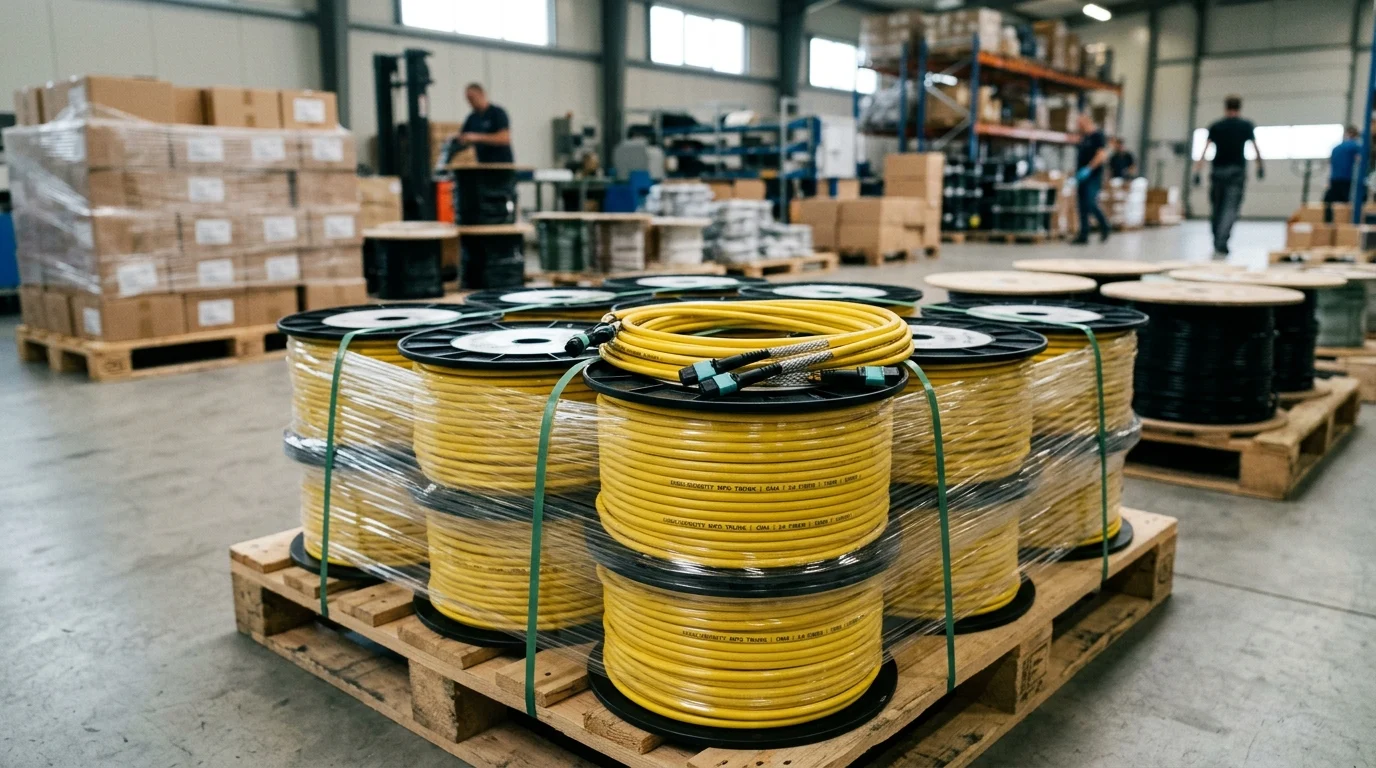
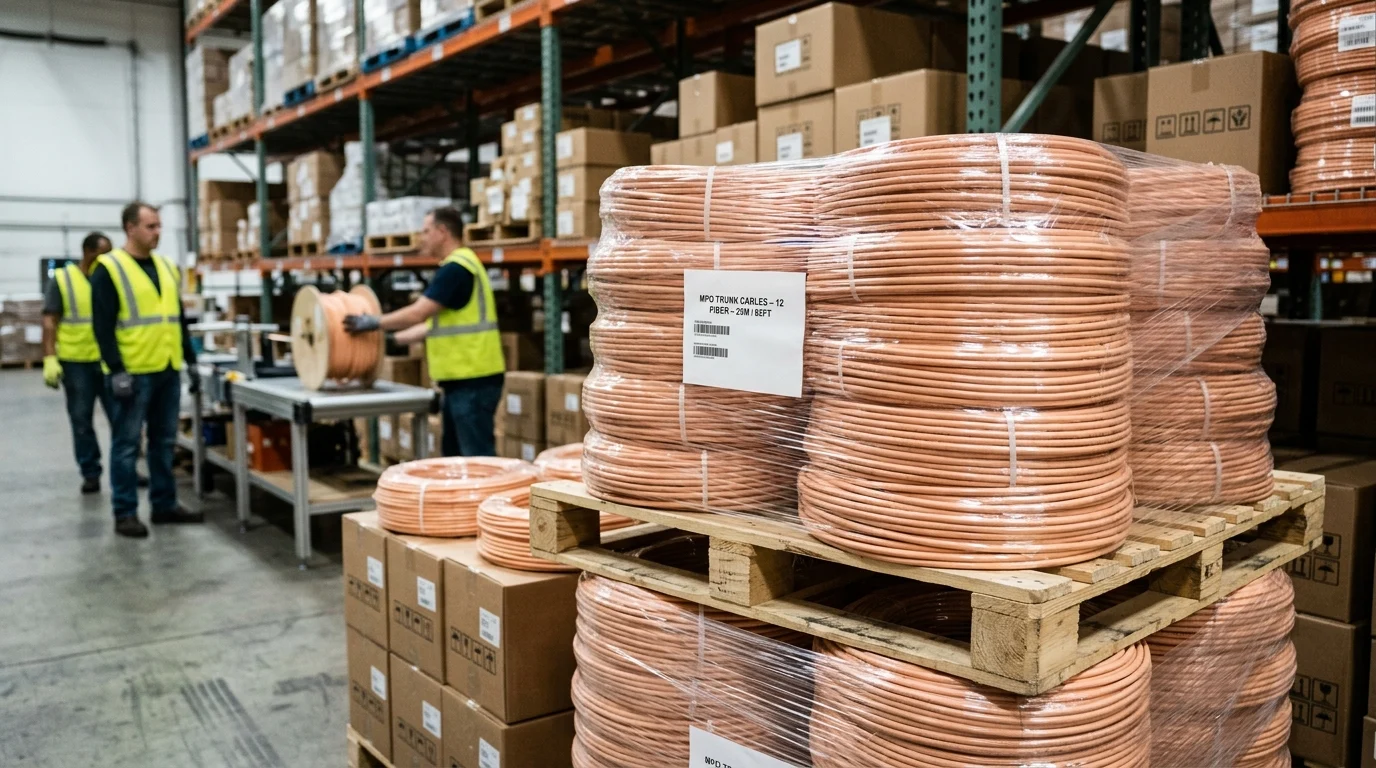
Proper packaging is essential for protecting fragile optical assemblies. Trunks exceeding 30 meters must be spooled on heavy-duty wooden or impact-resistant plastic reels, ensuring the bend radius never falls below the critical threshold, which is typically 20x the cable diameter during installation. Factory-installed pulling eyes are mandatory to protect the connectors and distribute pulling tension across the aramid yarn strength members, rather than the glass fibers. Furthermore, robust labeling systems incorporating RFID tags or wrap-around barcodes detailing length, polarity, and serialization are critical for rapid asset tracking.
Lead times, Incoterms, and buffer stock
Custom pre-terminated MPO assemblies typically require manufacturing lead times of 3 to 6 weeks, depending on fiber availability and factory load. Global distributors often utilize EXW (Ex Works) or FOB (Free on Board) Incoterms for bulk sea freight to optimize costs, reserving expensive DAP (Delivered at Place) air freight for urgent AI cluster expansions. To mitigate supply chain disruptions, procurement teams should maintain a buffer stock of 10% to 15% of standard trunk lengths (e.g., 15m, 30m, and 50m assemblies) in regional warehouses.
Deployment readiness and implementation steps
Pre-deployment readiness hinges on strict adherence to installation parameters. Technicians must be restricted to a maximum pulling tension of roughly 400 N (90 lbs) for standard multi-fiber trunks to prevent elongation. Cable routing pathways, such as overhead fiber raceways or under-floor trays, must be sized to accommodate the outer diameter of the trunks (typically 3.0mm to 5.5mm for 12F/24F micro-distribution cables) while maintaining a maximum fill ratio of 40% to 50%. This prevents crushing forces at the bottom of the tray and allows for future AI Data Center Connectivity expansions without requiring complete pathway overhauls.
Purchasing Framework for MPO Trunk Cable Selection
Establishing a standardized procurement framework ensures that every fiber deployment meets the rigorous demands of next-generation AI workloads. A structured approach to vendor selection and specification guarantees alignment between capital expenditure and network performance goals.
Balancing performance, interoperability, and cost
| Evaluation Criterion | Minimum Acceptable Standard | Premium/AI-Grade Standard |
|---|---|---|
| Insertion Loss (Mated Pair) | < 0.75 dB | < 0.35 dB (Low-Loss) |
| Return Loss (Singlemode APC) | > 50 dB | > 60 dB |
| End-Face Geometry | Visual Inspection Only | 100% 3D Interferometer Tested |
| Warranty Period | 1 – 3 Years | 10 – 25 Years (System Warranty) |
| Custom Length Tolerance | ± 10 cm | ± 5 cm |
Cost optimization should never compromise optical performance. While generic MPO connectors may offer a 15% to 20% cost reduction upfront, they often introduce interoperability issues and higher insertion losses compared to premium patented connectors. Buyers must balance these factors, recognizing that the cost of troubleshooting and replacing a faulty trunk in a live AI cluster vastly outweighs the initial premium paid for elite-grade, fully certified assemblies.
When MPO trunk cable becomes a strategic investment
Viewing cabling as a simple commodity is a critical error in AI infrastructure planning. With the transition to 1.6T networking on the horizon for 2026, high-quality multi-fiber trunks represent a strategic, long-term asset. Properly specified trunks with high fiber counts, such as 144F or 288F backbone cables, provide the necessary dark fiber for future scaling, delivering a usable lifespan of 7 to 10 years. By investing in premium, low-loss assemblies today, data center operators avoid costly rip-and-replace scenarios, ultimately reducing the total cost of ownership by up to 30% over the facility’s lifecycle.
Key Takeaways
- Wholesale sourcing and supply-chain implications for MPO Trunk Cable
- Specifications, compliance, and commercial terms buyers should validate
- Actionable recommendations for distributors and procurement teams
Frequently Asked Questions
Why are MPO/MTP trunk cables central to 2026 AI data center upgrades?
They support 800G and 1.6T links with far higher fiber density than LC duplex, saving pathway space and enabling scalable leaf-spine AI fabrics.
Should I choose OM4 or OS2 MPO trunk cable for my project?
Use OM4 for short in-row or ToR links up to about 100m with SR8/VR8. Choose OS2 for longer leaf-spine or inter-hall runs and DR8/2xFR4 optics.
What fiber count is best for 800G AI deployments?
Base-16 is a practical choice for 800G SR8 and DR8 because it aligns directly with transceiver lanes and avoids extra conversion modules.
What insertion loss target should buyers request for MPO trunk cables?
Specify less than 0.35 dB per mated pair, or lower for tighter budgets. This helps preserve optical margin in dense AI data center links.
What should I verify when sourcing MPO trunk cables from Newsunn?
Confirm polarity type, fiber count, connector grade, and test documents such as insertion loss and 3D interferometer reports for each assembly.