


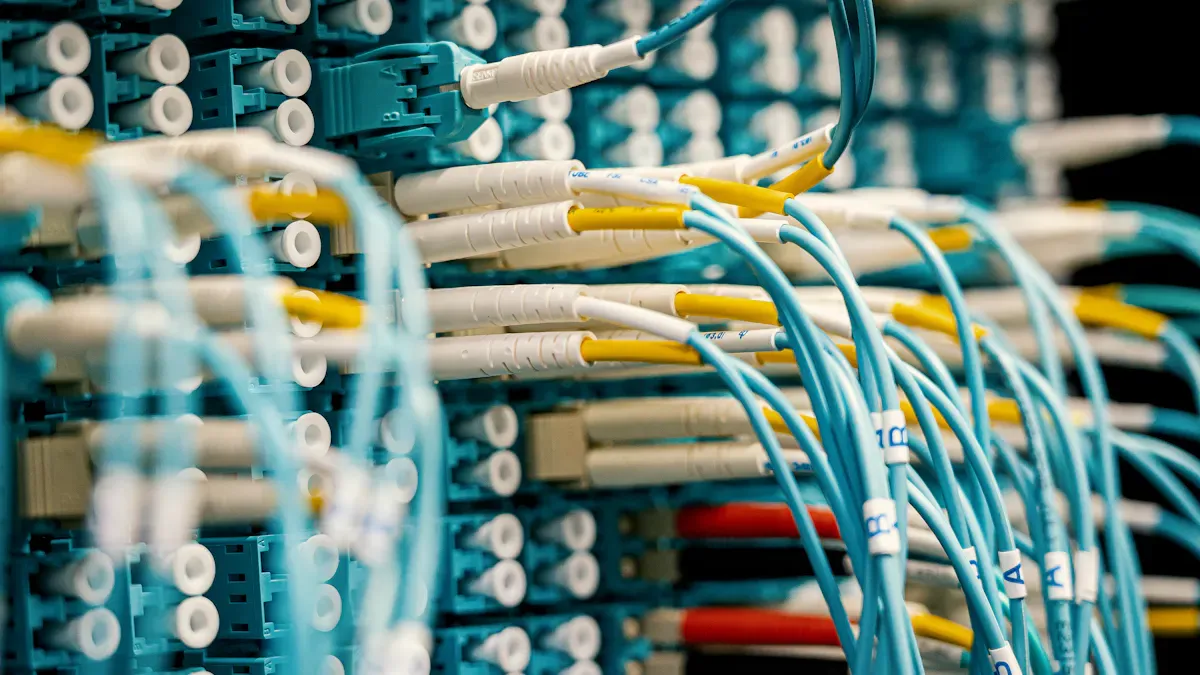
MPO Breakout Harness Cables significantly enhance connectivity in AI Data Centers, especially those operating at hyper-scale. With their capability to support high-bandwidth applications, they ensure that data transfer is both efficient and reliable. The modular designs of MPO Breakout cables facilitate seamless scalability, which is essential as data demands continue to rise. Additionally, by simplifying the cabling infrastructure, these harness cables greatly improve overall performance and efficiency in data center operations.
Did you know that utilizing MPO Breakout Harness Cables can even lead to lower energy costs? It’s a win-win for any data center!
Key Takeaways
- MPO breakout cables enhance connectivity in AI-driven data centers, supporting high-bandwidth applications for efficient data transfer.
- These cables simplify cabling infrastructure, reducing clutter and improving airflow, which is crucial for cooling in data centers.
- MPO breakout cables allow for easy upgrades from lower to higher speeds, future-proofing your data center without major overhauls.
- Using MPO breakout cables can cut installation time by 70-80%, speeding up data center deployments significantly.
- High-density connectivity from MPO cables supports advanced Ethernet standards, essential for managing massive data demands.
- MPO breakout cables can lead to significant energy savings, reducing power consumption and cooling needs in data centers.
- The modular design of MPO cables allows for quick reconfigurations, making it easier to adapt to changing data center needs.
- Investing in MPO breakout cables is a smart choice for any data center aiming to thrive in a data-driven world.
Importance of High-Density Connectivity
Demand for Bandwidth
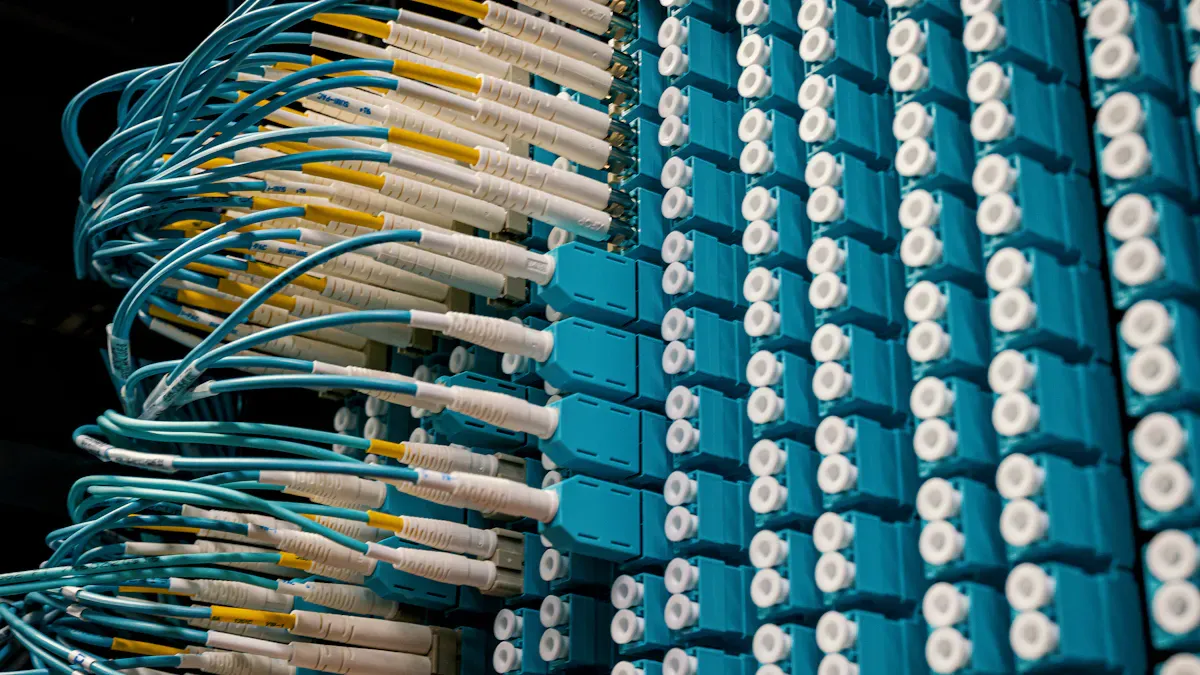
In today’s data-driven world, the demand for bandwidth is skyrocketing. I often find myself amazed at how much data we generate and process daily. High-density connectivity plays a crucial role in meeting these demands. It allows seamless communication between numerous servers and storage units, which is essential for optimizing resource allocation and reducing latency. With the rise of AI workloads, the need for massive data processing capabilities has never been more critical. High-density connectivity supports this by enabling advanced Ethernet standards like 400G and 800G, which are vital for modern data centers.
Space Optimization
Space is a premium in any data center, and I’ve seen firsthand how high-density connectivity can lead to significant space savings. For instance, using traditional cabling for 500 servers typically requires about 8 switches and 16 rack units of space. However, with MPO breakout cables, I can support the same number of servers with just a single 64-port 800 Gig switch, occupying only 2 rack units! This kind of optimization not only reduces cable clutter but also enhances airflow, which is crucial for cooling.
| Benefit | Description |
|---|---|
| Reduces Cable Clutter | Simplifies network changes and reduces the number of cables needed, which enhances airflow. |
| Facilitates Rapid Scaling | Plug-and-play capability allows for quick connections and reconfigurations without specialized skills. |
| Maximizes Rack Space Utilization | Scalable architectures can cut cable counts by up to 80%, freeing up space for other equipment. |
Future-Proofing Infrastructure
As technology evolves, so do our bandwidth needs. I appreciate how MPO breakout cables allow for easy upgrades from 10G to 40G or even 100G without needing to replace the entire cabling infrastructure. This adaptability is crucial for future-proofing our data centers. The scalability of these cables means I can meet increasing data demands without overhauling existing systems. They convert multi-fiber connectors into individual simplex or duplex connectors, offering customized configurations that fit our specific needs.
Technical Advantages of MPO Breakout Harness Cable
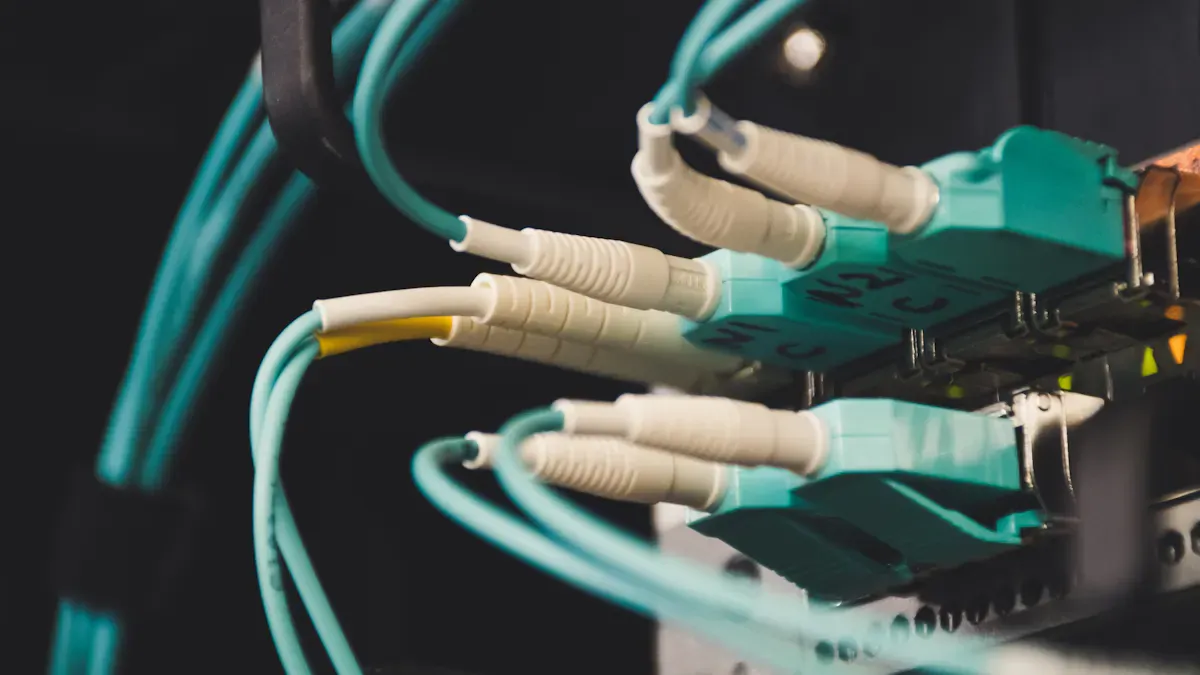
Fiber Count and Configuration
When I think about the fiber count and configuration of MPO Breakout Harness Cables, I realize how crucial they are for optimizing network performance. The variety of fiber counts available allows me to tailor my cabling solutions to specific applications. Here’s a quick overview of the most common fiber counts and their applications:
| Fiber Count | Common Applications | Supported Speeds |
|---|---|---|
| 8-Fiber MPO | Legacy 40G (SR4) | 40G |
| 12-Fiber MPO | 100G (SR4), 40G BiDi | 40G, 100G |
| 16-Fiber MPO | 200G/400G Breakout | 200G, 400G |
| 24-Fiber MPO | 400G/800G, Hyperscale | 400G, 800G |
The choice of fiber count directly impacts network design and performance, especially in AI-driven environments. I’ve found that using monomode fiber enhances communication speed and reliability over long distances. This is essential for AI workloads that demand high bandwidth and low signal attenuation. By integrating AI technologies with these fiber networks, I can create intelligent systems capable of dynamic bandwidth allocation and real-time performance optimization.
Reduced Installation Time
One of the standout benefits of using MPO Breakout Harness Cables is the significant reduction in installation time. I’ve experienced firsthand how pre-terminated solutions can cut installation time by 70-80% compared to conventional cabling methods. This efficiency comes from eliminating complex on-site fiber termination processes. Projects that used to take weeks can now be completed in just a few days, accelerating data center deployments.
Here’s a quick look at some of the challenges that MPO breakout cables help minimize:
| Benefit | Description |
|---|---|
| Dramatically Faster Installation | Pre-terminated solutions can cut installation time by 50–80% for both fiber and copper links. |
| Consistent, High-Quality Performance | 100% factory termination and testing ensures reliability and uniform performance across cables. |
| Reduced Errors and Rework | Pre-tested cables lead to lower error rates, reducing the need for troubleshooting and fixes. |
| Cleaner Cable Management | Prefabricated solutions can eliminate over 75% of cabling congestion, improving airflow and access. |
Enhanced Signal Integrity
Signal integrity is another area where MPO Breakout Harness Cables shine. I’ve noticed that these cables significantly reduce signal loss compared to other fiber optic solutions. The integration of Semiconductor Optical Amplifiers (SOAs) in AI-driven data centers enhances signal integrity, which is essential for achieving high data transmission rates. This improvement helps mitigate insertion losses and supports advanced optical networking.
Here’s a comparison of how MPO Breakout Harness Cables stack up against other fiber optic solutions:
| Feature | MPO Breakout Harness Cables | Other Fiber Optic Solutions |
|---|---|---|
| Patching Organization | Yes | Varies |
| Direct Device Connections | Yes | Often No |
| Signal Loss Reduction | Yes | Varies |
| Integration with Existing Infrastructure | Seamless | May Require Adapters |
| Flexibility and Scalability | High | Limited |
| Ease of Upgrades | High | Varies |
With enhanced signal integrity, I can ensure that data remains accurate across extensive optical networks, which is critical for applications requiring ultra-low latency and high throughput. This capability is vital for supporting next-generation technologies like autonomous vehicles and smart cities.
Integration into AI Infrastructure
Compatibility with AI Workloads
When I think about integrating MPO breakout cables into AI workloads, I realize how crucial compatibility is. I’ve learned that several factors can impact the effectiveness of these cables in an AI environment. For instance, understanding the optical module types is essential. Whether I’m using a single MPO-16 or dual MPO-12 can make a big difference in cabling.
Here’s a quick overview of the compatibility factors I keep in mind:
| Compatibility Factor | Description |
|---|---|
| Optical Module Types | Understanding whether the module uses a single MPO-16 or dual MPO-12 is crucial for cabling. |
| Polarity Considerations | Type-B polarity is recommended to ensure correct lane alignment and avoid link failures. |
| Common Cabling Mistakes | Issues like using the wrong connector type or mixing APC and UPC connectors can lead to failures. |
| Best Practices for Deployment | Verifying interfaces, using consistent polarity, and matching connector genders are essential. |
By paying attention to these factors, I can ensure that my data center operates smoothly and efficiently.
Role in Data Processing and Storage
MPO breakout cables play a significant role in data processing and storage within AI-driven environments. I’ve noticed that their high-density connectivity supports multiple fibers in a single connector, which is crucial for managing the massive data demands of AI applications.
Here’s how these cables enhance data processing and storage:
| Feature/Benefit | Description |
|---|---|
| High-density connectivity | Supports multiple fibers in a single connector, crucial for managing data demands in AI applications. |
| Reduced signal loss | Enhances data transmission efficiency, vital for AI-driven environments. |
| Support for legacy and future speeds | APC connectors provide assurance for higher-speed migrations and ongoing operations. |
| Efficient installation | Factory-terminated trunk cables allow for quick on-site installation, reducing downtime. |
| Performance assurance | APC connectors minimize return loss impact, crucial for high data rate applications. |
| Sustainability considerations | Reduces the need for frequent cable replacements, addressing sustainability concerns in AI setups. |
With these advantages, I can ensure that my data center remains agile and capable of handling the evolving demands of AI technologies.
Supporting Edge Computing
As edge computing becomes more prevalent, I see how MPO breakout cables support this trend effectively. They provide high-density connectivity, which is essential for connecting various devices in a hyper-scale data center.
Here’s how these cables facilitate edge computing:
| Functionality | Description |
|---|---|
| High-Density Connectivity | MPO breakout cables provide a transition from MPO connectors to multiple LC connectors, enabling efficient connections in data centers. |
| Signal Distribution | They facilitate the distribution of signals from high-speed switch ports to lower-speed devices, essential for edge computing. |
| Scalability | These cables simplify network scalability, allowing for flexible configurations in hyper-scale environments. |
By leveraging MPO breakout cables, I can create a more efficient and responsive edge computing environment that meets the needs of modern applications.
Implications for Data Center Performance
Cost Efficiency
When I think about cost efficiency in data centers, MPO breakout cables stand out as a game changer. These cables can lead to significant savings, especially in large-scale deployments. For instance, I’ve seen documented power savings that can reach up to 8.68 kW per 16-cabinet row, which translates to a 53.3% reduction in power consumption. The actual savings often hover around 7.2 kW, or 54.5%. This kind of efficiency not only reduces operational costs but also allows for reinvestment in other critical areas of the data center.
| Type of Power Savings | Value |
|---|---|
| Total Power Savings per 16 Cabinet Row | 8.68 kW (53.3%) |
| Actual Power Savings per 16 Cabinet Row | 7.2 kW (54.5%) |
Energy Consumption
Energy consumption is a hot topic in the data center world, and I’ve found that MPO breakout cables can significantly reduce it. These cables combine multiple fiber links into a single connector, which reduces cable volume and weight. This compact design improves airflow within server racks, leading to lower cooling requirements.
- MPO breakout cables help reduce energy costs by:
- Minimizing cable clutter, which enhances airflow.
- Allowing cooling units to maintain consistent cold air delivery.
- Enabling a 10–20% reduction in Power Usage Effectiveness (PUE) compared to traditional fiber optic solutions.
Dense and unorganized fiber cabling obstructs airflow, leading to higher cooling demands and energy inefficiency. Poorly optimized network components consume more power, undermining sustainability initiatives.
By optimizing the cabling infrastructure, I can create a more energy-efficient environment that aligns with sustainability goals.
Reliability and Redundancy
Reliability is crucial in any data center, and I’ve noticed that MPO breakout cables enhance this aspect significantly. Their design allows for better redundancy, which is vital for maintaining uptime. With fewer points of failure and a more organized cabling system, I can ensure that my data center remains operational even during maintenance or unexpected issues.
The modular nature of MPO breakout cables means I can easily replace or upgrade components without disrupting the entire network. This flexibility not only boosts reliability but also allows for quick recovery from potential outages.
MPO breakout cables are essential for the success of AI-driven hyper-scale data centers. They provide the necessary connectivity and efficiency for advanced AI applications. As I’ve seen, the demand for high-density fiber solutions has surged, driven by the need for massive data throughput. These cables support ultra-high-speed connections, enabling seamless communication between servers and storage. Their scalability and performance enhancements are vital for future growth in data center operations. I truly believe that investing in MPO breakout cables is a smart move for any data center looking to thrive in this data-driven age.
FAQ
What are MPO breakout cables?
MPO breakout cables are high-density fiber optic cables that connect multiple fibers into a single connector. They simplify cabling in data centers, making it easier to manage connections and improve overall performance.
How do MPO breakout cables improve efficiency?
I’ve found that MPO breakout cables reduce installation time and cable clutter. Their modular design allows for quick reconfigurations, which enhances network efficiency and speeds up deployment.
Can MPO breakout cables support future upgrades?
Absolutely! MPO breakout cables allow easy upgrades from lower speeds to higher ones, like 10G to 100G. This flexibility helps me future-proof my data center without overhauling the entire cabling system.
Are MPO breakout cables compatible with AI workloads?
Yes, they are! MPO breakout cables provide the high-density connectivity needed for AI workloads. They support fast data transfer, which is crucial for processing large amounts of data efficiently.
How do these cables affect energy consumption?
Using MPO breakout cables can significantly lower energy consumption. Their compact design improves airflow, reducing cooling needs and leading to lower overall energy costs in the data center.
What is the typical installation time for MPO breakout cables?
I’ve seen installation times cut by 70-80% with MPO breakout cables. Their pre-terminated design eliminates complex on-site termination, allowing for faster deployments.
How do I choose the right fiber count for my needs?
Choosing the right fiber count depends on your specific applications. I recommend assessing your bandwidth requirements and future growth plans to determine the best fit for your data center.
What maintenance is required for MPO breakout cables?
MPO breakout cables require minimal maintenance. Regular inspections for physical damage and ensuring proper connections can help maintain optimal performance over time.
 English
  Russian
  Spanish
  Portuguese
  Korean
  Japanese