


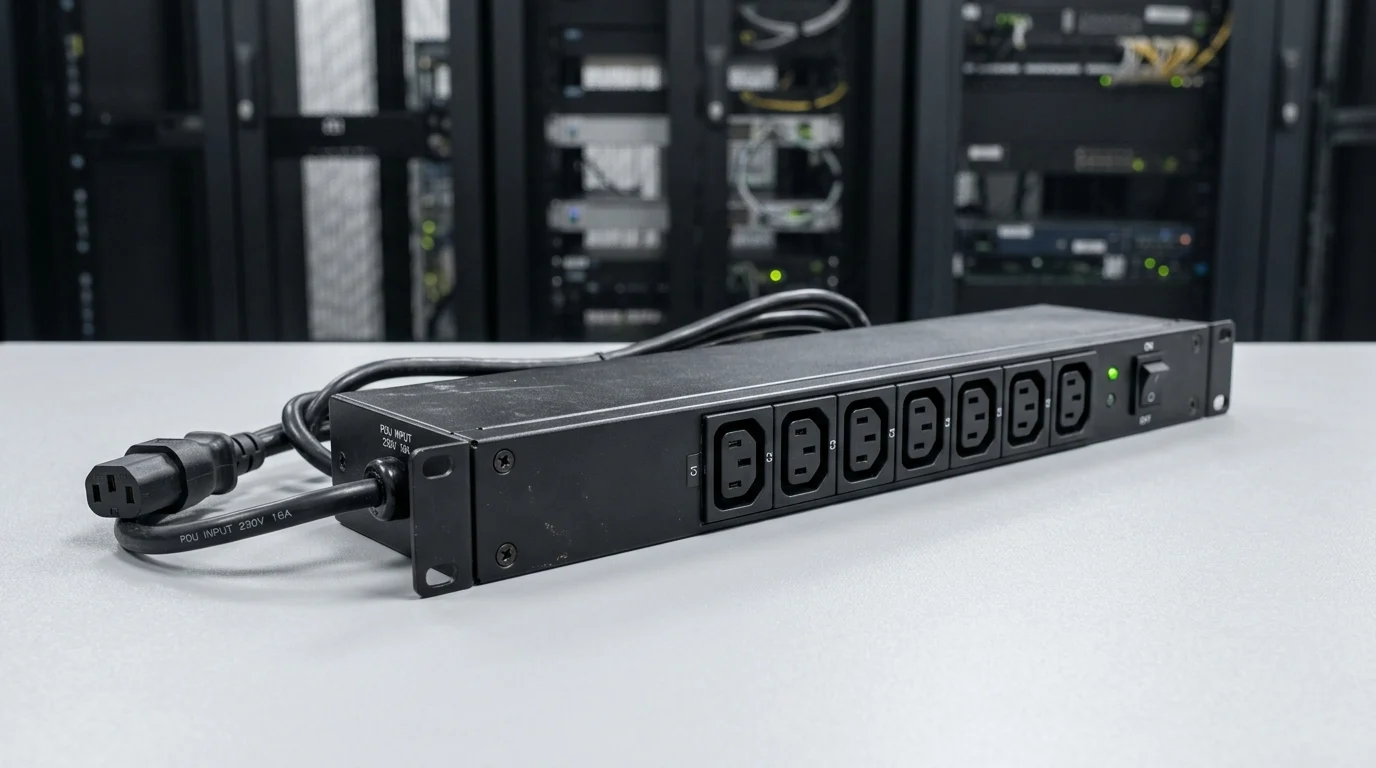
Edge computing is moving latency-sensitive workloads out of protected data halls and into telecom rooms, retail sites, factories, and roadside cabinets. That shift changes what a PDU must do. In this context, the term is not just a networking reference to a protocol data unit; it also describes the power hardware that keeps distributed compute alive. With many edge racks operating around 2kW to 20kW and often running without onsite staff, power distribution must provide remote control, resilient feeds, secure receptacles, and controlled recovery after outages. This article explains the specialized PDU requirements that turn fragile remote infrastructure into manageable, SLA-ready edge deployments.
Specialized PDU Requirements for Edge Computing
The migration of compute resources from centralized hyperscale data centers to the network edge necessitates a fundamental reevaluation of physical infrastructure. At the core of this transition is the Power Distribution Unit (PDU). While networking professionals often associate the acronym with a protocol data unit in the OSI model, facility and IT engineers recognize the Power Distribution Unit as the critical hardware bridging raw utility power and sensitive compute equipment. Edge computing environments—ranging from modular micro-data centers to retrofitted telecommunications closets—lack the highly controlled, redundant facility architectures of traditional enterprise sites.
Consequently, the PDU must absorb responsibilities typically delegated to upstream uninterruptible power supplies (UPS) or facility-level switchgear. These units provide localized intelligence, environmental resilience, and granular control. As organizations push high-performance computing closer to the data source to reduce latency, specifying the correct power distribution architecture becomes a foundational requirement rather than an afterthought.
Why Edge Computing Changes PDU Selection
Traditional data centers operate in the megawatt range, utilizing massive three-phase power distribution systems managed by dedicated onsite personnel. In contrast, edge deployments frequently operate within a tight 2kW to 20kW power envelope per rack, distributed across hundreds or thousands of unmanned locations. This geographic dispersion completely alters the total cost of ownership (TCO) calculus.
An equipment lockup at a centralized facility requires a brief walk across the server floor; a similar fault at an edge node requires a costly truck roll. Therefore, edge PDUs must possess remote management capabilities, allowing administrators to execute power cycling without physical intervention. Furthermore, the seamless processing and routing of every network protocol data unit depends directly on the localized power stability provided by these specialized distribution units. Without intelligent power management, minor logical faults at remote sites rapidly escalate into sustained network outages.
How PDUs Support Edge Reliability
Reliability at the edge is measured by the ability to maintain continuous operations despite fluctuating environmental and electrical conditions. Advanced PDUs support this mandate through dual-feed architectures, often utilizing an A/B power path configuration to ensure that the failure of a single upstream UPS or utility feed does not result in a catastrophic localized outage.
To meet stringent Service Level Agreements (SLAs) targeting 99.999% uptime—equating to roughly 5.26 minutes of allowable downtime annually—edge PDUs incorporate high-retention or locking receptacles. These specialized outlets prevent accidental disconnections caused by vibration, seismic activity, or human error during routine maintenance. Additionally, integrated power sequencing prevents high-inrush currents from tripping upstream breakers when multiple servers initialize simultaneously after a localized blackout, ensuring a controlled and stable recovery.
Key Constraints at Distributed Edge Sites
Deploying power infrastructure at the edge introduces severe physical and environmental constraints. Space is inherently limited; unlike the expansive hot/cold aisles of a centralized facility, edge nodes often utilize shallow-depth wall-mount cabinets or harsh-environment NEMA enclosures. This restricts the use of standard 0U (vertical) PDUs, frequently necessitating compact 1U or 2U horizontal configurations that consume valuable rack units otherwise reserved for compute hardware.
Thermal management presents another significant hurdle. Traditional data centers maintain strict ambient temperatures around 22°C (72°F). Edge locations, however, may lack dedicated precision cooling, exposing the PDU to ambient temperatures exceeding 60°C (140°F). Consequently, edge-grade PDUs must utilize high-temperature-rated internal components, specialized potting for heat dissipation, and hydraulic-magnetic circuit breakers that maintain their precise trip curves regardless of extreme ambient heat.
Edge PDU Types and Site Profiles
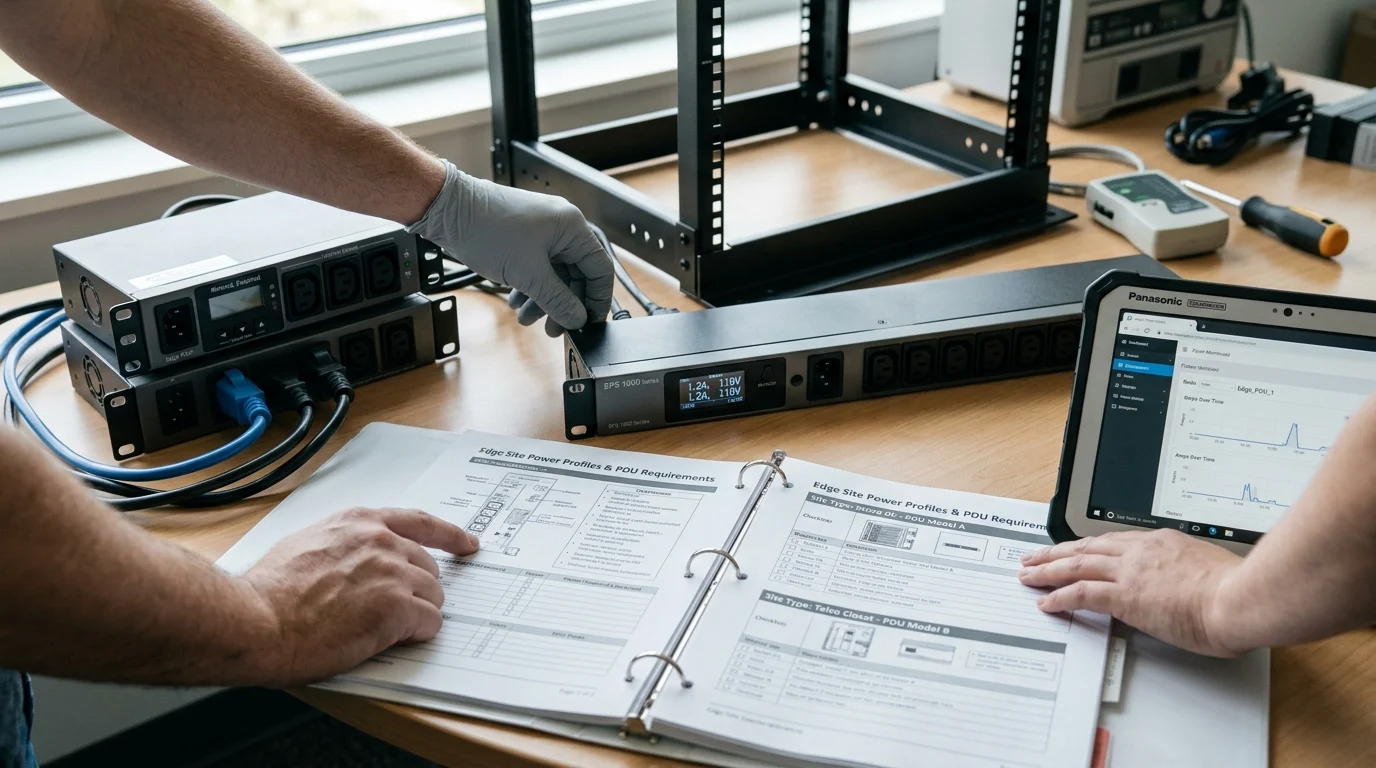
Selecting the appropriate power distribution unit requires aligning the hardware's capabilities with the specific topological and environmental realities of the deployment site. Edge computing is not a monolithic architecture; it encompasses a diverse array of physical environments, each demanding distinct form factors, power capacities, and intelligence levels.
Categorizing these edge profiles allows infrastructure architects to standardize PDU selections across disparate geographic regions, ensuring consistency in deployment, monitoring, and maintenance protocols.
Rack, Intelligent, Switched, and Metered PDUs
The PDU market is segmented into four primary intelligence tiers: Basic, Metered, Monitored, and Switched. Basic units function as reliable, industrial-grade power strips without network connectivity, suitable only for highly cost-constrained, non-critical edge nodes. Metered units add a local digital display to help technicians balance phase loads during installation but lack remote visibility.
Intelligent PDUs—encompassing both Monitored and Switched variants—are the standard for critical edge deployments. Monitored PDUs transmit real-time telemetry (voltage, amperage, kilowatt-hours) to centralized management systems, enabling predictive maintenance and capacity planning. Switched PDUs represent the highest tier, combining comprehensive monitoring with bi-stable relays at each receptacle. This allows administrators to remotely toggle power to individual outlets, shedding non-essential loads during battery operation or rebooting unresponsive servers without dispatching personnel.
Common Edge Site Profiles
Edge sites generally fall into distinct architectural profiles, dictating the physical and electrical requirements of the PDU. Telecommunications edge sites, such as 5G base stations, often rely on -48V DC power distribution and require extreme weatherproofing. In contrast, retail edge environments—typically housed in back-office IT closets—utilize standard 120V or 208V AC power and prioritize quiet operation and physical security to prevent unauthorized tampering.
Industrial IoT (IIoT) edge deployments present the most challenging profiles. Located on manufacturing floors or within energy substations, these sites expose equipment to high levels of electromagnetic interference (EMI), airborne particulates, and mechanical vibration. PDUs in these environments must feature ruggedized chassis and conformal-coated internal electronics to prevent short circuits caused by conductive dust or condensation.
| Edge Site Profile | Typical Load Density | Preferred PDU Form Factor | Minimum Environmental Rating |
|---|---|---|---|
| Telecom Cell Tower / 5G Node | 2kW – 5kW | 1U/2U Horizontal, DC Power | IP54 to IP65, 65°C Operating Temp |
| Retail / Branch Office Closet | 3kW – 8kW | 0U Vertical (Half-Height) | Standard IT (IP20), 45°C Operating Temp |
| Industrial IoT / Manufacturing | 5kW – 15kW | 0U Vertical or Ruggedized | IP54, High Vibration Tolerance |
| Modular Micro Data Center | 10kW – 30kW+ | 0U Vertical (Full-Height) | Standard IT (IP20), 60°C Operating Temp |
Load Density, Redundancy, and Environmental Factors
Load density at the edge is rapidly increasing. While early edge nodes averaged 3kW to 5kW per rack, the integration of localized AI inferencing hardware and GPU accelerators has pushed densities to 10kW or even 15kW per rack. This necessitates a transition from standard single-phase 120V/208V distribution to higher-efficiency three-phase 400V distribution, which delivers more power over smaller copper cables and reduces line losses.
Redundancy architectures also dictate PDU selection. High-density edge sites often require 2N redundancy, deploying dual PDUs per rack. To prevent localized thermal events from cascading into structural fires, these high-density units must meet strict environmental and ingress protection (IP) standards. An IP54 rating, for example, provides crucial protection against dust ingress and splashing water, a common requirement for edge nodes located outside of pristine clean-room environments.
Critical Technical Specifications
Beneath the chassis, the technical specifications of an edge PDU determine its operational lifespan, safety profile, and integration capabilities. Engineers must evaluate these specifications not merely for compatibility with current IT loads, but with an eye toward future scalability and increasingly stringent environmental conditions.
A rigorous assessment of electrical ratings, telemetry granularity, and built-in protection mechanisms ensures that the selected unit will not become a physical or logical bottleneck as the edge site evolves.
Electrical Ratings, Outlets, and Phase Options
The fundamental electrical specifications of a PDU dictate its total power capacity. Input voltages typically range from 120V for legacy North American installations to 230V globally, and up to 400V/415V three-phase for high-density compute nodes. Input amperage thresholds—commonly 16A, 32A, or 60A—must strictly align with the upstream circuit breaker ratings to comply with electrical codes.
Outlet configuration is equally critical. Historically, administrators were forced to predict the exact ratio of IEC C13 (lower current) to C19 (higher current) receptacles required for a deployment. Modern edge PDUs mitigate this forecasting risk by incorporating hybrid C39 outlets. These highly versatile receptacles accept both C14 and C20 plugs, allowing IT teams to dynamically adapt to changing hardware requirements without replacing the entire power distribution unit. Furthermore, alternating phase receptacles on three-phase models simplify load balancing, reducing the risk of tripping an upstream breaker due to an overloaded single phase.
Monitoring, Switching, and Outlet-Level Metering
Effective remote management relies on highly accurate telemetry. Enterprise-grade intelligent PDUs feature billing-grade metering accuracy, typically within a 1% error margin. This precision is vital for colocation environments or multi-tenant edge sites where power consumption is charged back to specific departments or external clients.
The internal controller formats this telemetry into a structured protocol data unit for transmission over the management network. Support for modern cryptographic and management protocols—including SNMPv3, RESTful APIs, and Redfish—is mandatory for secure integration into Data Center Infrastructure Management (DCIM) platforms. Outlet-level metering provides the ultimate granularity, allowing administrators to identify specific servers exhibiting anomalous power draw (so-called "zombie servers") or hardware experiencing thermal runaway before a catastrophic failure occurs.
Protection Features for Edge Environments
Edge environments are uniquely susceptible to power anomalies. Unlike hyperscale facilities with massive line-conditioning transformers, edge sites often draw power directly from volatile municipal grids or industrial sub-panels shared with heavy machinery. Consequently, robust transient voltage surge suppression (TVSS) is highly recommended. PDUs equipped with surge protection should feature high Joule ratings (e.g., 2000J or greater) and visual degradation indicators.
Overcurrent protection is the last line of defense against electrical fires. Standard thermal circuit breakers are highly sensitive to ambient temperatures; a thermal breaker rated for 20A might prematurely trip at 15A if the edge cabinet reaches 50°C. To combat this, purpose-built edge PDUs utilize hydraulic-magnetic circuit breakers. These advanced breakers rely on the magnetic flux generated by the electrical current rather than heat, ensuring their trip threshold remains absolutely stable in ambient temperatures up to 65°C.
How to Compare Edge PDU Solutions
Navigating the procurement landscape requires balancing upfront capital expenditures (CapEx) against long-term operational resilience. With numerous vendors offering overlapping feature sets, infrastructure teams must implement a standardized comparative matrix to evaluate edge PDU solutions objectively.
This evaluation must account for functional intelligence, strict adherence to international safety and compliance standards, and the hidden operational costs associated with managing distributed power infrastructure over a typical five-to-seven-year hardware lifecycle.
Basic vs Metered vs Monitored vs Switched PDUs
The decision between Basic, Metered, Monitored, and Switched PDUs fundamentally dictates the edge site's operational model. Basic units offer the lowest initial cost but enforce a reactive maintenance posture. Metered units provide local visibility but still require on-site personnel for troubleshooting. Monitored units bridge the gap by enabling proactive capacity management through remote telemetry.
Switched PDUs represent the highest functional tier. While they carry the highest capital cost, the ability to execute remote power cycling is indispensable for unmanned edge sites. When comparing solutions, buyers must also evaluate the unit's network controller design. Hot-swappable network modules allow technicians to replace a failed communication board without interrupting power to the critical load, a feature that significantly enhances overall system availability.
| PDU Category | Local Metering | Remote Monitoring | Outlet Switching | Typical Price Premium vs Basic |
|---|---|---|---|---|
| Basic | No | No | No | Baseline (1.0x) |
| Metered | Yes | No | No | 1.3x – 1.5x |
| Monitored | Yes | Yes (Phase/Circuit) | No | 2.0x – 2.5x |
| Switched | Yes | Yes (Outlet-Level) | Yes | 3.0x – 4.5x |
Compliance, Safety, and Regional Requirements
Compliance with regional and international electrical standards is non-negotiable, particularly for global organizations deploying edge nodes across multiple jurisdictions. In North America, UL 62368-1 has superseded legacy standards (like UL 60950-1) for information technology equipment, emphasizing a hazard-based safety engineering approach. In the European Union, the CE mark and adherence to the RoHS (Restriction of Hazardous Substances) directive are mandatory.
Furthermore, the physical connectors must comply with IEC 60320 standards to ensure global interoperability of power cords. Buyers should request comprehensive compliance documentation from vendors, including Mean Time Between Failures (MTBF) calculations derived from Telcordia or MIL-HDBK-217F methodologies. Deploying non-compliant power distribution hardware not only voids facility insurance policies but introduces severe liability risks in the event of an electrical fire.
Cost Drivers and Procurement Considerations
While the base cost of an edge PDU can range from $100 for a basic strip to over $1,500 for a high-density switched unit, CapEx represents only a fraction of the Total Cost of Ownership. The primary cost driver in edge computing is operational maintenance, specifically the "truck roll"—the dispatch of a technician to a remote site.
Industry averages place the cost of a single truck roll between $300 and $500, factoring in labor, travel time, and vehicle expenses. If a Switched PDU prevents just two physical dispatches over its lifespan by allowing remote server reboots, it entirely offsets its initial price premium. Procurement teams must also factor in the cost of DCIM software licensing, warranty extensions (typically pushing standard 2-year warranties to 5 years), and the labor associated with physical installation and network provisioning.
Decision and Deployment Process
The final phase of edge power distribution involves transforming technical specifications into a successful physical deployment. Even the most advanced intelligent PDU will fail to deliver its intended value if improperly sized, configured, or installed.
A methodical deployment process—beginning with rigorous load auditing and concluding with standardized networking and security checks—is essential to minimize field failures and ensure the power infrastructure seamlessly supports the overarching IT mission.
Audit Power Loads and Redundancy Needs
Before issuing a purchase order, engineers must conduct a comprehensive audit of the anticipated power loads. This involves calculating the nameplate power draw of all servers, switches, and storage arrays, and then applying a realistic utilization factor (typically 60% to 70% of nameplate). Crucially, deployments in North America must adhere to the National Electrical Code (NEC) 80% rule for continuous loads. Under this regulation, a PDU connected to a 30A circuit must not be loaded beyond 24A continuously.
Redundancy needs further complicate this math. In a 2N (A/B) configuration, each individual PDU must be capable of supporting the entire rack's load if the opposing feed fails. Therefore, in a rack with a 15kW total load, both the A and B PDUs must be individually sized for at least 15kW, ensuring that a failover event does not trigger an overcurrent cascade that drops the entire site.
Deployment Steps That Reduce Field Failures
Physical deployment at the edge requires strict adherence to standardization to reduce human error. All power feeds should be systematically color-coded (e.g., red cables for Feed A, blue for Feed B) from the UPS down to the server chassis. Locking power cords should be utilized universally to secure connections against accidental dislodgement.
Logical deployment is equally critical. Before a site is handed over to production, the PDU's network controller must be secured. This includes disabling insecure legacy protocols (such as Telnet or HTTP), enforcing strong password policies, and configuring encrypted SNMPv3 or HTTPS communications. Administrators must verify the protocol data unit definition within the Simple Network Management Protocol (SNMP) Management Information Bases (MIBs) to ensure telemetry packets are accurately parsed by the central Network Management System. Failing to validate this configuration results in blind spots during critical power events.
Final Selection Checklist
To guarantee consistency across distributed deployments, organizations should utilize a strict final selection checklist. This checklist must verify the physical form factor (ensuring it fits the specific edge cabinet without obstructing airflow), the input power specifications (voltage, amperage, plug type), the required outlet count and types, and the necessary intelligence tier.
Additionally, the checklist should confirm the unit's environmental tolerances, specifically its maximum operating temperature and IP rating, against the realities of the target deployment site. By treating the Power Distribution Unit not as a passive accessory, but as a strategic, intelligent component of the edge network, organizations can ensure high availability, drastically reduce maintenance overhead, and build a resilient foundation for next-generation distributed computing.
Key Takeaways
- Specify edge PDUs for remote management so administrators can reboot locked equipment without dispatching technicians to unmanned sites.
- Match PDU capacity to the common 2kW to 20kW edge rack power envelope to avoid overbuilding while preserving safe load headroom.
- Use A/B power paths where uptime is critical, because a single feed failure should not take down an entire edge node.
- Choose high-retention or locking receptacles to reduce accidental power loss from vibration, maintenance, or environmental movement.
- Deploy power sequencing to limit inrush current after outages and prevent upstream breakers from tripping during recovery.
- Select compact 1U or 2U PDU formats for shallow cabinets or constrained edge enclosures where standard vertical 0U units will not fit.
Frequently Asked Questions
Is a PDU here a protocol data unit or a power distribution unit?
In networking, PDU can mean protocol data unit, but this article focuses on the Power Distribution Unit: the rack or cabinet hardware that delivers controlled electrical power to edge computing equipment.
Why do edge sites need intelligent PDUs?
Edge locations are often unmanned and widely distributed, so remote outlet control, monitoring, and reboot capability can prevent expensive truck rolls when devices lock up or power faults occur.
What power range is typical for edge racks?
Many edge deployments operate in a tight 2kW to 20kW envelope per rack, making right-sized PDU capacity, circuit protection, and load visibility essential.
How do A/B power feeds improve edge reliability?
A/B feed architectures connect equipment to two independent power paths, helping maintain service if one UPS, utility feed, or upstream circuit fails.
Why are locking receptacles important in edge cabinets?
High-retention or locking outlets reduce accidental disconnects caused by vibration, maintenance activity, or seismic movement, supporting uptime goals such as 99.999% availability.