


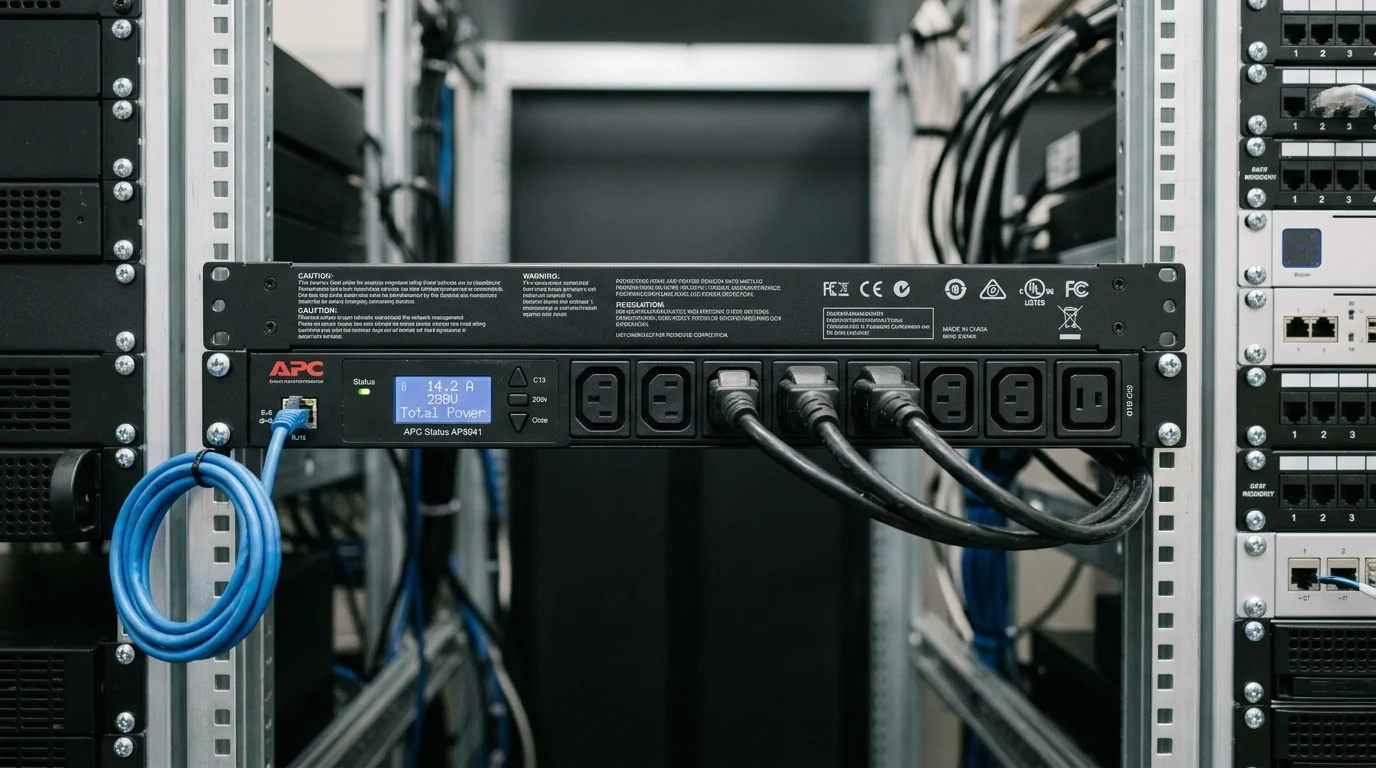
As rack densities climb from traditional 5kW deployments to AI and HPC environments drawing 40kW or more, power distribution has become a strategic infrastructure decision rather than a simple accessory purchase. Data center managers must balance uptime targets, redundancy design, monitoring depth, electrical capacity, and budget discipline while avoiding stranded rack space or preventable outages. This article provides a practical framework for selecting the right PDU, beginning with a clear distinction between a networking protocol data unit and a physical power distribution unit, then connecting equipment choice to density, availability, telemetry, and long-term operational efficiency.
How to Frame PDU Selection
Data center infrastructure relies heavily on precise power management architectures to maintain continuous operations. As rack densities escalate from historical averages of 5kW per rack to high-performance computing environments demanding 40kW or more, the selection of power distribution equipment becomes a critical operational pillar. Facility managers must establish a robust framework to evaluate and procure hardware that aligns with overarching topology, redundancy requirements, and budget constraints.
Choosing the right equipment is no longer a simple matter of counting available outlets. Modern facilities require intelligent power delivery mechanisms that integrate with Data Center Infrastructure Management (DCIM) platforms, support complex thermal management strategies, and adapt to fluctuating computational loads. A structured decision-making process prevents costly over-provisioning while safeguarding against catastrophic downtime caused by undersized or misconfigured power infrastructure.
Distinguish Rack PDUs from Protocol Data Units
A common semantic overlap in IT environments requires immediate clarification. In telecommunications and networking, a protocol data unit refers to a specific block of information transferred over a network, corresponding to layers in the Open Systems Interconnection (OSI) model, such as a frame, packet, or segment. Conversely, in data center facilities, the acronym PDU universally denotes a Power Distribution Unit—the physical hardware responsible for delivering alternating current (AC) or direct current (DC) electrical power to servers, switches, and storage arrays.
While network engineers analyze the structure of a network protocol data unit to troubleshoot latency and routing inefficiencies, facility managers analyze power distribution units to prevent thermal or electrical overloads. This decision framework focuses entirely on the latter: the critical electrical infrastructure required to keep the physical hardware running. Understanding this distinction ensures that procurement discussions between IT networking teams and facility operations teams remain aligned on the correct hardware categories.
Tie PDU Choice to Power Density and Uptime
The correlation between power distribution and system uptime is absolute. Data centers classified under Uptime Institute's Tier III or Tier IV standards mandate 99.982% to 99.995% availability, which equates to mere minutes of allowable downtime per year. Achieving these metrics requires power distribution hardware capable of supporting dual-corded IT equipment through fault-tolerant A/B power feeds.
Furthermore, power density directly influences equipment selection. A standard enterprise rack drawing 7kW requires vastly different power distribution architecture than an artificial intelligence training cluster drawing 50kW. High-density deployments necessitate three-phase power delivery directly to the rack to minimize amperage constraints and reduce cable bulk. Failing to match the power distribution unit to the anticipated density results in stranded rack space, where physical room exists for servers, but the electrical capacity is exhausted.
Define Selection Goals Before Comparing Models
Before evaluating specific manufacturers or models, infrastructure managers must define concrete operational goals. These objectives typically fall into three categories: capital expenditure (CapEx) limits, operational expenditure (OpEx) optimization, and telemetry granularity. For example, a facility targeting a Power Usage Effectiveness (PUE) ratio of less than 1.5 will require highly accurate power monitoring at the outlet level to identify inefficient legacy servers.
Establishing these goals prevents feature creep during the procurement phase. If a data center utilizes a localized, hands-on administrative team, investing in models with remote outlet switching may yield a low return on investment. Conversely, for unstaffed edge computing sites, remote reboot capabilities are a non-negotiable requirement to eliminate expensive truck rolls for simple hardware resets. Documenting these baseline operational requirements forms the foundation of a logical comparison matrix.
Key PDU Types and Terms
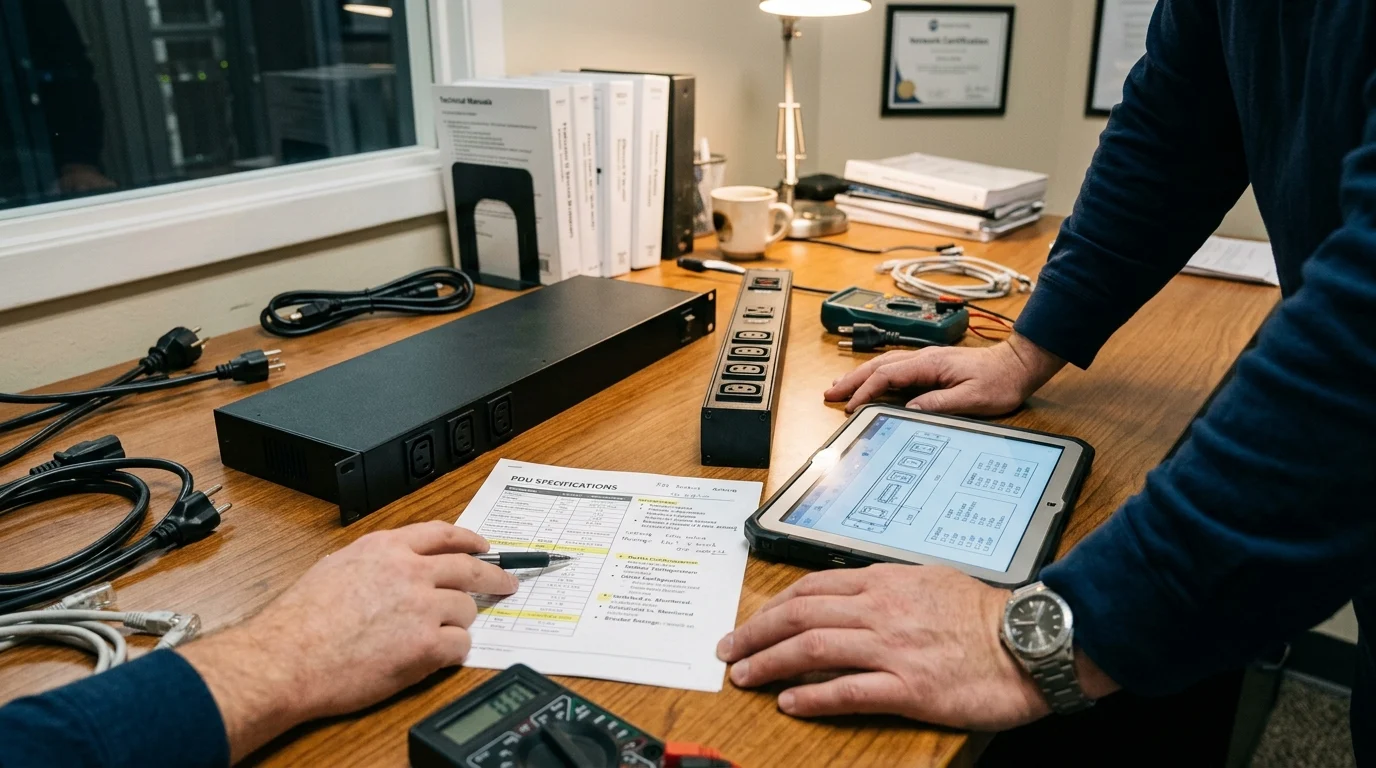
Navigating the power distribution market requires a firm grasp of industry taxonomy and electrical specifications. Manufacturers categorize their hardware into distinct tiers based on embedded intelligence and management capabilities. Misunderstanding these categories or the underlying electrical terms often leads to incompatible deployments, tripped breakers, and compromised safety.
Compare Basic, Metered, Monitored, Switched, and Intelligent PDUs
The market offers five primary tiers of power distribution units, each serving distinct operational needs. Basic models are reliable, low-cost power strips without network connectivity or metering, suitable for small, non-critical telecom closets. Metered models introduce a localized digital display showing aggregate current draw, allowing technicians to avoid overloading circuits during manual provisioning.
Monitored units represent the entry point for enterprise data centers, featuring network cards that transmit power metrics to DCIM software via SNMP or API, enabling proactive load balancing. Switched models add internal relays, allowing administrators to remotely toggle individual outlets to reboot hung servers or enforce provisioning policies. Finally, Intelligent models combine granular outlet-level monitoring, remote switching, and environmental sensor integration, representing the highest tier of visibility and control.
Clarify Voltage, Phase, Amperage, Outlet Type, and Form Factor
Electrical specifications dictate the physical and functional compatibility of the unit. Voltage determines the electrical potential; standard data centers operate at 120V, 208V, or 230V, while modern hyperscale facilities increasingly adopt 415V distribution to minimize step-down transformer losses. Phase refers to the delivery method: single-phase power is standard for lower densities, whereas 3-phase power provides a more continuous flow of energy, capable of delivering up to 43kW per rack at 60A.
Amperage dictates the total current capacity, typically ranging from 15A to 60A per unit. Outlet type must match the IT equipment's power cords, with IEC C13 and C19 being the global standards, though newer C39 combo outlets offer flexibility by accepting both plug types. Form factor defines the physical installation: 0U models mount vertically in the back of the cabinet, preserving rack space, while 1U or 2U models mount horizontally and are typically used in shallow networking cabinets.
Identify Common Terminology Mistakes
Procurement errors frequently stem from fundamental terminology mistakes. A prevalent error is confusing Kilovolt-Amps (kVA) with Kilowatts (kW). While kVA represents apparent power, kW represents real power consumed by the IT load. The ratio between them is the Power Factor, which in modern IT equipment typically ranges from 0.95 to nearly 1.0. Failing to account for power factor can lead to miscalculating the true capacity of the distribution circuit.
Another common mistake is conflating input metering with output metering. Input metering only measures the total power drawn by the entire strip, which is sufficient for preventing branch circuit overloads. Output metering measures the draw of each individual receptacle, which is mandatory for departmental chargeback billing and identifying specific stranded capacity. Clarifying these terms, alongside understanding the protocol data unit definition in networking contexts versus facility contexts, ensures precise communication with vendors.
Technical Specifications That Matter
Translating operational goals into technical specifications requires rigorous analysis of the electrical and network capabilities of the hardware. The chosen specifications must not only support the current IT deployment but also accommodate hardware refresh cycles over the next three to five years. Evaluating load capacity, redundancy, and telemetry accuracy ensures the infrastructure remains resilient under peak utilization.
Evaluate Load Capacity and Redundancy Requirements
Evaluating load capacity requires strict adherence to regional electrical codes. In North America, the National Electrical Code (NEC) mandates the 80% rule for continuous loads. This dictates that a circuit rated for 30A must not carry a continuous IT load exceeding 24A. Facility managers must calculate the maximum theoretical draw of the installed servers and ensure it falls safely below this derated threshold to prevent nuisance tripping.
Redundancy architectures further complicate capacity planning. In a standard 2N deployment (A and B feeds), each power distribution unit must be capable of supporting the entire rack load if the alternate feed fails. Therefore, in normal operation, neither the A nor the B unit should exceed 40% of its total rated capacity. Evaluating load capacity through the lens of failover scenarios is critical; a rack that operates perfectly at 60% load on both feeds will immediately trip breakers during a localized failure when one unit is forced to carry 120% of the load.
Assess Monitoring, Remote Management, and Environmental Sensors
The intelligence of modern power hardware is defined by its monitoring hardware and network interfaces. Enterprise deployments require units that support secure protocols such as SNMPv3, RESTful APIs, and SSH for seamless integration into existing DCIM and building management systems. The accuracy of the internal metering chipset is also paramount; billing-grade accuracy (certified to +/- 1% variance) is required for colocation providers charging tenants based on exact power consumption.
Furthermore, advanced units serve as localized environmental hubs. They feature auxiliary ports for connecting daisy-chained sensors that monitor rack-level temperature, humidity, airflow, and water leaks. By centralizing environmental telemetry through the power unit's network interface, data centers can eliminate the need for parallel environmental monitoring networks, significantly reducing IP address consumption and switch port utilization.
Use a Comparison Table to Rank PDU Options
To systematically rank options, facility managers should utilize a structured comparison matrix. This prevents subjective biases and ensures all competing models are evaluated against the same technical baselines.
| PDU Tier | Network Connectivity | Metering Granularity | Remote Switching | Estimated Cost Premium | Ideal Application |
|---|---|---|---|---|---|
| Basic | None | None | No | Baseline ($) | Non-critical network closets |
| Metered | None (Local Display) | Aggregate Input | No | + 30% | Small server rooms with manual oversight |
| Monitored | Ethernet / SNMP | Input or Outlet | No | + 80% | Enterprise data centers needing load balancing |
| Switched | Ethernet / SNMP | Input | Yes | + 120% | Remote edge sites requiring hard reboots |
| Intelligent | Ethernet / API | Outlet | Yes | + 180% | Colocation billing and high-density hyperscale |
Using this table allows procurement teams to rapidly eliminate models that do not align with the overarching goals established in the initial planning phase.
Sourcing, Compliance, and Installation
Procuring power distribution hardware extends beyond selecting a specification sheet. The sourcing process involves verifying regulatory compliance, evaluating the manufacturer's supply chain reliability, and planning for physical integration into the data center racks. Overlooking these logistical and compliance factors can result in delayed deployments, failed safety inspections, and voided equipment warranties.
Check Regional Standards and Safety Certifications
Data center hardware must comply with stringent regional safety and environmental standards. In North America and Europe, IT and electrical equipment must adhere to the IEC/UL 62368-1 standard, which recently replaced the legacy UL 60950-1 standard, introducing a hazard-based safety engineering approach. Hardware lacking proper Underwriters Laboratories (UL) or Conformité Européenne (CE) markings cannot be legally deployed in commercial facilities and will fail municipal electrical inspections.
Additionally, environmental regulations such as the Restriction of Hazardous Substances (RoHS) and the Waste Electrical and Electronic Equipment (WEEE) directive govern the materials used in the hardware and its end-of-life disposal. Facility managers must request certificates of compliance from vendors during the RFP process. Deploying non-compliant power distribution units exposes the organization to severe liability in the event of an electrical fire or workplace injury.
Assess Vendor Reliability, Warranty, and Support
Vendor reliability is just as critical as the hardware specification. Facility managers must evaluate the manufacturer's Mean Time Between Failures (MTBF) data, which for enterprise-grade units should comfortably exceed 100,000 hours. The underlying build quality—such as the use of high-retention outlets, hydraulic-magnetic circuit breakers, and welded chassis construction—directly impacts long-term reliability.
Supply chain lead times and warranty support must also be scrutinized. While basic models may be available off-the-shelf, custom configurations featuring specific cord lengths, plug types, and chassis colors often require lead times of 4 to 12 weeks. Furthermore, standard warranties typically cover 2 to 3 years, but reputable vendors offer extended warranties up to 5 years. Evaluating the vendor's firmware update policy is equally important to ensure the network management cards remain secure against emerging cybersecurity vulnerabilities.
Follow Safe Rack Installation and Integration Practices
The physical installation of power distribution units dictates rack airflow efficiency and long-term serviceability. High-density environments utilize hot-aisle/cold-aisle containment, meaning the rear of the rack (where 0U units are installed) acts as an exhaust plenum. Consequently, power hardware must be rated for high continuous operating temperatures, typically up to 60°C (140°F), to prevent thermal degradation of the internal components.
Cable management practices during installation are critical. Technicians must strictly separate alternating current power lines from low-voltage copper data cables to prevent electromagnetic interference. Using color-coded chassis (e.g., red for the A-feed, blue for the B-feed) significantly reduces human error during server provisioning and maintenance. Finally, ensuring that all input whips are properly secured with locking mechanisms prevents accidental disconnections caused by vibration or routine rack maintenance.
PDU Decision Framework
Synthesizing technical specifications, compliance mandates, and operational goals yields a definitive decision framework. This framework transitions the procurement process from an abstract evaluation into a concrete, repeatable scoring mechanism. By matching specific data center architectures with appropriate power hardware tiers, facility managers can execute procurement decisions with confidence and precision.
Score Options by Resilience, Visibility, Cost, and Scalability
A standardized scoring matrix ensures objective evaluation across competing proposals. Facility managers should assign weighted values to four primary categories based on their specific operational priorities. A recommended baseline allocation assigns 40% of the total score to Resilience (build quality, MTBF, high-temperature ratings), reflecting the critical nature of uptime.
Visibility and Telemetry (monitoring accuracy, sensor integration, API support) should account for 30% of the score, ensuring the hardware supports modern DCIM automation. Cost, encompassing both the initial CapEx and the projected OpEx savings from improved efficiency, accounts for 20%. Finally, Scalability (firmware upgrade paths, modular network cards, high-amperage support) makes up the remaining 10%. Scoring vendor proposals against this weighted matrix rapidly highlights the optimal solution.
Match PDU Choices to Common Data Center Scenarios
Different deployment topologies naturally dictate specific hardware choices. The following table maps common data center scenarios to the recommended power distribution specifications, ensuring the hardware matches the environmental demands.
| Data Center Scenario | Rack Density | Recommended Hardware Tier | Key Required Feature |
|---|---|---|---|
| Edge Computing Node | 3kW – 7kW | Switched | Remote outlet reboot to avoid truck rolls |
| Enterprise Colocation | 7kW – 15kW | Monitored (Outlet Level) | +/- 1% accuracy for chargeback billing |
| HPC / AI Training | 20kW – 50kW+ | Intelligent (3-Phase 415V) | 60A capacity, 60°C high-temp rating |
| Legacy Telecom Closet | < 3kW | Metered | Local display to prevent branch overloads |
By aligning the deployment scenario with this matrix, organizations avoid the trap of paying for Intelligent features in a legacy telecom closet, or conversely, starving an AI training cluster of necessary telemetry.
Turn Requirements into a Final Procurement Decision
The final procurement decision requires calculating the Total Cost of Ownership (TCO) over a standard 5-year hardware lifecycle. This calculation must include the baseline purchase price, the cost of specialized receptacles, software licensing fees for DCIM integration, and the projected energy savings derived from optimized load balancing. Facility managers should also factor in a 20% capacity growth buffer to accommodate future hardware refreshes without requiring immediate electrical upgrades.
Once the TCO is established and the scoring matrix is complete, the final step is generating the Bill of Materials (BOM). This BOM should explicitly detail the required voltage, phase, amperage, outlet counts, and network card specifications. By executing this comprehensive decision framework, data center managers guarantee that their power distribution infrastructure will deliver the resilience, visibility, and scalability necessary to support the next generation of enterprise computing.
Key Takeaways
- Clarify whether stakeholders mean a networking protocol data unit or a power distribution unit before procurement discussions begin.
- Match each rack PDU to the expected load profile, since a 7kW enterprise rack and a 40kW high-density rack require different power architectures.
- Use A/B power feeds and suitable PDUs for dual-corded equipment when designing for Tier III or Tier IV availability targets.
- Define CapEx, OpEx, and telemetry requirements before comparing PDU models to avoid overbuying or under-provisioning.
- Select intelligent or outlet-level monitored PDUs when PUE optimization, DCIM integration, and granular energy visibility are operational priorities.
Frequently Asked Questions
What does PDU mean in a data center context?
In data centers, PDU usually means Power Distribution Unit, not protocol data unit. It refers to the rack or facility hardware that distributes electrical power to servers, switches, and storage systems.
How is a protocol data unit different from a rack PDU?
A protocol data unit is a networking term for data at an OSI layer, such as a packet or frame. A rack PDU is physical power equipment used to deliver, monitor, or control electricity in IT cabinets.
When should a data center choose a metered or intelligent PDU?
Choose metered or intelligent PDUs when you need real-time load visibility, outlet-level monitoring, remote control, DCIM integration, or better capacity planning for higher-density racks.
Why does rack power density affect PDU selection?
A 7kW rack and a 40kW rack require different electrical designs. Higher-density environments often need three-phase input, higher current ratings, better monitoring, and careful A/B feed planning.
What role do PDUs play in uptime and redundancy?
PDUs support uptime by distributing power through reliable A/B feeds, helping dual-corded equipment remain online during maintenance or feed failure. This is critical for Tier III and Tier IV facilities.