


Introduction
Rack PDUs have moved far beyond basic power strips, becoming networked devices that shape how data centers monitor, allocate, and protect power at the cabinet level. This shift reflects broader changes in IT environments, where higher rack densities, variable workloads, and remote operations demand more than simple outlet access. Understanding that evolution helps explain why visibility, metering, switching, and integration now matter as much as raw power delivery. The discussion ahead traces how PDU networking transformed rack power strategy, what problems intelligent units solve, and how these capabilities support safer capacity planning, faster troubleshooting, and more efficient infrastructure management.
How PDU Networking Is Changing Rack Power Strategy
The paradigm of data center power distribution has fundamentally transitioned over the past decade. As facilities evolve from localized server rooms to hyper-scale and edge computing architectures, the strategic importance of power delivery has magnified. Modern rack power strategies now prioritize deep visibility, remote management, and capacity planning over simple electron delivery, fundamentally altering the operational baseline of the white space.
To support the massive influx of computational demands, infrastructure managers can no longer rely on static capacity models. The introduction of dynamic workloads requires an equally dynamic approach to energy distribution at the cabinet level.
Why rack PDUs have shifted from passive distribution
Historically, rack power distribution was treated as a static, passive plumbing exercise. Facility managers deployed simple power strips to distribute bulk power from a remote power panel (RPP) to individual IT assets. However, as infrastructure matured, the inability to measure localized current draw created stranded capacity and increased the risk of cascading breaker trips.
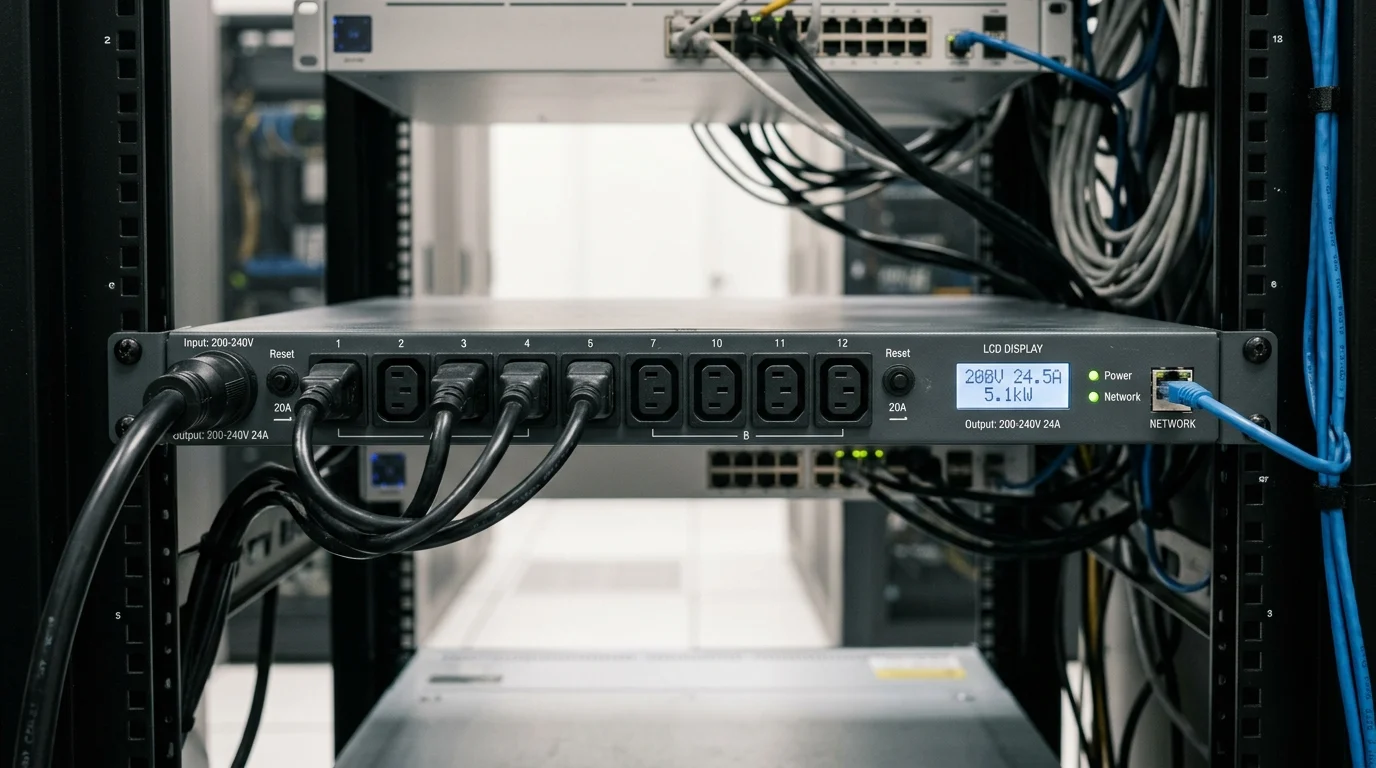
The shift toward modern pdu networking topologies addresses these blind spots by integrating telemetry directly into the receptacle level. By embedding microprocessors and network interfaces, modern rack power controllers transform the cabinet into an active node on the facility's management network, capable of streaming real-time voltage, amperage, and power factor metrics to Data Center Infrastructure Management (DCIM) platforms.
How density growth, hybrid infrastructure, and edge deployments affect power strategy
Density growth is the primary catalyst forcing this strategic pivot. A decade ago, average rack densities hovered between 3 kW and 5 kW. Today, standard enterprise deployments routinely demand 15 kW to 20 kW, while high-performance computing (HPC) and AI/ML clusters frequently push cabinet loads beyond 80 kW. At these extremes, traditional phase balancing and thermal management become highly volatile, demanding millisecond-level precision in power reporting.
Furthermore, the proliferation of hybrid infrastructure and decentralized edge deployments complicates physical access. Edge computing sites often operate "lights out," meaning there are no onsite personnel to physically reset a locked server. Network-enabled power controllers allow administrators to execute hard reboots remotely, drastically reducing mean time to recovery (MTTR) and eliminating costly maintenance dispatches.
How Rack PDUs Have Evolved

The technological lineage of rack-level power distribution demonstrates a clear trajectory from passive hardware to highly sophisticated, software-defined appliances. Understanding this evolution is critical for aligning infrastructure investments with operational maturity.
Differences among basic, metered, monitored, switched, and intelligent PDUs
The market categorizes rack power hardware into five distinct tiers based on functionality and onboard intelligence. Each progressive tier introduces additional microprocessors, relays, and network interfaces, transitioning the hardware from a simple copper busbar to an advanced computing appliance.
| PDU Classification | Power Monitoring Level | Outlet Switching | Primary Use Case |
|---|---|---|---|
| Basic PDU | None | No | Low-density, budget-constrained legacy racks |
| Metered | Local display only | No | Manual capacity checks during provisioning |
| Monitored | Networked (Aggregate or Per-Outlet) | No | DCIM integration and billing/capacity planning |
| Switched | Networked (Aggregate) | Yes | Remote troubleshooting and sequential power-up |
| Intelligent PDU | Networked (Per-Outlet) | Yes | Granular control, automated shedding, and edge computing |
Key technical criteria for comparing rack PDU generations
When evaluating generations of rack power hardware, several technical criteria dictate their utility in modern environments. First is metering accuracy; legacy metered units often suffered from ±5% variance, whereas modern intelligent controllers deliver ±1% billing-grade accuracy, enabling precise chargeback models for colocation tenants.
Second is network cascading capability. Older networked units required a dedicated switch port and IP address for every single device. Modern controllers utilize fault-tolerant daisy-chaining, allowing up to 64 devices to share a single IP address via Rapid Spanning Tree Protocol (RSTP), massively reducing top-of-rack (ToR) switch port consumption. Finally, controller modularity is paramount. Advanced units feature hot-swappable intelligence modules, meaning the network board can be replaced upon failure or upgraded to support new security protocols without interrupting power to the critical load.
How to evaluate legacy vs modern rack PDUs
Evaluating legacy architecture against a modern pdu unit requires a comprehensive risk-reward analysis. Legacy power strips lack environmental monitoring ports and cannot alert administrators to localized thermal events before thermal runaway occurs.
Upgrading to intelligent models introduces immediate operational efficiencies but requires coordination during the physical cutover, which often entails scheduled downtime. Organizations must weigh the risk of undocumented stranded capacity and prolonged outage recovery against the capital expenditure of the upgrade. Often, the ROI of modernizing is realized within 18 to 24 months simply through reclaimed power capacity and avoided truck rolls.
Which Specifications and Integration Factors Matter Most
Operational success depends heavily on properly specifying the mechanical and electrical characteristics of the hardware. The integration of power distribution into the rack ecosystem demands precise alignment with facility inputs and IT asset requirements.
How to assess electrical specifications
Electrical specifications form the foundation of any deployment. North American data centers traditionally standardized on 120V or 208V single-phase and three-phase systems, supporting roughly 5 kW to 17 kW per rack. However, the demand for higher efficiency has driven the adoption of 415V three-phase power directly to the cabinet.
A 415V, 60A configuration can deliver up to 43 kW per vertical unit while utilizing smaller gauge copper wiring, reducing both line losses and capital costs. Decision-makers must also specify the correct overcurrent protection; UL 489 branch circuit breakers are mandatory for certain high-amperage deployments, whereas UL 1077 supplementary protectors may suffice in others. Phase balancing is another critical metric, with modern alternating-phase designs simplifying cable management by distributing all three phases down the entire length of the chassis.
Which networked features matter most in PDU networking
The utility of a modern pdu power distribution unit is largely defined by its network stack and integration protocols. Standard support for SNMP v2/v3 remains prevalent, but modern automation relies heavily on RESTful APIs and Redfish support to integrate seamlessly with orchestration tools like Ansible or Terraform.
Security is a paramount concern, as these devices control the lifeblood of critical servers. Enterprise-grade units must support TLS 1.3 for encrypted web management, SSH for secure command-line access, and central authentication via RADIUS, TACACS+, or LDAP. Furthermore, dual Gigabit Ethernet ports are increasingly specified to provide redundant management paths, ensuring power telemetry is maintained even if the primary out-of-band management network experiences an outage.
How form factor, airflow, and cord retention affect deployment
Mechanical integration factors dictate how seamlessly the hardware coexists with IT assets. The 0U vertical form factor is the industry standard for server cabinets, but physical dimensions vary wildly. High-density units can exceed 2.5 inches in width and depth, potentially encroaching on server extraction paths or blocking rear exhaust fans.
Airflow and thermal ratings are equally critical; modern hot-aisle containment systems routinely push ambient rack temperatures above 45°C (113°F). Specifying hardware rated for 60°C (140°F) continuous operation ensures the onboard relays and microprocessors do not degrade prematurely. Additionally, cord retention is vital. Standard IEC C13 and C19 receptacles are prone to accidental disconnection during maintenance. Integrated locking receptacles—which require over 100 Newtons of pull force to dislodge without depressing the release tab—eliminate this risk without requiring proprietary power cords.
How Compliance, Supply Chain, and Total Cost Influence PDU Selection
Beyond technical specifications, the procurement process is heavily influenced by global compliance standards, supply chain volatility, and rigorous financial analysis. Strategic sourcing requires a holistic view of the product lifecycle.
Which compliance and regional requirements affect sourcing
Regulatory compliance dictates market accessibility and safety baselines. In North America, UL/cUL certification is mandatory, while the European market requires CE marking alongside strict adherence to RoHS (Restriction of Hazardous Substances) and REACH directives.
The transition from the legacy IEC 60950-1 standard to the hazard-based IEC 62368-1 standard has forced manufacturers to redesign internal architectures to meet modern safety thresholds. For global operators, sourcing hardware that carries universal certifications (combining UL, CE, and regional marks like UKCA or CCC) simplifies the supply chain, allowing a single SKU to be deployed across multiple geographic regions without violating local electrical codes.
How manufacturing quality, component sourcing, and lead times impact decisions
Supply chain mechanics and manufacturing quality directly impact project timelines. The global semiconductor shortage highlighted the vulnerability of intelligent power controllers, pushing lead times from a standard 4 weeks to upwards of 16 to 24 weeks in some instances.
To mitigate this, organizations must evaluate the manufacturer's component sourcing strategy and geographic footprint. Custom configurations often trigger a Minimum Order Quantity (MOQ)—typically 25 to 50 units—which can complicate small-scale edge deployments. Furthermore, manufacturing quality is non-negotiable; top-tier vendors subject their units to 100% automated testing for hipot (high potential), ground continuity, and relay functionality, targeting an out-of-box defect rate of strictly less than 0.1%.
How to compare total cost of ownership
A comprehensive Total Cost of Ownership (TCO) analysis frequently justifies the premium of advanced models. While the capital expenditure for networked hardware is significantly higher than basic alternatives, the operational expenditure savings accumulate rapidly.
| Cost Component | Passive/Legacy Approach | Intelligent Networked Approach |
|---|---|---|
| Initial Hardware CapEx | $150 – $300 per unit | $800 – $1,500+ per unit |
| Installation & Provisioning | Fast (No IP setup) | Moderate (Requires network config) |
| Remote Troubleshooting | $200+ per truck roll | $0 (Remote reboot via UI/API) |
| Capacity Optimization | Poor (Stranded power) | High (Real-time load balancing) |
| Lifecycle Value (5-Year) | High risk of hidden overloads | Lower OpEx, maximized rack density |
Avoiding just three remote service calls for a frozen server can completely offset the initial hardware premium, making the intelligent approach financially superior over a standard five-year refresh cycle. Furthermore, the ability to safely run racks closer to their maximum rated thresholds delays the need to construct net-new cabinet space.
What Decision Framework Should Guide Rack PDU Selection
Selecting the optimal power distribution architecture requires a rigorous, standardized methodology. By implementing a structured decision framework, infrastructure teams can align their hardware choices with current operational realities while preserving flexibility for future computing demands.
A step-by-step process for matching PDU type to requirements
The selection process should follow a sequential, data-driven framework. Step one is calculating the maximum theoretical kilowatt load of the cabinet, factoring in future growth, to determine the necessary input voltage and amperage. Step two involves auditing the receptacle requirements—counting the exact number of C13, C19, or localized NEMA outlets needed, and adding a 20% buffer for future expansion.
Step three requires defining the intelligence level; infrastructure teams must decide if they require aggregate metering at the phase level or granular per-outlet monitoring for chargeback purposes. The final step is a physical fit-check, ensuring the specified 0U chassis length does not conflict with the cabinet's internal mounting brackets, cable management arms, or zero-U network switches.
When a basic power strip is still the right choice
Despite the industry's shift toward intelligent edge devices, there remain specific scenarios where deploying a basic power strip is technically and economically justified. In small Intermediate Distribution Frame (IDF) network closets supporting a handful of PoE switches, the upstream Uninterruptible Power Supply (UPS) often provides sufficient load monitoring and remote management capabilities, rendering intelligent receptacles redundant.
Similarly, in out-of-band management (OOBM) racks or highly secure air-gapped environments where IP-enabled power controllers are prohibited by cybersecurity policies, unmanaged distribution remains the only viable path. In these niche applications, focusing on robust build quality and high-retention outlets is more critical than network integration.
How to plan for future rack power needs
Future-proofing rack power infrastructure requires anticipating the trajectory of server hardware. As GPU-accelerated computing becomes mainstream, racks that once drew 10 kW are rapidly scaling to 40 kW and beyond. To accommodate this, forward-looking facilities are deploying universal power distribution architectures.
These systems feature a universal input chassis that can accept interchangeable power cables, allowing operators to upgrade from a 208V/30A input to a 415V/30A input without ripping and replacing the entire vertical strip. Furthermore, adherence to National Electrical Code (NEC) standards mandates that continuous loads must not exceed 80% of the breaker's rating. By deploying high-capacity hardware and strictly managing utilization thresholds, data centers can ensure they maintain the critical failover capacity necessary to survive an A-side or B-side power feed interruption without dropping the critical load.
Key Takeaways
- The most important conclusions and rationale for pdu networking
- Specs, compliance, and risk checks worth validating before you commit
- Practical next steps and caveats readers can apply immediately
Frequently Asked Questions
What is PDU networking in a rack environment?
It connects rack PDUs to your management network so you can view power data, receive alarms, and manage outlets remotely through DCIM, web, or SNMP tools.
When should I choose an intelligent PDU over a basic power strip?
Choose an intelligent PDU when you need per-outlet monitoring, remote reboot, capacity planning, or support for edge and high-density racks above typical legacy loads.
How does a networked PDU reduce breaker-trip risk?
It provides real-time current and voltage visibility, helping you spot overloads early, balance phases, and move equipment before circuits exceed safe limits.
Why is outlet-level switching useful for edge sites?
It lets admins remotely power-cycle a frozen server or sequence startup without sending onsite staff, cutting downtime and service-call costs.
What should I compare when upgrading legacy rack PDUs?
Check metering accuracy, per-outlet monitoring, switching capability, network cascading, hot-swappable controllers, and protocol support to match your DCIM and security requirements.