


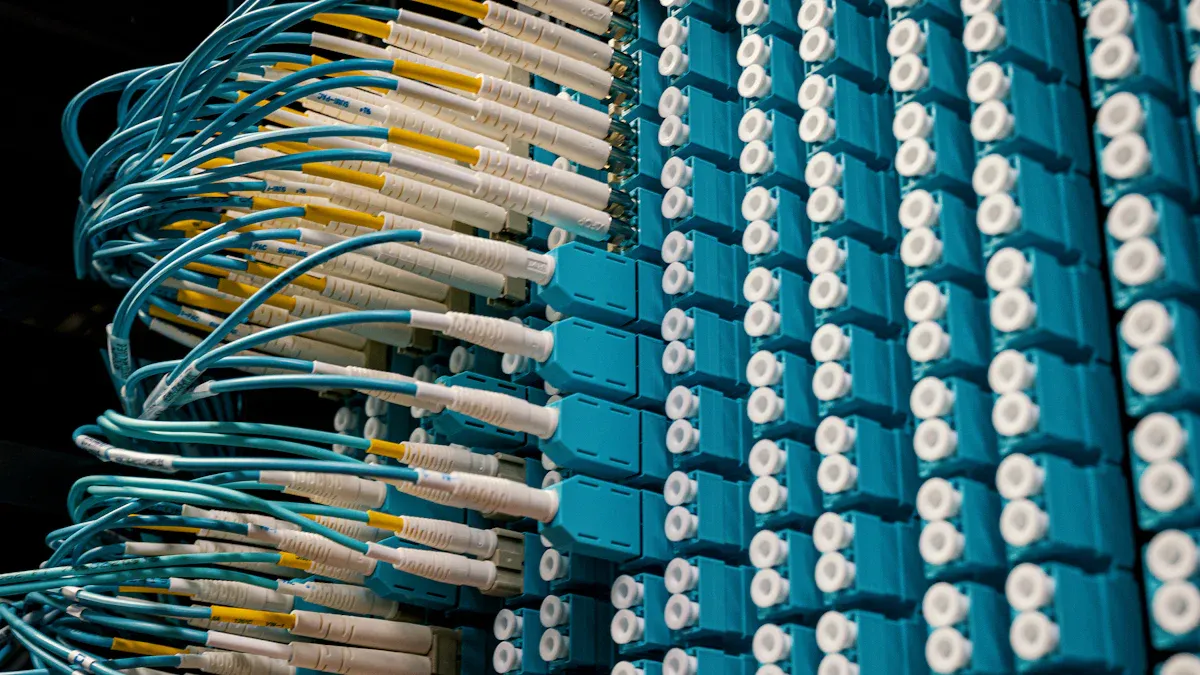
MPO trunk cables offer a high-density fiber optic solution. They are the backbone of modern data centers. These cables manage the increasing demands for bandwidth and connectivity. The global MPO trunk cable market shows significant expansion, projected to reach an estimated $1.8 billion by the end of the forecast period. This growth occurs at an 8.5% compound annual rate. This market trend underscores their indispensable role in current and future data center infrastructure.
Key Takeaways
- MPO trunk cables are essential for modern data centers. They handle high bandwidth and connectivity needs.
- MPO cables offer high-density connections. They save space and reduce cable clutter in data centers.
- MPO cables are pre-terminated. This makes installation fast and easy. It also reduces errors.
- MTP connectors are a better type of MPO connector. They offer improved performance and less signal loss.
- MPO cables support high-speed Ethernet. They work with 400G and 800G networks. They are ready for future speeds.
- MPO cables are vital for AI data centers. They provide fast and low-latency connections for GPUs.
- MPO cables offer long-term benefits. They reduce installation costs and simplify cable management. They also last a long time.
Understanding MPO Trunk Cables: The Foundation
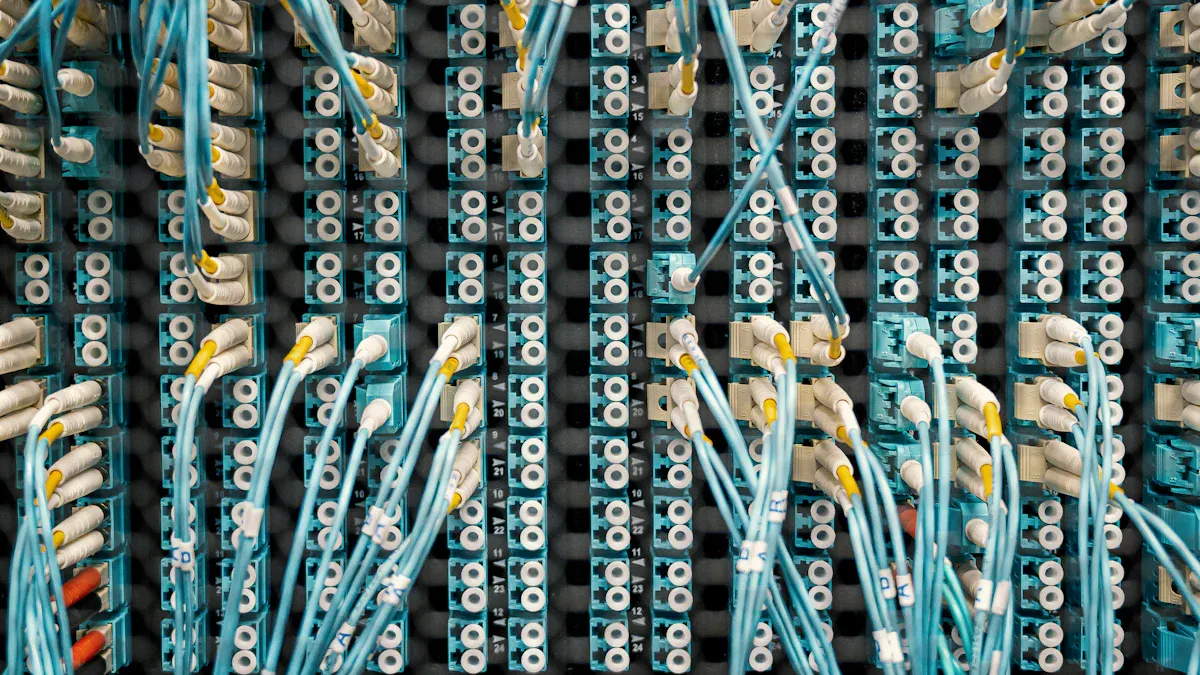
Data centers rely on robust cabling solutions. MPO trunk cables form a critical part of this foundation. They provide the high-density connectivity modern networks demand. Understanding their core components and variations helps in designing efficient infrastructure.
What Defines an MPO Trunk Cable?
An MPO trunk cable is a specialized fiber optic assembly. It combines multiple optical fibers within a single jacket. This design offers significant advantages for high-density environments.
Multi-Fiber Connectors
MPO stands for Multi-fiber Push On. This connector type houses multiple optical fibers in a single ferrule. Standard MPO connectors typically contain 8, 12, 16, or 24 fibers. They allow for quick connections of many fibers at once. This design reduces the physical space needed for cabling.
Pre-terminated Assemblies
MPO trunk cables arrive as pre-terminated assemblies. Manufacturers factory-terminate and test these cables. This process ensures high quality and consistent performance. Technicians simply plug them into place. This "plug-and-play" nature speeds up installation. It also minimizes potential errors during deployment.
Fiber Counts and Types
MPO trunk cables come in various fiber counts. This flexibility supports diverse network requirements. Common MPO trunk cable fiber counts include 12-fiber, 24-fiber, 48-fiber, 72-fiber, and 144-fiber configurations. MPO bundles are rated for between 12 and 144 fibers. Manufacturers can also customize MPO trunk cables with fiber counts ranging from two fibers up to 288 fibers. Specific configurations often include:
- 12-fiber optic trunk cables (1 MPO connector per end)
- 24-fiber optic trunk cables (2 MPO connectors per end)
- 48-fiber optic trunk cables (4 MPO connectors per end)
- 72-fiber optic trunk cables (6 MPO connectors per end)
- 96-fiber optic trunk cables (8 MPO connectors per end)
- 144-fiber optic trunk cables (12 MPO connectors per end)
These cables use either single-mode or multimode fibers. Single-mode fibers transmit data over longer distances. Multimode fibers are suitable for shorter distances within a data center.
MPO vs. MTP Connectors
People often use the terms MPO and MTP interchangeably. However, a key distinction exists between them.
Key Distinctions
MPO is a generic term for a multi-fiber connector. MTP, on the other hand, is a brand name for a specific type of MPO connector. US Conec manufactures the MTP connector. It represents a high-performance version of the MPO connector. MTP connectors feature design enhancements. These enhancements improve mechanical and optical performance.
Performance Benefits
MTP connectors offer superior optical performance compared to generic MPO connectors. Manufacturers produce MTP connectors to stricter tolerances. This precision leads to better signal integrity.
| Metric | MPO Connectors | MTP Connectors |
|---|---|---|
| Insertion Loss | Higher, typically 0.3 dB to 0.75 dB due to looser tolerances and simpler construction. | Lower, typically 0.1 dB to 0.35 dB due to stricter manufacturing tolerances, elliptical ferrules, and high-quality guide pins. |
| Return Loss | Generally lower performance. | Higher performance due to more refined designs that reduce reflected light. |
MTP connectors achieve lower insertion loss and higher return loss. This enhances signal integrity and overall network performance. Their design includes elliptical ferrules and high-quality guide pins. These features contribute to better fiber alignment and contact. This reduces signal degradation.
Base-8 and Base-16 Architectures for MPO Trunk Cables
MPO trunk cables utilize different fiber architectures. Base-8 and Base-16 are two common types. They optimize fiber usage for various Ethernet speeds.
Base-8 for 40G and 100G
Base-8 architecture uses groups of 8 fibers. This design perfectly aligns with the fiber requirements of 40G and 100G Ethernet standards.
- 40GBASE-SR4: This standard uses four lanes of 10Gb/s. It requires 8 fibers (four transmit and four receive). Base-8 cabling directly supports this 8-fiber configuration. It avoids unused fibers. Older 12-fiber MPO systems would leave 4 fibers dark, leading to inefficiency.
- 100GBASE-SR4: This standard utilizes four lanes of 25Gb/s. It also perfectly matches the 8-fiber configuration of Base-8. This direct alignment ensures all fibers in a Base-8 MPO connector are actively used.
Base-8 eliminates fiber wastage. It provides an efficient solution for these common data center speeds.
Base-16 for 400G and 800G
Base-16 architecture uses groups of 16 fibers. This design is crucial for supporting next-generation Ethernet speeds. Base-16 MTP/MPO fiber contains 16 fiber cores. It achieves higher transmission capacity in a smaller space. This effectively improves fiber utilization. It typically pairs with optical modules that support 8-channel transmission, such as 400G-SR8. This significantly increases connection density.
Base-16 MTP/MPO fibers can seamlessly transition to 800G or even 1.6T speeds. This avoids large-scale wiring overhauls. It ensures the data center remains technologically advanced for years. The MPO solution breaks through the bandwidth bottleneck of traditional single-fiber optics. It uses multi-core parallel transmission. Base-16 fibers meet the high-speed transmission demands of 400G/800G. They offer 3-5 times higher parallel transmission efficiency compared to traditional LC single-core wiring.
Base-16 connection solutions feature a compact design. This suits high-density deployment requirements. They are ideal for AI computing environments with limited cabinet space. Fewer cables mean clearer cabling paths and lower air resistance. This facilitates more effective heat dissipation and energy consumption control. The MTP-16/MPO-16 connector is primarily designed for high-bandwidth transmission requirements. These include 400G-SR8 and 800G-DR8 applications. It effectively improves data channel utilization and reduces waste of unused fiber resources. Each MTP-16/MPO-16 interface can accommodate 16 fibers. This significantly increases connection density per unit of space. This is especially important for data centers and high-speed transmission networks. The rapid adoption of 800G optics drives a shift to Base-16 connectivity. Transceivers require either two MPO-8 connectors or one MPO-16.
Technical Advantages of MPO Trunk Cables in Data Centers
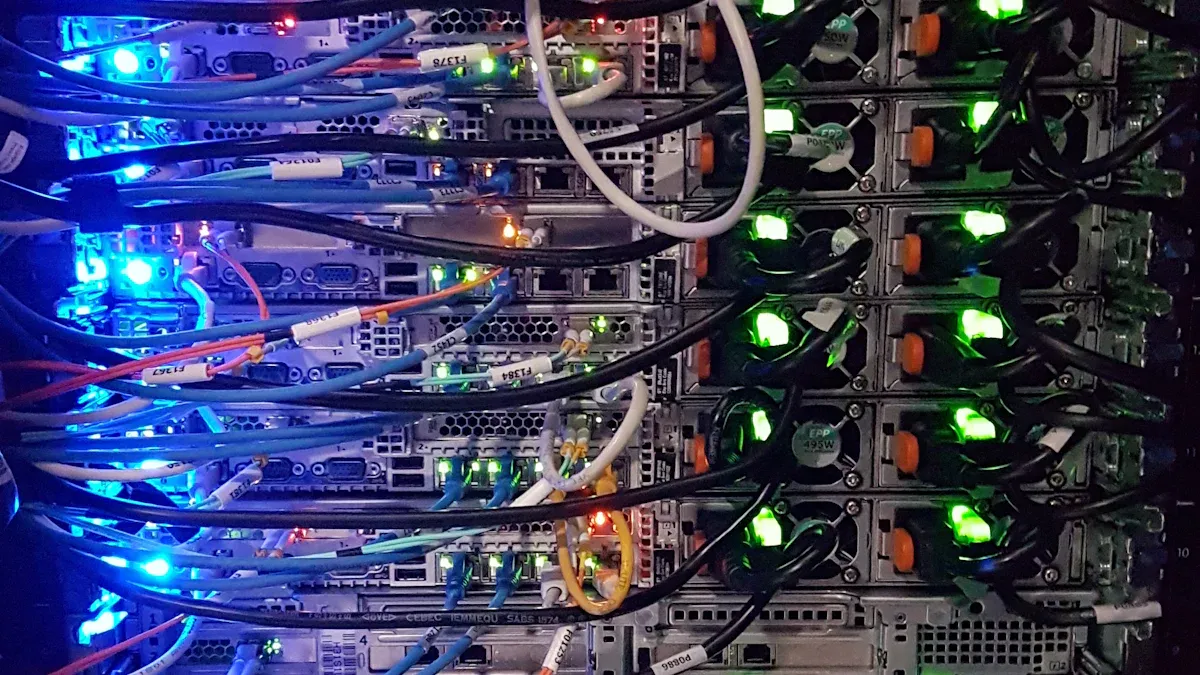
MPO trunk cables offer significant technical advantages. These benefits make them essential for modern data center operations. They improve efficiency, simplify management, and support high-speed networks.
High-Density Connectivity
MPO trunk cables excel in high-density environments. They consolidate many fibers into a single cable. This design optimizes space and reduces clutter.
Maximizing Rack Space
Data centers constantly seek to maximize rack space. MPO trunk cables provide a solution. MTP fiber systems can save over 50% of cable routing space compared to traditional cabling. A typical implementation reduces 288 LC duplex cables to 24 MTP trunks. This achieves approximately 85-90% space reduction in cable management pathways. Using 12-fiber MTP connections for the same configuration reduces horizontal space consumption by 87%.
Reducing Cable Congestion
Cable congestion hinders airflow and complicates maintenance. MPO trunk cables consolidate multiple links into a single assembly. This significantly reduces cable clutter. Their small diameter improves airflow and cable management in server racks. DENALI™ MPO Trunk Assemblies with reduced-diameter MicroCore® cable enhance space usage and airflow in tight pathways. MPO Trunk Cables decrease cable volume and improve airflow conditions. This is particularly true in backbone cabling within or between buildings.
Scalability and Modularity
Data centers require infrastructure that can grow. MPO trunk cables offer excellent scalability and modularity.
Future-Proofing Infrastructure
MPO cables help future-proof data center infrastructure. They provide the capability for data centers to grow their networking capacity incrementally. This ensures future upgrades can be accommodated without extensive re-wiring. As bandwidth demands increase, MPO solutions adapt easily.
Simplified Expansion
Expanding a network becomes simpler with MPO cables. High-density connectivity, with 12 to 144 fibers in a single connector, reduces physical space. This simplifies network connections. The push-pull coupling mechanism of MPO connectors speeds up fiber mating. This facilitates easier installation and expansion. Customizable cable lengths reduce over-abundance and improve cable management. This makes maintenance and upgrading easier. Appropriate jacket types also ensure safety and operability in various data center environments.
Rapid Deployment and Installation
Time is critical in data center operations. MPO trunk cables offer rapid deployment benefits.
Plug-and-Play Efficiency
MPO trunk cables are pre-terminated and factory-tested. This makes them "plug-and-play." Technicians simply connect them. This efficiency minimizes on-site termination. It also reduces the chance of installation errors.
Reduced Installation Time
MPO/MTP systems significantly reduce installation time. They typically cut fiber installation time by 75-80% compared to traditional field-terminated methods. This substantial reduction can transform projects. Projects that would normally take weeks can now be completed within a day.
Enhanced Reliability and Performance
MPO trunk cables significantly enhance network reliability and performance. Their design and manufacturing processes contribute to stable and efficient data transmission. This ensures data centers operate with minimal interruptions.
Factory-Tested Quality
Manufacturers produce MPO trunk cables under controlled conditions. They perform rigorous testing before shipping these cables. This factory testing ensures each cable meets strict performance standards. It guarantees consistent quality across all assemblies. This process eliminates the variability often associated with field terminations. Factory-polished end faces typically achieve 0.35 dB insertion loss or better. This contrasts with the variable results field technicians obtain in challenging environments. The table below illustrates typical insertion loss values for various MPO connector types:
| MPO Connector Type | Typical Insertion Loss (dB) |
|---|---|
| Standard MPO (per manufacturer specs) | 0.20 – 0.75 |
| Elite/Low-Loss MPO | 0.20 |
| MTP Elite (maximum random mated loss) | 0.35 |
| MTP Elite (typical values) | 0.15 – 0.20 |
| Factory-polished end faces | 0.35 or better |
| Field technicians (variable results) | Variable |
This pre-testing ensures high reliability from the moment of installation. It reduces the need for on-site troubleshooting and re-work.
Minimized Signal Loss
Minimizing signal loss is crucial for high-speed data transmission. MPO trunk cables achieve this through precision engineering. Their multi-fiber connectors ensure accurate fiber alignment. This precise alignment reduces light dispersion and signal degradation. The use of high-quality optical fibers also contributes to lower attenuation. Lower insertion loss values, especially with MTP Elite connectors, mean more signal power reaches its destination. This directly translates to better network performance. It supports higher bandwidth applications without compromising data integrity. Data centers benefit from stable connections and fewer transmission errors. This optimized performance is vital for demanding applications like AI and cloud computing. The robust construction of these cables also protects the fibers from physical damage. This further contributes to long-term reliability and consistent signal quality.
MPO Trunk Cables for High-Speed Ethernet
MPO trunk cables are fundamental for achieving the high speeds required by modern Ethernet standards. They provide the necessary bandwidth and density for 400G, 800G, and future network generations.
Supporting 400G Ethernet with MPO Trunk Cables
Data centers increasingly deploy 400G Ethernet to meet growing bandwidth demands. MPO trunk cables are crucial for these deployments.
Breakout Configurations
MPO connectors facilitate breakout cabling schemes, especially for OSFP and QSFP-DD transceivers. These configurations allow a single high-speed port to connect to multiple lower-speed ports. For example, a 16-fiber MPO connector supports 200G and 400G Ethernet. A 16-fiber MPO trunk can break out a 400G-SR4.2 transceiver into two independent 200G-SR4 links. This design doubles the fiber count within the same physical connector space as a 12-fiber single-row MPO. This enhances rack density and provides efficient paths for splitting high-speed links. The PanMPO Connector offers flexibility to change polarity and gender in the field, easing migration from lower to higher speed Ethernet. For 400G single-mode connectivity, a ‘Male to Male, Method B’ PanMPO trunk cable assembly (OS2) is a specific configuration.
Parallel Optics
Parallel optics transmission schemes utilize MPO trunk cables to achieve 400G Ethernet speeds. A 400G-SR8 transceiver uses 8 fibers for transmission (Tx) and 8 for reception (Rx). A 16-fiber MPO trunk cable provides a direct 1:1 connection without unused fibers. MPO trunk cables, with their multi-core structure, are crucial for high-bandwidth density interconnection in 400G networks. Common configurations include 8-core, 12-core, and 16-core MTP/MPO cables. For short-distance single-mode scenarios, 8-core or 12-core MTP/MPO single-mode cables connect two 400G-DR4 optical modules.
Enabling 800G and Beyond
The evolution of Ethernet continues towards 800G and even higher speeds. MPO trunk cables are at the forefront of this advancement.
Emerging Standards
Several standards bodies define the specifications for MPO technology. IEC 61754-5 defines MT ferrules, and IEC 61754-7 specifies MPO formats. TIA-604-5 and -18 define critical connectors. For higher speeds, 16-fiber solutions are strategic for efficient 200G/400G SR8 deployments. Furthermore, 24-fiber cables are the high-density champion for 400G/800G and hyperscale data centers. They maximize port density and minimize cable bulk.
Future-Ready Infrastructure
Data centers require infrastructure ready for future demands. Higher density solutions like Fiber Ribbon Stacking increase fiber count within the same connector size. Angled Physical Contact (APC) reduces back-reflection and lowers connection loss. Fiber-Ferrule Optimization refines ferrule shape and dimensions for better fiber alignment. Pitch Reduction and Miniaturization accommodate more connectors in the same space. Preparing for 800GbE and beyond requires parallel single-mode multi-fiber connectors aligned to DR8 transmission. MTP® & MPO are at the core of fiber infrastructure for AI-scale compute, supporting high-performance interconnects across thousands of GPUs.
Migration Paths and Strategies
Upgrading existing infrastructure to higher speeds requires careful planning. MPO trunk cables offer flexible migration paths.
Seamless Upgrades
Organizations can leverage existing 8-, 12-, or 24-fiber subunit MPO trunks, even though 400G and 800G applications optimize for 16 fibers. Breakout array cables facilitate transition to network ports if fiber counts align with 16- or 8-fiber groupings. For example, a 144-fiber trunk can support nine array cables of eight duplex LC connectors to MPO16. MPO16 to 2x MPO8 array assemblies are useful for 400G and 800G applications that split eight lanes into 2 x 4 lane applications, especially with legacy MPO8 trunks. Conversion assemblies can fully utilize existing fiber by terminating trunk cables to inline adapter packs.
Cost-Effective Transitions
Cost-effective transitions involve careful assessment of existing infrastructure. Testing and documenting Insertion Loss (IL) and Return Loss (RL) ensures compliance with application requirements. Organizations must ensure sufficient fiber counts for new octal applications. They also consider existing fiber types (SM, OM4, OM5), polarity, and MPO trunk cable lengths and gender. Verifying channel performance with tools like the SYSTIMAX Fiber Performance Calculator provides a starting point for planning.
The Indispensable Role of MPO Trunk Cables in AI Data Centers
Artificial intelligence (AI) workloads demand immense computational power and data transfer capabilities. MPO cables are fundamental to building the high-performance infrastructure AI data centers require. They provide the necessary bandwidth, low latency, and density for advanced AI applications.
Powering GPU Interconnects
AI models, especially large language models (LLMs), rely heavily on Graphics Processing Units (GPUs) working in parallel. Efficient communication between these GPUs is paramount.
High-Bandwidth Communication
MPO cables handle the massive data throughput AI workloads generate. They support speeds of 100G, 400G, and even higher, often utilizing PAM4 signaling for increased efficiency. MPO cables, particularly those with Angled Physical Contact (APC) connectors, improve signal integrity for PAM4 modulation. This enables higher data rates like 400G/800G with minimal interference. These cables offer ultra-high bandwidth, facilitating rapid and efficient transfer of massive datasets for AI training and inference. This ensures seamless GPU communication and minimizes latency. Modern MPO cables, using single-mode fiber and PAM4 modulation, achieve hundreds of Gigabits per second per fiber. They aggregate bandwidths in the Terabits per second range. They enable fast and efficient communication between GPUs for large-scale AI training. This reduces training times and supports larger, more complex models. For example, Meta’s RSC-2024 AI SuperCluster uses 16,384 MPO-16 cables to interconnect 24,576 NVIDIA GB200 GPUs. This demonstrates their high-density and efficiency benefits. MPO cabling supports parallel transmission and high fiber counts. This is crucial for massive GPU-to-GPU communication and the terabit speeds AI workloads require. Parallel optics enable simultaneous multi-lane data transfer, a key benefit for AI infrastructure. This ensures low-latency, high-bandwidth connectivity for training large AI models.
Low-Latency Data Transfer
Low latency is crucial for AI models to train efficiently. It prevents processing bottlenecks, idle GPUs, and extended training times, which increases operational costs. MPO cables contribute to reduced latency due to the low signal loss of fiber optics. This is critical for real-time AI applications and faster GPU communication. AI networks often utilize shorter cabling runs, with many SuperPods under 50 meters. Over these distances, light propagation delay remains below 250 nanoseconds. This is negligible compared to delays from switching and signal processing. Properly designed structured cabling, including MPO cables, does not negatively impact latency-sensitive AI workloads. This counters the misconception that it introduces excessive latency. In cabling, the primary factor for latency is the overall length of the optical channel. Light propagates at approximately 5 nanoseconds per meter.
Massive Data Throughput Requirements
AI data centers face unprecedented demands for data throughput. MPO cables are specifically designed to meet these challenges.
Handling AI Workloads
AI performance is highly sensitive to latency, especially when scaling to 10,000+ GPUs. Cabling infrastructure must evolve rapidly to keep pace with AI scale. AI-ready data center cabling requires native support for Base-8 and Base-16 parallel fiber. It needs compatibility with current 400G/800G SR optics and the ability to migrate to 1.6T without stranded fiber. Standards like IEEE P802.3dj are already defining 200G/400G/800G/1.6T standards for the coming wave of AI hardware. This emphasizes the need for flexible, forward-looking structured cabling. Large-scale AI training models, especially those involving deep learning and large language models (LLMs), necessitate massive GPU-to-GPU communication. Data moves at terabit speeds. MPO cables are crucial for meeting these demands by providing high-speed, low-latency interconnects. They support parallel optics and large-scale fiber counts. This enables simultaneous multi-lane data transfer and high-density connections. These are vital for training large AI models and powering next-gen AI workloads.
Distributed Computing Needs
MPO cabling, including Base-8 and Base-16 configurations, matches switch port distributions. This improves bandwidth efficiency and fiber resource utilization for high-throughput applications like GPU server clusters and AI model training. These compact designs reduce cabling space and optimize cooling. They support future rate evolutions up to 800G or even 1.6T. This ensures scalability and avoids redundant investments for long-term expansion of AI centers.
Optimizing AI Infrastructure
MPO cables play a vital role in optimizing AI infrastructure. They reduce bottlenecks and ensure efficient resource utilization.
Performance Bottleneck Reduction
Low latency is crucial for AI models to train efficiently. It prevents processing bottlenecks, idle GPUs, and extended training times. MPO cables help meet these stringent latency demands. Training large language models (LLMs) and other AI workloads necessitates massive parallel data transfers at speeds of 100G, 400G, and even higher. Data centers adopt PAM4 signaling to meet these demands. PAM4 doubles efficiency but is highly sensitive to signal degradation from reflections. MPO cables, particularly those with APC connectors, are crucial for supporting these rates. APC connectors reduce reflections by redirecting reflected light into the cladding. This improves signal integrity for PAM4 modulation and enables higher data rates like 400G/800G with minimal interference. MPO cables significantly reduce the amount of cabling and pathway congestion compared to using individual patch cords. A single 72-fiber MPO/MTP cable can replace up to 36 traditional duplex fiber patch cords. This drastically cuts down cable congestion. This efficient use of space results in better organization and management of cable systems. It leads to less congestion in the work area and improved maintenance. This indirectly supports better airflow by reducing physical obstructions.
Efficient Resource Utilization
Structured cabling ensures unimpeded airflow. This allows CRAH units to maintain consistent cold-air delivery. This is especially crucial for high-density air-cooled halls. Enhanced cooling efficiency enables operators to raise chiller set points. This leads to a 10–20 percent reduction in PUE and lower power bills. MTP/MPO cables simplify cable management. Their high-density connectors reduce clutter, leading to faster installation times and easier troubleshooting. This simplification directly minimizes downtime during AI data center expansion or upgrades. The ease of maintenance allows network administrators to quickly address issues, implement upgrades, and perform routine maintenance with minimal disruption. MPO cables offer superior scalability and flexibility. They support multiple fiber strands in a single connector for higher density cabling and easier upgrades. This capability is crucial for hyperscale data centers. It enables quick network expansion and reconfiguration without extensive re-cabling. This future-proofs the infrastructure against increasing bandwidth demands. The modular design of MPO solutions directly contributes to cost savings and faster expansion cycles. This supports a ‘pay-as-you-grow’ strategy. AI infrastructure adapts to rising demands from AI clusters, cloud computing, and video streaming without incurring prohibitive costs associated with extensive overhauls. MPO cables, while potentially more expensive initially, offer significant long-term cost savings in AI infrastructure. They avoid frequent upgrades and replacements, leading to better overall value and performance over time. This ‘pay-as-you-grow’ approach allows for easier expansion and reduces reconfiguration work. It justifies the higher initial investment through reduced operational costs and future-proofing against increasing bandwidth demands. Even with emerging technologies like co-packaged optics (CPO) and on-board optics moving closer to or directly onto the switch ASIC, the need for high-density fiber cabling like MPO for rack-to-rack connections is unlikely to be eliminated.
Operational Benefits and Cost Efficiency of MPO Trunk Cables
MPO trunk cables offer significant operational benefits. They also provide substantial cost efficiencies for data centers. These advantages stem from their design and deployment methodology.
Reduced Installation Costs
MPO trunk cables significantly lower the expenses associated with setting up network infrastructure.
Labor Savings
Pre-terminated MPO cables arrive ready for use. This eliminates the need for on-site fiber termination. Technicians simply plug them into place. This "plug-and-play" approach drastically reduces the labor hours required for installation. It allows teams to complete projects faster. This efficiency translates directly into lower labor costs for data center operators.
Error Minimization
Factory testing ensures MPO cables meet high performance standards. This process minimizes the risk of installation errors. On-site termination often introduces variability and potential faults. MPO cables bypass these issues. Fewer errors mean less rework and troubleshooting. This saves both time and money during deployment.
Simplified Cable Management
MPO trunk cables streamline the organization and maintenance of data center cabling.
Easier Troubleshooting
MPO cables consolidate many fibers into a single assembly. This reduces cable clutter. A cleaner cabling environment makes it easier for technicians to identify and trace connections. This simplifies troubleshooting when network issues arise. Faster problem resolution minimizes downtime.
Improved Airflow
Dense cable bundles can obstruct airflow within server racks. MPO cables, with their compact design, reduce cable volume. This improves air circulation. Better airflow helps cooling systems operate more efficiently. It prevents hot spots and maintains optimal temperatures for equipment.
Long-Term Return on Investment
Investing in MPO trunk cables yields substantial long-term returns for data centers.
Durability and Longevity
Fiber optic cabling systems, including MPO/MTP, can last 15 years or more. This requires proper installation and maintenance. This extended lifespan means data centers avoid frequent cable replacements. The durability of MPO cables contributes to a stable and reliable network foundation. This reduces future capital expenditures.
Lower Maintenance
MPO cables require less ongoing maintenance. Their robust construction and simplified management reduce the likelihood of physical damage or connection issues. The return on investment for structured cabling, including MPO/MTP, manifests through reduced downtime, lower energy consumption, faster maintenance, easier compliance audits, and flexibility for new technologies. Operational savings and avoided disruptions typically surpass the initial investment significantly over a decade. For example, a B2B SaaS company deployed MTP cabling for 400G links. This added $3,400 to their infrastructure budget. This strategic investment allowed them to avoid leasing a second rack. That would have cost $4,800 per month. This resulted in an ROI achieved in just 26 days.
Future Trends for MPO Trunk Cables in 2025
MPO trunk cables continue evolving. They adapt to the increasing demands of data centers. Several key trends will shape their development by 2025. These trends focus on higher density, advanced technology, and integration with new computing paradigms.
Higher Fiber Counts and Density
Data centers constantly seek to maximize space and connectivity. MPO cables will offer even greater fiber counts and density.
Increased Connectivity
MPO-16 connectors consolidate 16 fibers. This significantly increases connection density compared to 8 or 12 fiber connectors. By 2025, the MPO-16 fiber optic connector is anticipated to become the primary standard for high-speed transmissions. This includes 800G and 1.6T, with future capabilities for 3.2T. This advancement is driven by the need for higher port density. It offers 33% more density than 12-fiber MPOs. This is crucial for AI and cloud computing applications. MPO 16 cables are particularly advanced for AI infrastructure. They pack 16 fibers into a single connector. For instance, Meta’s RSC-2024 AI SuperCluster utilizes 16,384 MPO 16 cables. These cables interconnect 24,576 NVIDIA GB200 GPUs. This demonstrates their capacity for massive fiber counts in compact spaces. It also reduces cabling mass by 28 tons compared to MPO-12 solutions.
| Feature | Description |
|---|---|
| Fiber Count | MPO-16 connectors consolidate 16 fibers, significantly increasing connection density compared to 8 or 12 fiber connectors. |
| Ethernet Protocols | MPO-16 cables (including MMC-16) are fundamental for ultra-high-speed Ethernet, supporting 400G Ethernet, 400GBASE-SR8, 800G, and 1.6 Terabit applications. Future capabilities include 3.2 Terabit with 200 Gb/s lane rates. |
New Connector Designs
New connector designs will support these higher fiber counts. Engineers focus on miniaturization and improved alignment mechanisms. This ensures reliable performance in extremely dense environments.
Advanced Connector Technology
Connector technology will see further advancements. These improvements enhance both performance and durability.
Improved Performance
Future MPO connectors will feature even lower insertion loss. They will also offer higher return loss. This ensures optimal signal integrity for next-generation speeds. Precision manufacturing processes will become standard.
Enhanced Durability
Engineers will design connectors for increased robustness. This protects against physical stress and environmental factors. Enhanced durability reduces maintenance needs and extends cable lifespan.
Integration with Emerging Technologies
MPO cables will play a critical role in supporting new computing paradigms.
Quantum Computing
MPO trunk cables are integrating with quantum computing infrastructure. Innovations include embedding Quantum Key Distribution (QKD) channels within MPO ribbons. Researchers at Toshiba Europe successfully enabled 256-fiber MPO cables. These cables simultaneously carry both classical and quantum data. This breakthrough has been trialed in BT’s London network. It demonstrates a practical application for quantum-secure MPO links. MPO-16 cables are specifically designed to meet the demands of quantum computing infrastructure. IBM’s VP of Cloud Infrastructure, Dr. Sarah Aerni, notes MPO-16 serves as the foundation for rearchitecting exascale systems with photonic determinism. This indicates its crucial role in advanced computing environments like quantum computing.
Advanced AI Architectures
MPO systems offer a high-density, future-ready cabling infrastructure. This infrastructure supports current and future transceiver generations. It minimizes the need for "rip-and-replace" upgrades. It also simplifies migration to higher speeds (400 Gb, 800 Gb, even 1.6 Tb).
- High-Performance Interconnects: MPO cables support high-performance interconnects across thousands of GPUs. This is crucial for real-time inference, distributed training, and scalable model deployment in advanced AI architectures.
- Flexible Topologies: They enable flexible topologies for AI fabrics like NVLink, InfiniBand NDR, and Ethernet-based systems. This occurs through breakout configurations (e.g., 1×4, 1×8, 1×12).
- Rapid Deployment: Pre-terminated trunk assemblies and polarity-managed cabling reduce installation time and error rates. This is vital for phased rollouts and dynamic scaling of AI environments.
MPO trunk cables are essential for data center evolution. They provide the high-density, scalable, and efficient connectivity modern infrastructure demands. Data centers rely on these cables to support increasing bandwidth needs and advanced technologies like AI. The future of data center connectivity clearly relies on MPO trunk cables. They enable seamless upgrades and robust performance.
FAQ
What is an MPO trunk cable?
An MPO trunk cable is a fiber optic assembly. It contains multiple optical fibers within a single jacket. This design offers high-density connectivity. Manufacturers pre-terminate and test these cables. This ensures quick, reliable installation in data centers.
What is the difference between MPO and MTP connectors?
MPO is a generic term for multi-fiber connectors. MTP is a specific brand name for a high-performance MPO connector. US Conec manufactures MTP connectors. They feature design enhancements for better mechanical and optical performance. MTP connectors offer lower insertion loss.
Why are MPO trunk cables crucial for modern data centers?
MPO trunk cables provide high-density connectivity. They maximize rack space and reduce cable congestion. They also support rapid deployment and offer enhanced reliability. These features are essential for managing increasing bandwidth demands in data centers.
How do MPO cables support high-speed Ethernet?
MPO cables use Base-8 and Base-16 architectures. These architectures align with fiber requirements for 40G, 100G, 400G, and 800G Ethernet. They enable parallel optics transmission. This supports the massive data throughput needed for high-speed networks.
Do MPO cables reduce installation time and costs?
Yes, MPO cables significantly reduce installation time. They are pre-terminated and factory-tested, offering "plug-and-play" efficiency. This minimizes on-site labor and reduces potential errors. These factors lead to lower overall installation costs for data centers.
Are MPO trunk cables suitable for AI data centers?
Absolutely. MPO cables are indispensable for AI data centers. They power GPU interconnects with high-bandwidth and low-latency communication. They handle massive data throughput requirements. This optimizes AI infrastructure by reducing performance bottlenecks and ensuring efficient resource utilization.
What long-term benefits do MPO trunk cables offer?
MPO trunk cables provide a strong long-term return on investment. They offer durability and longevity, lasting 15 years or more. Their simplified cable management leads to lower maintenance needs. This results in reduced downtime and significant operational savings over time.