


MPO trunk cables deliver high-density fiber optic connectivity. They perform a fundamental role in modern data center infrastructure. The global MPO trunk cable market projects substantial growth, with a Compound Annual Growth Rate (CAGR) of approximately 8.5% over the next five years. This expansion underscores the critical need for an MPO trunk cable for data center operations, supporting ever-increasing bandwidth demands. This MPO trunk technology is vital for current and future high-speed networks.
Key Takeaways
- MPO trunk cables are important for modern data centers. They help manage many fiber optic connections.
- These cables use MPO technology. This technology puts many fibers into one connector. This saves space and makes connections faster.
- MPO trunk cables come ready to use. This means they are easy to install. They save time and money during setup.
- They support very fast internet speeds. This includes 40GbE to 400GbE. This is important for cloud computing and big data.
- MPO cables are key for AI data centers. They help powerful computers talk to each other quickly. This is needed for training AI models.
- These cables help data centers save money over time. They reduce installation costs and make networks more reliable.
- MPO technology keeps getting better. It will support even faster speeds in the future. This helps data centers grow.
What are MPO Trunk Cables?
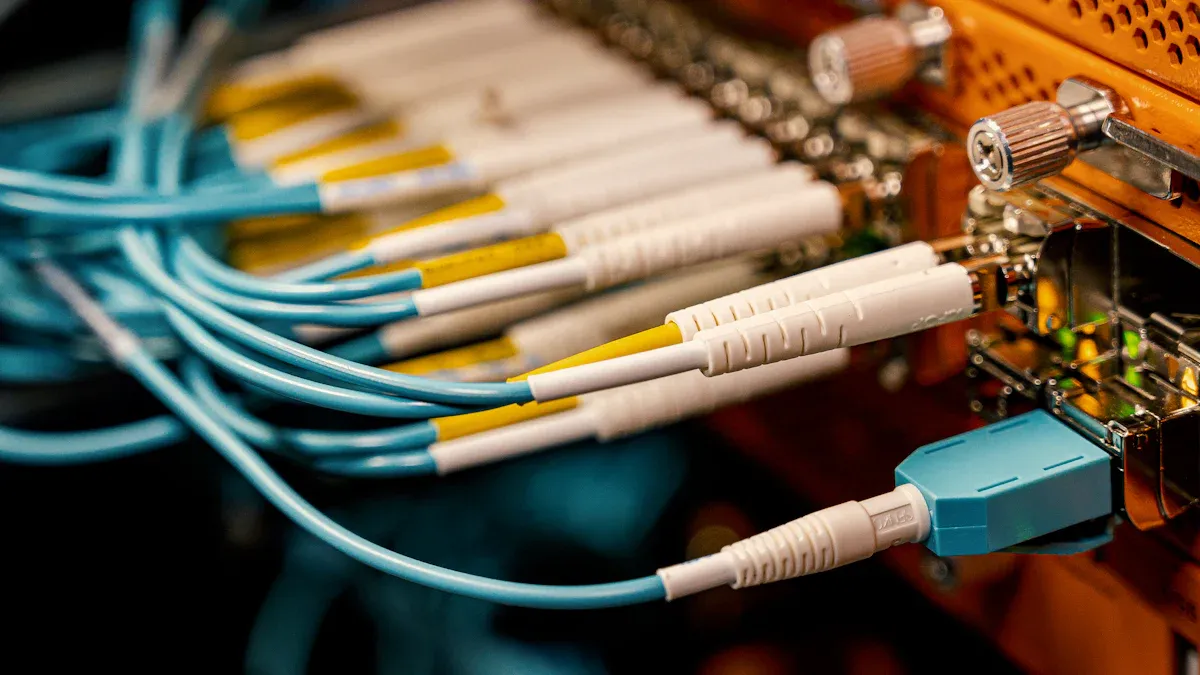
MPO trunk cables represent a cornerstone of modern fiber optic infrastructure, particularly within data centers. They offer a sophisticated solution for managing the ever-growing demand for bandwidth and connectivity. Understanding their fundamental design and operational principles reveals why they are indispensable.
Defining Multi-Fiber Push-On (MPO) Technology
Multi-Fiber Push-On (MPO) technology refers to a specific type of optical fiber connector. This technology allows for the termination of multiple optical fibers within a single connector ferrule. This design significantly increases fiber density compared to traditional single-fiber connectors.
Multi-Fiber Connectors for High Density
MPO connectors are multi-fiber connectors designed for high-density applications. They consolidate numerous optical fibers into a compact form factor. This design enables efficient use of space within network equipment and cabling pathways. This technology adheres to stringent industry standards, ensuring reliable performance. The table below outlines key technical specifications defining MPO technology:
| Specification Category | Details |
|---|---|
| Fiber Counts | 8, 12, 16, 24 (common); 32, 48, 60, 72 (higher density) |
| Connector Types | Male (with pins) and Female (without pins) |
| Keying | Keyed, with a white dot indicating the first fiber position. Key location varies (e.g., center for 8, 12, 24-fiber; offset for 16, 32-fiber). |
| Compliance Standards | IEC 61754-7, EIA/TIA-604-5 (FOCIS 5), IEC PAS 61755-3-31 |
| End Face Geometry Parameters | Angle of polish, fiber protrusion height, maximum fiber height differential across all and adjacent fibers |
| Performance Parameters | Insertion loss and return loss (specific values vary by network speed and fiber type) |
| Supported Fiber Types | Singlemode (SM), Multimode (MM) |
| Operating Temperature | -40 to +85 °C |
| Storage Temperature | -40 to +90 °C |
Pre-terminated Assemblies for Rapid Deployment
MPO trunk cables are typically pre-terminated assemblies. Manufacturers factory-terminate and test these cables before shipment. This pre-termination eliminates the need for on-site fiber splicing and connectorization. This significantly reduces installation time and labor costs. The plug-and-play nature of these cables facilitates rapid deployment of backbone infrastructure. This also simplifies future upgrades and expansions within the network.
Core Functionality of MPO Trunk Cables for Data Center
MPO trunk cables perform critical functions within data center environments. They are essential for building robust, high-speed, and scalable network infrastructures.
Consolidating Multiple Fiber Connections
A primary function of MPO trunk cables involves consolidating multiple fiber linkages. They bundle numerous optical fibers into a single connector casing. This creates a high-density structured cabling solution. This consolidation is vital for data centers with limited space. It improves organization, management, and reduces cable congestion. MPO bundles are high-density structured cables. They consolidate multiple optical fibers into a single connector casing. These cables are rated for 12 to 144 fibers. They offer a compact footprint for space efficiency and minimal signal loss in high-density environments. This makes the mpo trunk cable for data center environments an ideal choice for maximizing rack space utilization.
Enabling High-Speed Interconnects
MPO trunk cables enable high-speed interconnects between network devices. They support high data transfer rates, which are essential for cloud computing and large data requirements. With low insertion losses and precise fiber alignments, MPO assemblies ensure signal integrity. The push-pull coupling mechanism simplifies and speeds up fiber mating. This facilitates easier installation and expansion while maintaining high data rates and signal quality. MPO trunk cable assemblies are multi-fiber cables with MPO connectors. They are essential for high-density fiber networks. These cables enable seamless data transfer in data centers and other high-fiber count environments. They are considered future-proof. They facilitate cost-effective data transfer by supporting 100G Ethernet and higher speeds.
MPO Trunk Cables in Current Data Center Architectures
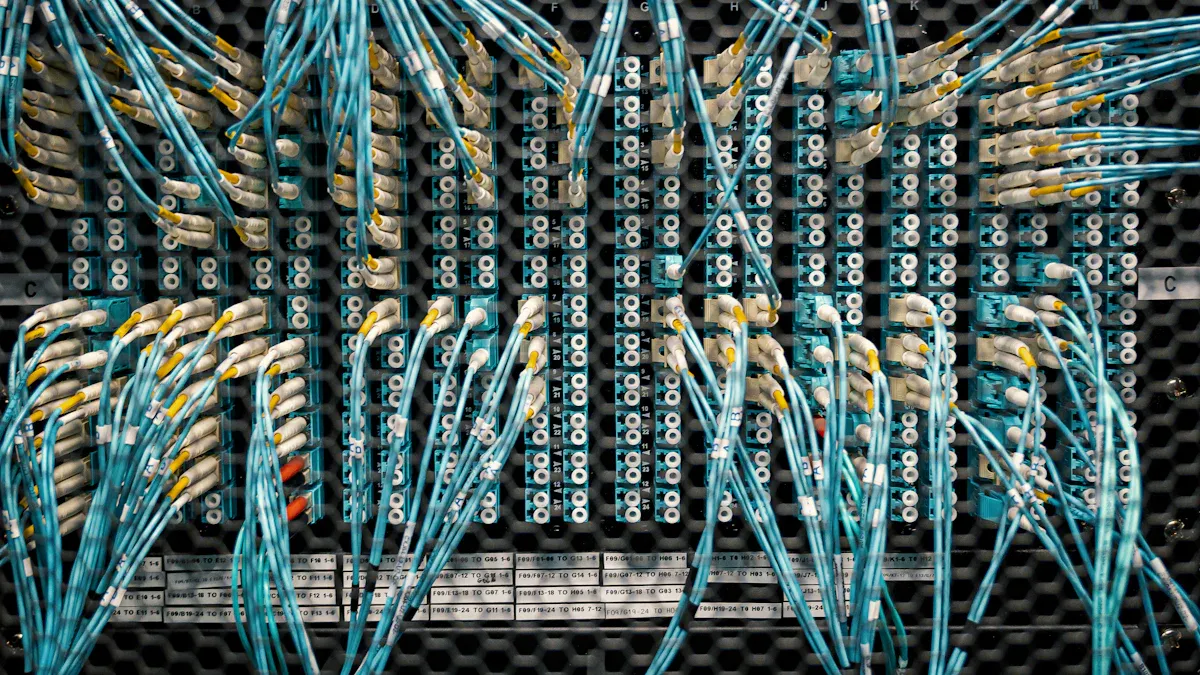
MPO trunk cables are fundamental components in today’s data center architectures. They provide the high-density, high-speed connectivity necessary for modern network demands. These cables support the rapid data transfer rates that define contemporary data center operations.
Supporting High-Speed Ethernet Standards
Data centers constantly upgrade their infrastructure to meet increasing bandwidth requirements. MPO trunk cables play a crucial role in this evolution.
From 40GbE to 400GbE Deployments
MPO trunk cables are essential for supporting high-speed Ethernet standards, ranging from 40GbE to 400GbE deployments. They enable the parallel optical transmission required for these speeds. For example, specific MPO trunk cable configurations facilitate 40G and 100G networks:
- MPO Trunk BASE-8: This configuration supports 40G or 100G deployments. It uses 8 out of 12 fibers (4 for transmit, 4 for receive). Each fiber supports 25G for 100G or 10G for 40G. It requires female patching cables and Type B polarity.
- MPO to LC Assembly BASE-8: This converts parallel to duplex transmission. It enables 1x40G to 4x10G or 1x100G to 4x25G conversion.
The industry continues to develop standards for even higher speeds:
| Speed | Ethernet Standard IEEE | Connector Interface |
|---|---|---|
| 100GbE | 802.3ba-2010 | MPO (2×12) |
| 100GbE | proprietary (Jan 2014) | MPO 12 |
| 100GbE | 802.3bm-2015 | MPO 12 |
Backbone for Spine-Leaf Topologies
MPO trunk cables are crucial for spine-leaf topologies. They establish permanent backbone connections. This helps reduce pathway congestion and improves airflow within the network infrastructure. MPO trunk cables significantly increase fiber network density. They consolidate multiple fiber linkages into a minimal physical size, simplifying network connections.
- They provide scalability for growing bandwidth requirements. This supports high-speed data flow and ensures network accuracy and improved performance.
- Their pre-terminated nature allows for rapid deployment. This eliminates the need for complex field termination and ensures a plug-and-play design.
- The single jacket construction saves considerable space in high-density cabling networks. This contributes to a cleaner and more organized infrastructure.
- They support state-of-the-art Ethernet technologies like 40G, 100G, 400G, and even higher capacities. This ensures adaptability to increasing data traffic and future equipment upgrades.
Key Applications of MPO Trunk Cables for Data Center
MPO trunk cables find extensive use across various critical data center applications.
Server-to-Switch and Switch-to-Switch Links
Data centers heavily rely on MPO trunk cables for server-to-switch and switch-to-switch links. These connections form the backbone of the network. They facilitate the rapid exchange of data between computing resources and network devices. The high fiber count within a single MPO cable reduces cable bulk. This simplifies cable management in densely packed server racks.
Storage Area Network (SAN) Connectivity
MPO trunk cables also play a vital role in Storage Area Network (SAN) connectivity. SANs require high bandwidth and low latency to ensure efficient data access and storage. MPO cables provide the necessary performance for these demanding environments. They connect storage arrays to servers and switches, ensuring fast and reliable data transfer for critical applications. The use of an mpo trunk cable for data center SANs enhances overall storage performance and reliability.
Technical Advantages and Specifications of MPO Trunk Cables
MPO trunk cables offer significant technical advantages. These advantages make them indispensable for modern data center infrastructure. Their design and performance characteristics meet the rigorous demands of high-speed networks.
High Fiber Count and Space Efficiency
MPO trunk cables excel in managing high fiber counts. They achieve this within a compact footprint. This design directly addresses the need for space efficiency in data centers.
Common Fiber Configurations (8, 12, 24, 32)
MPO trunk cables come in various fiber configurations. These configurations support diverse network requirements. Common fiber counts include 8, 12, 24, and 32 fibers. However, customized solutions can range from 2 to 288 fibers. For example, an Ultra Low Loss (ULL) Singlemode MPO8 to MPO8 fiber trunk cable features 8 fibers. It has one MPO-08/APC Female connector on both ends.
Specific configurations cater to different network speeds:
- 12-fiber cables terminate with one MPO connector on each end.
- 24-fiber cables terminate with two MPO connectors on each end.
- 48-fiber cables terminate with four MPO connectors on each end.
- 72-fiber cables terminate with six MPO connectors on each end.
- 96-fiber cables terminate with eight MPO connectors on each end.
- 144-fiber cables terminate with twelve MPO connectors on each end.
MTP/MPO trunk cables also come in symmetric and asymmetric configurations. Symmetric trunks use the same number of MTP/MPO connectors on both ends. Asymmetric trunks fan out into multiple LC connectors for device aggregation. For 400G networks, 8-core, 12-core, and 16-core MTP/MPO cables are crucial. 16-core MTP trunk cables are designed for 800G interconnects in large data centers.
Maximizing Rack Space Utilization
The high fiber count within a single MPO cable maximizes rack space utilization. It significantly reduces cable bulk. This leads to cleaner, more organized cabling pathways. Data centers can fit more connections into less physical space. This optimizes valuable rack real estate.
Modularity, Scalability, and Polarity Management
MPO trunk cables offer inherent modularity and scalability. They also incorporate essential polarity management features. These aspects simplify network design and maintenance.
Plug-and-Play Installation for Future Growth
MPO trunk cables feature a plug-and-play design. This allows for rapid installation. Pre-terminated assemblies eliminate on-site fiber splicing. This significantly reduces deployment time and labor costs. This modularity also supports future network growth. Data centers can easily add or upgrade connections as demands increase.
Ensuring Correct Signal Transmission
Correct signal transmission is vital for fiber optic networks. MPO trunk cables address this through polarity management. Three common methods ensure proper fiber alignment: Method A, Method B, and Method C. A Universal System also exists. Method A uses two different patch cable configurations. Method B uses special “Key-up/Key-up” adapters with a Type B rollover trunk cable. Method C performs the swap directly within the trunk cable itself. These methods guarantee that the transmit signal from one device connects to the receive port of another.
Performance Characteristics
MPO trunk cables deliver exceptional performance. They ensure reliable and high-speed data transmission.
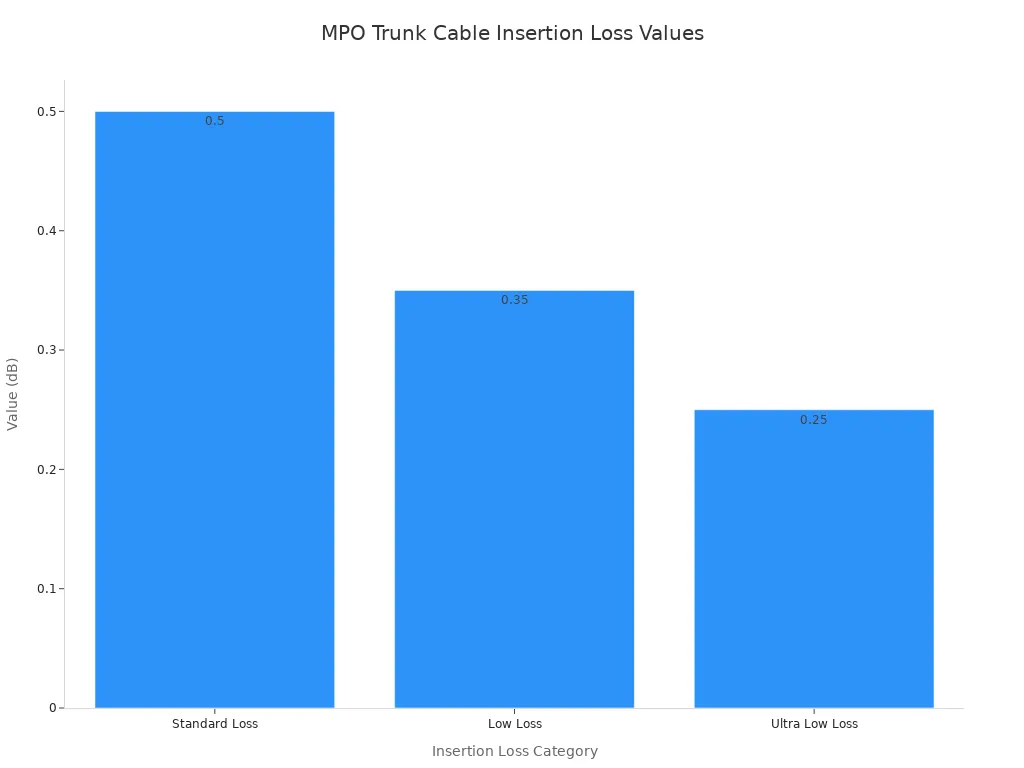
Ultra-Low Insertion Loss for Signal Integrity
MPO trunk cables feature ultra-low insertion loss. This is critical for maintaining signal integrity over long distances. Lower insertion loss means less signal degradation. This allows for more reliable data transmission.
| Insertion Loss Category | Value (dB) |
|---|---|
| Standard Loss | ≤0.5 |
| Low Loss | ≤0.35 |
| Ultra Low Loss | ≤0.25 |
Multimode MPO connectors typically have an insertion loss of approximately 0.25dB. Conventional single-mode MPO connectors have an insertion loss of about 0.6dB. Low insertion loss single-mode MPO connectors can achieve a maximum insertion loss not exceeding 0.35 dB.
Robustness and Reliability
MPO trunk cables are robust and reliable. They are designed for demanding data center environments. Their construction ensures consistent performance. This minimizes downtime and maintenance needs. The durability of these cables contributes to the overall stability of the network infrastructure.
The Indispensable Role of MPO Trunk Cables in AI Data Centers by 2025
Artificial intelligence (AI) workloads demand unprecedented levels of connectivity and processing power. MPO trunk cables are becoming increasingly indispensable in AI data centers. They provide the high-bandwidth, low-latency infrastructure essential for advanced AI applications. By 2025, these cables will form the backbone of AI superclusters, enabling rapid communication between powerful GPUs and supporting massive data throughput.
Enabling High-Bandwidth GPU Communication
AI development relies heavily on the efficient communication between Graphics Processing Units (GPUs). MPO trunk cables facilitate this critical interaction.
Interconnecting AI Clusters and Accelerators
MPO trunk cables are vital for interconnecting AI clusters and accelerators. They provide the necessary high-density, high-speed links. Meta’s RSC-2024 AI SuperCluster, for instance, uses 16,384 MPO 16 cables to interconnect 24,576 NVIDIA GB200 GPUs. This deployment significantly reduces cabling mass by 28 tons compared to MPO-12 solutions. It demonstrates the high-density and efficiency benefits of MPO-16 for large-scale AI infrastructure.
As IBM’s VP of Cloud Infrastructure, Dr. Sarah Aerni, notes, "MPO 16 isn’t just about density—it’s the foundation for rearchitecting exascale systems with photonic determinism."
MPO cabling supports parallel transmission and high fiber counts. These features are crucial for massive GPU-to-GPU communication and terabit speeds. AI workloads like deep learning training and large language models require these capabilities. Parallel optics enable simultaneous multi-lane data transfer, a key benefit for AI infrastructure. MPO ensures low-latency, high-bandwidth connectivity vital for training large AI models. MPO also provides high-density connections, reducing cabling clutter and saving space. This contributes to enhanced data throughput by optimizing physical infrastructure.
| Feature | Description |
|---|---|
| High Density | MPO-16 cables offer 33% more fibers than MPO-12 in the same connector footprint. This allows for more data lanes per cable. |
| Reduced Cabling Mass | Consolidating fibers into fewer cables significantly reduces the overall weight and volume of cabling. This improves airflow and simplifies cable management. |
| Scalability | The design supports future upgrades to higher speeds (e.g., 800GbE and beyond) without requiring a complete re-cabling. |
| Efficiency | Optimized for parallel optical transmission, MPO-16 directly supports the multi-lane requirements of modern AI accelerators. |
| Cost-Effectiveness | Fewer cables and faster deployment contribute to lower installation and operational costs for large-scale AI deployments. |
Meeting Ultra-Low Latency Requirements
Low latency is crucial for AI models to train efficiently. Near-instantaneous communication between nodes prevents processing bottlenecks, idle GPUs, and extended training times. This in turn increases operational costs. MPO trunk cables help meet these stringent latency demands.
AI networks often utilize shorter cabling runs. Many SuperPods are under 50 meters. Over these distances, light propagation delay remains below 250 nanoseconds. This is negligible when compared to delays from switching and signal processing. Structured cabling, when well-designed and adhering to connector loss limits (e.g., 1.5 dB for MMF and 2.5 dB for SMF channels), does not negatively impact latency-sensitive AI workloads. This counters the misconception that it introduces excessive latency.
In cabling, the primary factor for latency is the overall length of the optical channel. Light propagates at approximately 5 nanoseconds per meter. Properly designed structured cabling, including MPO trunk cables, does not introduce additional latency compared to direct cabling connections.
Supporting Massive Data Throughput for AI Workloads
AI workloads generate and process enormous amounts of data. MPO trunk cables are essential for handling this massive data throughput.
Training Large Language Models (LLMs)
Training large language models (LLMs) and other AI workloads necessitates massive parallel data transfers. These transfers occur at speeds of 100G, 400G, and even higher. To meet these demands, data centers are adopting PAM4 signaling. This technology doubles efficiency but is highly sensitive to signal degradation from reflections. MPO cables, particularly those with APC (Angled Physical Contact) connectors, are crucial for supporting these rates. APC connectors reduce reflections by redirecting reflected light into the cladding. This improves signal integrity for PAM4 modulation and enables higher data rates like 400G/800G with minimal interference.
- MPO cables offer ultra-high bandwidth. They facilitate rapid and efficient transfer of massive datasets for AI training and inference. This ensures seamless GPU communication, minimizing latency and maximizing processing power, especially in distributed training.
- Modern MPO cables, using single-mode fiber and PAM4 modulation, can achieve hundreds of Gigabits per second per fiber. They aggregate bandwidths in the Terabits per second range.
- They enable fast and efficient communication between GPUs for large-scale AI training. This significantly reduces training times and supports larger, more complex models through techniques like model and data parallelism.
- MPO cables contribute to reduced latency due to the low signal loss of fiber optics. This is critical for real-time AI applications and faster communication between GPUs. It leads to quicker training times and improved system responsiveness.
- MPO connectors simplify cable management. They consolidate multiple fiber strands into a single connector. This reduces clutter and eases installation, maintenance, and troubleshooting in high-density data centers.
Real-time AI Inference and Analytics
Real-time AI inference and analytics also demand high data throughput and low latency. Applications like autonomous driving, fraud detection, and personalized recommendations require immediate processing of vast data streams. An mpo trunk cable for data center environments provides the robust and high-speed connections necessary for these critical operations. They ensure that AI models can access and process data quickly, delivering timely and accurate results. The efficiency of an mpo trunk cable for data center operations directly impacts the responsiveness and effectiveness of real-time AI systems.
Future-Proofing AI Infrastructure with MPO Trunk Cables
The rapid evolution of AI technology requires infrastructure that can adapt and scale. MPO trunk cables offer a future-proof solution.
Scalability for Next-Generation AI Demands
MPO trunk cables provide inherent scalability for next-generation AI demands. Their modular design allows data centers to easily upgrade and expand their network capacity. As AI models grow in complexity and size, they require more powerful hardware and faster interconnections. MPO cabling systems can accommodate these increasing requirements without extensive overhauls. This ensures that AI infrastructure remains agile and responsive to future innovations.
Preparing for 800GbE and Beyond
Data centers are already preparing for 800GbE and beyond to support future AI workloads. MPO trunk cable technology is central to this preparation.
-
Connector Type: Parallel single-mode multi-fiber connectors aligned to DR8 transmission are essential.
-
Polarity Management: Factory-terminated trunks with defined polarity (Type-B or platform-recommended) are required for correct lane mapping.
-
Cabling Best Practices: Emphasizes straight-through structured cabling, factory-terminated MPO trunks to minimize field splicing variability, and end-to-end polarity verification (Type-B or recommended) before migration.
-
DR8 vs. DR4/FR-Class: DR8 utilizes higher-count MPO connectors and more parallel lanes to achieve greater aggregate bandwidth compared to DR4 for 400G applications.
-
Core Technology: MTP® & MPO are at the core of fiber infrastructure for AI-scale compute.
-
AI-Optimized Connectivity: Fiber solutions are designed for high-performance interconnects across thousands of GPUs. They support real-time inference, distributed training, and scalable model deployment.
-
Breakout Configurations: Supports 1×4, 1×8, and 1×12 breakout cables for flexible topologies in NVLink, InfiniBand NDR, and Ethernet-based AI fabrics.
-
Rapid Deployment: Pre-terminated trunk assemblies and polarity-managed cabling are crucial for reducing installation time and error rates in phased rollouts and dynamic scaling.
Operational Benefits and Cost Efficiency of MPO Trunk Cables
MPO trunk cables offer significant operational benefits and contribute to substantial cost efficiencies for data centers. Their design and deployment methodology streamline processes, enhance reliability, and ultimately reduce the total cost of ownership.
Reduced Installation Time and Labor Costs
MPO trunk cables dramatically cut down the time and effort required for network deployment. This directly translates into lower labor expenses.
Pre-terminated Solutions for Rapid Deployment
MPO trunk cables arrive as pre-terminated solutions. Manufacturers factory-test these cables, eliminating the need for on-site fiber splicing and connectorization. This plug-and-play approach significantly accelerates deployment. MPO/MTP systems typically reduce fiber installation time by 75-80% compared to traditional field-terminated methods. A mid-sized B2B SaaS company, for example, achieved an 80% reduction in installation time during a data center infrastructure upgrade. Furthermore, two technicians can mate 3,456 fibers using MTP trunk systems in one 8-hour workday, representing a 3-4x improvement over splicing the equivalent fiber count.
Simplified Cable Management
The high-density nature of MPO trunk cables simplifies cable management. A single trunk cable consolidates numerous fiber connections, reducing cable bulk and clutter within racks and pathways. This organized approach improves airflow, eases maintenance, and makes future upgrades more straightforward.
Enhanced Network Reliability and Maintainability
MPO trunk cables contribute to a more reliable and easily maintainable network infrastructure. Their standardized and pre-engineered nature minimizes potential issues.
Minimizing Human Error in Cabling
Pre-terminated MPO trunk cables significantly reduce the risk of human error during installation. They arrive fully assembled, eliminating the need for error-prone on-site termination. This streamlined process ensures greater reliability and network integrity. Several practices further minimize errors:
- Pre-terminated low-loss assemblies reduce field termination variability.
- Uniform, readable labeling on each trunk cable prevents confusion.
- Documenting and locking polarity methods before deployment avoids on-site improvisation.
- Modular trunk-to-breakout designs clarify connections and reduce ambiguity.
- Pre-defined pathways prevent technicians from crossing lanes or using incorrect cable types.
Streamlined Troubleshooting
The modularity and clear labeling of MPO trunk cables simplify troubleshooting. Technicians can quickly identify and isolate issues, reducing downtime. The standardized polarity management also ensures correct signal transmission, preventing common connectivity problems.
Lower Total Cost of Ownership (TCO) for Data Centers
MPO trunk cables offer a compelling proposition for lowering the total cost of ownership in data centers.
Operational Savings and Optimized Resource Use
MPO/MTP cabling solutions can significantly cut long-term operational expenditures (OpEx) by 30-50%. This reduction stems from lower labor costs, faster deployment times, and simplified upgrade processes. Data centers also achieve energy savings; MPO fiber systems can reduce energy costs by up to 30%, and switching to fiber optics can lower power consumption by up to 54%.
Long-Term Infrastructure Value
Data centers adopting MPO fiber systems can anticipate a return on investment (ROI) within a few years. This is primarily driven by significant reductions in energy expenses and improvements in operational efficiency. The long-term savings generated are expected to surpass the initial investment costs, providing lasting infrastructure value.
Future Trends and Evolution of MPO Trunk Cable Technology
MPO trunk cable technology continues its rapid evolution. It adapts to the ever-increasing demands of data centers. Innovations focus on higher densities, improved performance, and seamless integration with emerging technologies.
Advancements in Fiber Counts and Connector Designs
The industry constantly pushes the boundaries of fiber optic connectivity. This leads to significant advancements in MPO fiber counts and connector designs.
Emerging MPO Standards and Innovations
Industry standards guide the development of MPO technology. IEC 61754-5 defines MT ferrules, while IEC 61754-7 specifies MPO formats. TIA-604-5 and -18 also define these critical connectors. Fiber counts evolve to meet specific application needs. Twelve-fiber configurations remain relevant for 40G/100G applications. Sixteen-fiber solutions offer a strategic choice for efficient 200G/400G SR8 deployments, providing excellent density. Twenty-four-fiber cables serve as the high-density champion for 400G/800G and hyperscale data centers. They maximize port density and minimize cable bulk. While technically possible, significantly higher counts beyond 24 fibers face mechanical constraints and alignment challenges within the standard MPO footprint. The focus remains on optimizing 16-fiber and 24-fiber solutions.
Higher Density Solutions
Innovations aim for even higher density and performance. Fiber Ribbon Stacking stacks multiple ribbons vertically. This increases fiber count within the same connector size and simplifies manufacturing. Angled Physical Contact (APC) incorporates a slight angle on the ferrule end face. This reduces back-reflection and lowers connection loss, improving signal integrity. Fiber-Ferrule Optimization refines ferrule shape and dimensions for better fiber alignment. It uses advanced materials to minimize air gaps and maximize physical contact. Pitch Reduction and Miniaturization design connectors with reduced pitch and overall size. This accommodates more connectors in the same space, multiplying fiber capacity while balancing practicality. These advancements offer superior fiber density and enhanced mechanical stability. They also provide improved alignment precision and advanced fiber management.
Integration with Advanced Data Center Technologies
MPO trunk cables integrate seamlessly with advanced data center technologies. This ensures optimal performance and efficiency.
Impact on Cooling and Power Distribution
Efficient cable management directly impacts data center cooling and power distribution. Poor fiber management, such as overfilling cable trays, restricts airflow between cables. This restriction increases thermal loading. It forces cooling systems to work harder than necessary. This directly impacts power distribution and cooling efficiency. MPO patch panels utilize MPO connectors and trunk cables. They contribute to significant operational savings. They lower cooling energy consumption by 15-20%. Additionally, they reduce cabling infrastructure costs by 25%. Mass Connect Systems facilitate rapid deployment of AI and machine learning fiber networks.
Role in Hyperscale and Edge Computing
MPO trunk cables are crucial for hyperscale and edge computing environments. Hyperscale data centers demand extreme density and scalability. MPO cables provide the necessary high-fiber counts and plug-and-play deployment. Edge computing requires compact, robust, and rapidly deployable network infrastructure. MPO solutions meet these needs by offering high performance in a small footprint.
Continued Demand for MPO Trunk Cables for Data Center Growth
The demand for MPO trunk cables continues to grow. They remain essential for supporting expanding digital infrastructures.
Supporting Cloud and 5G Infrastructure
The expansion of 5G network rollouts significantly propels the MPO Trunk Market’s growth trajectory. There is a noticeable trend towards high-density interconnect solutions. These solutions streamline cabling and boost throughput, which are crucial for 5G infrastructure. The market anticipates robust growth through 2033. This growth is driven by the increasing need for cost-effective and scalable solutions, including those supporting 5G. Cloud data centers also heavily rely on MPO trunk cables for their high-density, high-bandwidth requirements.
Driving Network Performance
MPO trunk cables are indispensable for driving network performance. They enable the high-speed interconnects required for modern applications. As data rates increase and network architectures become more complex, the role of an mpo trunk cable for data center environments becomes even more critical. They ensure reliable, high-bandwidth connectivity, supporting the continuous growth of digital services and applications.
MPO trunk cables serve as the fundamental building blocks for high-performance data centers. They are indispensable for achieving current and future high-speed connectivity requirements. These advanced cables actively drive innovation across critical sectors, including AI, cloud computing, and enterprise networks. Their inherent high density, robust reliability, and impressive scalability ensure data centers effectively meet ever-evolving digital demands. MPO technology consistently supports the dynamic digital infrastructure of today and tomorrow.
FAQ
What is an MPO trunk cable?
An MPO trunk cable is a multi-fiber optic cable. It uses Multi-Fiber Push-On (MPO) connectors. These cables consolidate many optical fibers into a single connector. They provide high-density connectivity for data centers. Manufacturers pre-terminate and test these assemblies.
Why do data centers use MPO trunk cables?
Data centers use MPO trunk cables for several reasons. They offer high fiber density, saving space. They support high-speed data transmission, like 400GbE. Their pre-terminated design allows for rapid deployment. This reduces installation time and labor costs.
What are common fiber counts for MPO trunk cables?
Common fiber counts for MPO trunk cables include 8, 12, 24, and 32 fibers. Higher counts, such as 48 or 72 fibers, also exist. These various configurations support different network requirements and speeds.
How do MPO trunk cables support high-speed Ethernet?
MPO trunk cables support high-speed Ethernet by enabling parallel optical transmission. They facilitate speeds from 40GbE to 400GbE and beyond. Specific fiber configurations, like BASE-8, are crucial for these high-bandwidth deployments.
What is polarity management in MPO cables?
Polarity management ensures correct signal transmission in MPO cables. It guarantees the transmit signal from one device connects to the receive port of another. Methods like Type A, B, or C define the fiber alignment within the cable.
How do MPO trunk cables benefit AI data centers?
MPO trunk cables provide high-bandwidth and low-latency connectivity for AI data centers. They interconnect AI clusters and accelerators, like GPUs. This supports massive data throughput for training large language models and real-time AI inference.
Do MPO trunk cables reduce installation time?
Yes, MPO trunk cables significantly reduce installation time. Their pre-terminated, plug-and-play design eliminates on-site fiber splicing. This allows for rapid deployment of backbone infrastructure. It also simplifies future network upgrades and expansions.