

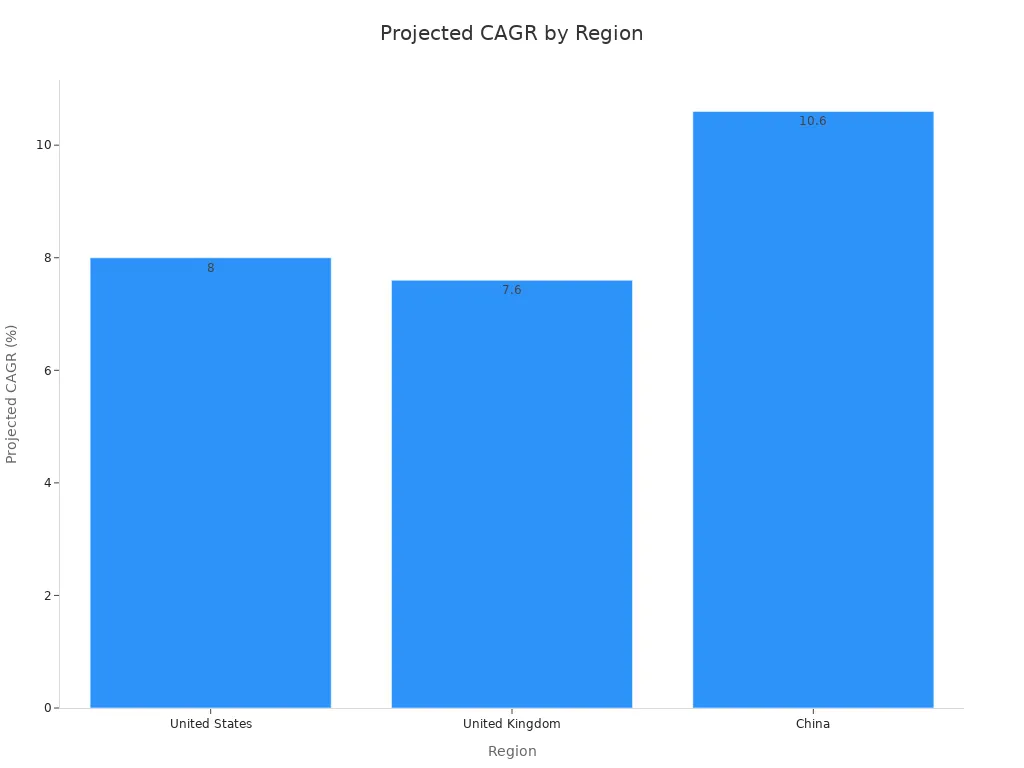
Os cabos tronco OM2 MPO/MTP personalizáveis fornecem uma solução robusta para infraestrutura de rede de alta densidade. Esses cabos garantem desempenho ideal e acesso ao mercado global. UM Cabo MPO personalizado solução, combinada com Certificado RoHS componentes, proporciona conformidade e responsabilidade ambiental. Este especializado Cabo Tronco OM2 atende aos rigorosos padrões da indústria. O mercado de infraestrutura de rede de alta densidade mostra um crescimento significativo, especialmente em regiões como a China, sublinhando a necessidade de soluções globalmente compatíveis.
Principais conclusões
- OM2 Cabos tronco MPO/MTP são importantes para redes de alta densidade. Eles ajudam a enviar bem os dados.
- Conectores MPO/MTP economize espaço. Eles tornam a configuração da rede mais rápida e fácil.
- Cabos personalizados atendem exatamente às necessidades da sua rede. Isso ajuda sua rede a funcionar melhor.
- A certificação RoHS significa que os cabos são seguros. Eles não possuem materiais nocivos. Isso ajuda o meio ambiente.
- As certificações ISO mostram boa qualidade. Eles também demonstram cuidado com o meio ambiente e com a segurança do trabalhador.
- Cabos personalizados certificados tornam sua rede mais rápida. Eles também o tornam mais confiável e fácil de configurar.
- Esses cabos funcionam bem em muitos lugares. Isso inclui data centers, escritórios e áreas industriais difíceis.
- Escolha um fornecedor com boa experiência. Eles devem oferecer muitas opções personalizadas e fortes verificações de qualidade.
Compreendendo os cabos tronco OM2 MPO/MTP: a base das redes de alta densidade
As redes de alta densidade dependem de soluções de cabeamento robustas. Cabos tronco OM2 MPO/MTP constituem uma parte crítica desta base. Eles oferecem transmissão de dados eficiente e confiável.
O que são cabos tronco OM2 MPO/MTP?
Esses cabos especializados combinam tipos específicos de fibra com tecnologia avançada de conectores. Eles criam uma solução poderosa para as demandas de redes modernas.
Definindo Fibra Multimodo OM2
OM2 refere-se a um tipo de fibra óptica multimodo. Possui um diâmetro de núcleo de 50 µm. Esta fibra suporta várias velocidades de rede.
| Especificação | Valor |
|---|---|
| Diâmetro do núcleo | 50 µm |
| Largura de banda (em 850 nm) | 500 MHz·km |
| Distância de transmissão (1 Gbps) | 550 metros |
| Distância de transmissão (10 Gbps) | 82 metros |
| Aplicações | Redes corporativas, data centers, aplicativos de velocidade moderada |
A fibra OM2 é uma escolha comum para conexões Gigabit Ethernet. Ele é usado em redes corporativas e data centers.
Tecnologia de conector MPO/MTP
Os conectores MPO (Multi-Fiber Push-On) e MTP (Mechanical Transfer Push-On) são interfaces multifibras. Eles permitem conectar múltiplas fibras em um único conector. MTP é uma versão aprimorada do MPO.
| Recurso | Conector MPO | Conector MTP |
|---|---|---|
| Descrição Geral | Multi-Fiber Push-On, o conector multifibra original. | Transferência Mecânica Push-On, uma versão aprimorada do MPO. |
| Interoperabilidade | Pode se conectar com infraestrutura baseada em MTP. | Pode se conectar com outra infraestrutura baseada em MPO. |
| Filosofia de Design | Conexão multifibra básica. | Projetado com vários aprimoramentos importantes para melhorar o desempenho. |
| Virola flutuante | Não fabricado com ponteira flutuante. | Apresenta uma ponteira flutuante, importante para aplicações diretas de dispositivos Tx/Rx. |
| Pinos guia | Usa pinos-guia com formato chanfrado, que podem produzir mais detritos. | Usa pontas de pino-guia elípticas de aço inoxidável com tolerância firme para reduzir detritos. |
| Carcaça removível | Não garante uma caixa removível. | Projetado com uma caixa removível para retrabalho, repolimento, testes de desempenho e mudanças de gênero. |
| Desempenho óptico (perda de inserção) | Reconhecido como padrão internacional, mas pode apresentar maior perda óptica. | Versão avançada projetada para minimizar a perda óptica e a perda de pacotes, garantindo um alinhamento preciso. |
| Confiabilidade | Pode estar sujeito a choques acidentais e instabilidade de sinal. | Componentes internos redesenhados para forças normais perfeitamente centralizadas, maior estabilidade e maior durabilidade, reduzindo o desgaste. |
Todos os conectores MTP são MPOs, mas nem todos os MPOs são MTPs. Os conectores MTP oferecem melhor desempenho e confiabilidade.
Funcionalidade do cabo tronco
Os cabos troncais servem como espinha dorsal de uma rede. Eles consolidam vários fios de fibra em um único cabo. Isso simplifica a infraestrutura de cabeamento e reduz a confusão.
Principais recursos e benefícios de desempenho do OM2
A fibra OM2 oferece vantagens específicas para determinados requisitos de rede.
Capacidades de largura de banda para atualizações de 10G a 100G
A fibra OM2 suporta velocidades Ethernet de até 10 Gbps. É uma escolha comum para conexões Gigabit Ethernet. A fibra OM2 pode ser utilizada para aplicações Ethernet de 10 Gigabit. Porém, possui uma limitação de distância máxima de 33 metros para esta velocidade.
| Aplicativo | Distância/Suporte |
|---|---|
| 10G | 82 metros |
| 40G | Não compatível |
| 100G | Não compatível |
Limitações de distância e casos de uso ideais
A fibra OM2 possui limites específicos de distância de transmissão com base nas taxas de dados.
| Taxa de dados | Distância de transmissão OM2 |
|---|---|
| Ethernet rápida | 2000m |
| 1GbE | 550m |
| 10GbE | 82m |
| 40GbE | Não compatível |
| 100GbE | Não compatível |
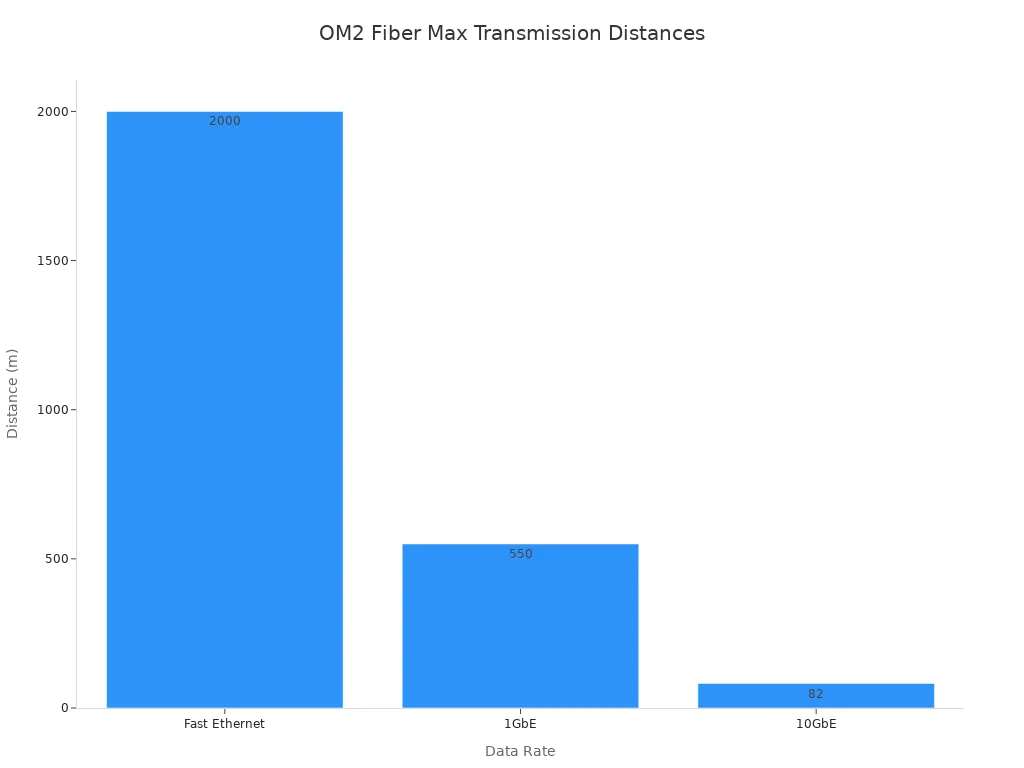
Essas distâncias tornam o OM2 adequado para aplicações de menor alcance em data centers ou ambientes de campus.
Adequação de aplicações em data centers
Os cabos OM2 são adequados para interligar equipamentos dentro de um data center. Eles suportam aplicações de velocidade moderada onde as distâncias não são extensas.
Por que MPO/MTP para ambientes de alta densidade?
A tecnologia MPO/MTP oferece vantagens significativas em configurações de rede de alta densidade.
Design que economiza espaço e redução de pegada
Os conectores MPO/MTP são projetados para cabeamento de alta densidade. Eles permitem inúmeras fibras em um único conector. Isto reduz significativamente o espaço físico necessário.
| Recurso | Conectores MPO/MTP | Conectores Tradicionais |
|---|---|---|
| Contagem de fibras por conector | Até 72 fibras | 1 fibra por conector |
| Eficiência Espacial | Alto (tamanho pequeno) | Baixo (requer conexões individuais) |
| Gerenciamento de cabos | Simplificado (redução da desordem) | Complexo (mais cabos individuais) |
Esses conectores podem acomodar até 72 fibras em um conector. Isso economiza espaço diretamente em comparação aos conectores tradicionais. Os conectores tradicionais precisam de conexões individuais para cada fibra.
Com mais fibra em uma conexão menor, os conectores da marca MTP® ajudam a garantir a entrega de cada bit, byte e pacote® aos seus dispositivos de monitoramento, economizando espaço vital no data center.
Vantagens de implantação e instalação rápida
Os sistemas MPO/MTP reduzem significativamente o tempo de instalação. Eles oferecem soluções plug-and-play pré-terminadas. Os sistemas MPO/MTP normalmente reduzem o tempo de instalação de fibra em 75-80% em comparação com os métodos tradicionais terminados em campo. Um projeto de atualização de data center, estimado em 45 dias úteis com métodos tradicionais, concluído em apenas 9 dias usando cabos troncais MTP. Isto representa uma redução de 80% no tempo de instalação.
Escalabilidade para crescimento futuro da rede
Os cabos tronco MPO/MTP oferecem excelente escalabilidade. Eles permitem atualizações fáceis para velocidades mais altas e maiores contagens de fibra. Isto prepara as redes para demandas futuras sem um extenso cabeamento.
## The Power of Customization: Tailoring Your Network with Custom MPO Cable Solutions

Customization plays a vital role in optimizing network infrastructure. Tailored solutions ensure precise fit, superior performance, and efficient resource utilization. A Custom MPO Cable solution allows network designers to meet specific operational demands.
### Cable Length and Fiber Count: Precision for Optimal Performance
Accurate cable length and fiber count are crucial for network efficiency. They prevent unnecessary clutter and ensure proper connectivity.
#### Avoiding Excess Slack and Cable Management
Excess cable slack can lead to poor cable management and airflow issues. Proper planning minimizes these problems. To determine optimal cable length in data center deployments, follow accurate measurement techniques. First, measure the exact pathway length. Account for bends, corners, and elevation changes. Second, decide if a service loop is needed for future equipment rack elevation changes. Third, add a recommended slack percentage, such as [10-20%](https://www.cablexpress.com/blog/guide-to-measuring-fiber-cables-in-data-center-installations), to the measured route length. This accommodates cable management, equipment installation, and potential movement. Finally, sum the measured route length, service loop length, and slack length for each segment to calculate the total cable length.
Before measuring, understand your data center's specific installation requirements. Consider pathway planning. Identify and plan cable routes through overhead trays, raised floors, or conduits. Ensure clear paths and adequate space. Determine the necessary cable types, including fiber type (single-mode or multimode), [connector type](https://www.fs.com/blog/mtpmpo81224-what-are-the-differences-13772.html) (MPO, LC, SN, MDC, CS), and initial cable length. Also, plan for growth and expansion. Allocate additional cable length to anticipate future reconfigurations or layout changes.
Service loops involve adding extra cable length for contingencies. These allow movement of patch panels or enclosures. Short loops, typically [three to six feet](https://www.cablexpress.com/whitepaper/15-best-practices-for-data-center-fiber-optic-cabling-installation), can be helpful. However, excessive loops can lead to cable pathway congestion. Modern pre-terminated systems often reduce the need for extensive service loops. A design architect can best determine the optimal approach. When using service loops, manage them with Velcro in a circular shape. Use at least four mounting points to prevent unraveling. If space is limited, consider a figure-8 coil for better length management. The data center operator should decide the placement of service loops. They can be vertical on cabinet sides or horizontal at specific rack units. Do not mount them in conveyance unless the design specifies it. This avoids interfering with hardware access. Confirm trunking direction, from both sides or one. Reference port maps to determine if a trunk spans multiple enclosures. If so, plug connectors into specified ports first. Then secure the furcation point to prevent damage.
#### Matching Port Density and Equipment Needs
Custom fiber counts directly match the port density of network equipment. This avoids unused fibers and optimizes hardware utilization.
### Connector Types and Polarity: Ensuring Seamless Integration
Selecting the correct connector type and polarity [method](https://www.flukenetworks.com/blog/cabling-chronicles/101-series-12-fiber-mpo-polarity) is essential for seamless network integration. These choices impact signal integrity and system compatibility.
#### MPO/MTP Connector Variations
MPO/MTP connectors come in various configurations. Each variation serves specific application needs.
| Connector Type | Description | Key Applications |
|---|---|---|
| **Base-8 MTP/MPO** | Utilizes 8 of the 12 fiber positions. It is not a strictly standards-recognized infrastructure interface. Efficient for QSFP applications, especially parallel-to-parallel transmission (e.g., 40G to 40G) and breakout methods (e.g., 10G to 40G). | QSFP applications (100% fiber transmission utilization), 40G to 40G transmission with SR4 transceivers, 10G to 40G breakout scenarios (MTP/MPO-8 to 4 LC duplex harness). |
| **Base-12 MTP/MPO** | Uses 12 fibers to increment fiber links. It is widely used and a globally recognized standard. Adaptable to multimode and single-mode fibers. | Various fields of fiber optic communication, duplex and simplex relay cable connections, higher density than 8-core products, supporting QSFP MTP/MPO-8 ports with full fiber utilization. |
| **Base-24 MTP/MPO** | High-density fiber optic connector providing 24 fibers in one connector. Supports both parallel and duplex fiber optic applications. | Scenarios requiring high-density and high-performance fiber optic connections, applications with extremely high requirements for space and efficiency. |
These variations allow for precise matching with network hardware and transmission requirements.
#### Type A/B/C Polarity Methods
Polarity refers to the correct alignment of transmit (Tx) and receive (Rx) signals. Different methods ensure proper signal flow.
* [**Type A (Straight Through)**](https://store.cablesplususa.com/mtp-brand-mpo-polarity-methods-vs-cable-types/): Pin 1 connects to Pin 1. The polarity swap is achieved by using two different configurations of patch cables on each end: one pair-flipped and one straight-through. Cassettes and the trunk cable are straight through.
* **Type B (Reversed/Crossed/Rollover)**: Pin 1 connects to Pin 12. The polarity swap is achieved using special 'Key-up/Key-up' adapters on straight-through cassettes at each end, with a Type B rollover trunk cable.
* **Type C (Flipped/Pair-Flipped/Swapped)**: Pin 1 connects to Pin 2, and Pin 2 connects to Pin 1 (for adjacent pairs). The polarity swap is performed by the Type C 'Pair-Flipped' trunk cable itself.
The choice of polarity method depends on the network architecture and equipment.
| Method | Application | Patch Cord (End 1) | Cable | Patch Cord (End 2) |
|---|---|---|---|---|
| A | 10 Gig Duplex | A-B | [Type A](https://www.fs.com/blog/understanding-polarity-in-mtpmpo-system-948.html) | A-A |
| A | 40/100 Gig Parallel | Type B | Type A | Type A |
| B | 10 Gig Duplex | A-B | Type B | A-B |
| B | 40/100 Gig Parallel | Type B | Type B | Type B |
| C | 10 Gig Duplex | A-B | Type C | A-B |
| C | 40/100 Gig Parallel | Type B | Type C | Type C |
* **Type A**: Uses a Type A trunk cable connecting MTP® modules. Standard A-to-B type duplex patch cables are used on both sides.
* **Type B**: Employs a Type B trunk cable where fiber positions are reversed at each end. Standard A-to-B type duplex patch cables are used on both sides.
* **Type C**: Utilizes a pair-reversed trunk cable to connect MTP® modules. Standard A-to-B type patch cords are used at both ends.
#### Method 1/2/3 Implementation for Specific Architectures
These methods define how MPO/MTP cables connect to achieve the desired polarity. They ensure compatibility between different network components. A Custom MPO Cable solution can be designed to support any of these methods.
### Jacket Material and Color Coding: Environmental and Identification Benefits
Cable jacket materials and color coding offer important benefits. They enhance safety, meet building codes, and simplify cable management.
#### LSZH (Low Smoke Zero Halogen) Options for Safety
LSZH cables are crucial for safety in enclosed spaces. They emit minimal smoke and no toxic halogens when exposed to fire.
| [Region/Country](https://www.tstcables.com/do-you-know-the-requirements-and-standards-for-lszh-cables-in-various-countries-around-the-world/) | Core Regulations/Standards | Key Requirements/Applications |
|---|---|---|
| **European Union (EU)** | Construction Products Regulation (CPR, EU No 305/2011), EN 50575, EN 13501-6 | Mandatory fire-rating (CE mark) for all permanent building cables since 2017. B2ca and Cca grades require low smoke (s1), low toxicity (d0/d1), and halogen-free (a1). Mandatory in subways, hospitals, schools, high-rise buildings, airports. |
| **United Kingdom (UK)** | BS 6724, BS 7211 | Similar to CPR, strengthened requirements. Recommended/mandated in public buildings. Halogen-containing cables banned in new London Underground and NHS hospital projects. |
| **United States (US)** | NFPA 130 (railway), NFPA 101 (life safety), Local legislation (NY, CA, Chicago) | No federal mandate, but NFPA strongly recommends LSZH in confined spaces. Local building codes prioritize LSZH in hospitals, subways, high-rise buildings. Large project owners (Google, Microsoft) require LSZH. |
| **Japan** | SONY SS-00259, JIS C 3665 series | Industry self-regulation. SONY requires LSZH from suppliers since 2005. JIS C 3665 specifies test methods. Mandated in JR East Japan, Tokyo Metro, and other public transportation. |
| **South Korea** | KCC, KS C IEC 60754 / KS C IEC 61034 | Standards equivalent to IEC international standards. Mandatory for critical facilities like Seoul Metro, Incheon Airport, and Samsung Semiconductor factories. |
| **China** | GB 31247-2014, CCC (3C) certification | Shifting from recommended to mandatory. B1 grade requires low smoke (light transmittance ≥60%), halogen-free (halogen acid gas ≤5mg/g), and low toxicity. New regulations from July 1, 2025, require CCC certification for all flame-retardant wires/cables. Mandatory in subways, high-speed rail, data centers, hospitals, super high-rise buildings. |
| **Australia/New Zealand** | AS/NZS 1670.3 | Requires LSZH cables in rail transit and underground facilities. |
| **Singapore** | BCA (Building and Construction Authority), IEC 60754/61034 | Mandates LSZH cables in subways, hospitals, and government buildings. |
Globally, a clear trend exists towards mandatory or highly recommended use of low-smoke zero-halogen (LSZH) cables. This is especially true in densely populated areas, high-risk environments, and locations with stringent environmental regulations. Common application scenarios universally requiring LSZH cables include underground or enclosed transportation facilities (subways, tunnels, airports), densely populated public places (hospitals, schools, theaters, shopping malls), critical infrastructure (data centers, nuclear power plants, control rooms), and vertical shafts and escape routes in high-rise buildings. The forecast indicates LSZH cables are transitioning from a 'high-end option' to a 'basic standard'. More countries expect to introduce mandatory regulations similar to the EU's CPR in the next 5-10 years. These regulations will restrict halogen-containing cables in new construction.
#### Plenum and Riser Ratings for Building Codes
Building codes often dictate specific cable ratings based on installation location. [Most local and national building codes](https://simcona.com/blog/what-is-a-plenum-rated-cable) mandate the use of plenum-rated wiring in air-handling spaces. Failure to use compliant materials can result in expensive remediation.
| [Cable Type](https://tektel.com/blogs/cable-university/differences-between-plenum-rated-and-riser-rated-cables) | Standard/Test | Material Requirements | Usage Location | Fire Resistance/Smoke Emission |
|---|---|---|---|---|
| **Plenum Rated** | UL 910 (Steiner Tunnel test) | FEP or low-smoke PVC | Air-handling spaces (above drop ceilings, beneath raised floors) | Assesses flame propagation and smoke concentration; must produce little smoke and harmful gases |
| **Riser Rated** | UL 1666 | PVC (self-extinguishing properties) | Vertical spaces between floors (risers, shafts, conduits) | Less strict fire resistance and smoke emission than plenum; designed to contain flames within a single floor-to-floor riser |
[Plenum cable is legally required](https://www.cbtnuggets.com/blog/technology/networking/plenum-vs-riser-rated-cable) by building codes when cabling runs through air-handling ducts or ceiling spaces. Examples include above drop ceilings in commercial office buildings or schools. Riser-rated cable (CMR) is designed for vertical spaces like shafts or conduits connecting floors. It has a fire-resistant jacket that is less stringent than plenum. It is built to contain flames within a single floor-to-floor riser. Always consult the National Electrical Code (NEC) and local regulations before purchasing cables.
#### Visual Management for Easy Identification
Color-coded jackets and labels simplify cable identification. This streamlines maintenance and troubleshooting.
### Breakout Options and Fanout Lengths: Flexibility for Diverse Equipment
Network architects require flexible cabling solutions. Breakout options and varying fanout lengths provide this flexibility. These features allow seamless integration with diverse network equipment. They optimize connectivity in complex environments.
#### Direct Connection vs. Fanout Configurations
Network designs often involve two primary connection methods for MPO/MTP trunk cables: direct connection and fanout configurations. Each method serves distinct purposes.
Direct connection involves linking MPO/MTP ports directly. This method is common for high-density, parallel optical links. For example, a 40G QSFP+ transceiver connects directly to another 40G QSFP+ transceiver using an MPO/MTP trunk cable. This approach simplifies cabling. It also reduces the number of individual patch cords. Direct connections are ideal for high-speed, port-to-port links within data centers. They maintain the high-density advantage of MPO/MTP technology.
Fanout configurations, also known as breakout cables, convert a single MPO/MTP connector into multiple individual connectors. These individual connectors are typically LC or SC. This configuration is essential when connecting MPO/MTP trunk cables to equipment that uses standard duplex fiber ports. For instance, a 12-fiber MPO/MTP connector can break out into six duplex LC connectors. This allows connection to six 10G SFP+ transceivers. Fanout cables bridge the gap between high-density MPO/MTP infrastructure and traditional equipment interfaces. They offer versatility in network design.
#### Fanout to LC/SC Connectors for Equipment Interfacing
Fanout cables are critical for interfacing MPO/MTP trunk cables with equipment using LC or SC connectors. These cables provide a practical solution for connecting high-density backbones to lower-density active equipment. A Custom MPO Cable with fanout capabilities ensures precise compatibility.
The fanout section of these cables typically consists of individual fiber strands. Each strand terminates with an LC or SC connector. These individual strands are often protected by smaller diameter tubing. This tubing helps manage and protect the individual fibers.
Fanout lengths vary to accommodate different equipment layouts and cable management needs. Common fanout lengths include:
* [0.5 Meter Breakout Length using 2mm Tubing](https://www.fibertronics.com/mtp-mpo-breakout-cables)
* 5 Meter Breakout Length using 2mm Tubing
These varying lengths allow installers to neatly route individual connectors to specific ports on switches, servers, or patch panels. Proper fanout length selection prevents excess cable slack. It also ensures efficient cable management. This flexibility makes fanout cables indispensable in modern data centers and enterprise networks. They enable efficient utilization of high-density MPO/MTP trunking while maintaining compatibility with diverse hardware.
## Global Compliance: RoHS and ISO Certifications Explained
Global compliance is essential for manufacturers in today's interconnected world. RoHS and ISO certifications demonstrate a commitment to product safety, quality, and environmental responsibility. These certifications open doors to international markets and build trust with customers.
### What is RoHS Certification and Why is it Crucial?
RoHS certification addresses the presence of hazardous substances in electronic products. It ensures products are safe for both people and the environment.
#### Restriction of Hazardous Substances Directive
The RoHS directive restricts [specific hazardous substances](https://www.ul.com/services/restriction-hazardous-substances-directive-rohs-compliance-services) in Electrical and Electronic Equipment (EEE). This directive protects human health and the environment. It limits the use of [ten key substances](https://www.nemko.com/blog/rohs-explained-a-comprehensive-guide):
1. Lead (Pb): Maximum 0.1% by weight in homogeneous materials.
2. Mercury (Hg): Maximum 0.1% by weight.
3. Cadmium (Cd): Maximum 0.01% by weight.
4. Hexavalent Chromium (Cr6+): Maximum 0.1% by weight.
5. Polybrominated Biphenyls (PBBs): Maximum 0.1% by weight.
6. Polybrominated Diphenyl Ethers (PBDEs): Maximum 0.1% by weight.
7. Bis(2-Ethylhexyl) Phthalate (DEHP): Maximum 0.1% by weight.
8. Benzyl Butyl Phthalate (BBP): Maximum 0.1% by weight.
9. Dibutyl Phthalate (DBP): Maximum 0.1% by weight.
10. Diisobutyl Phthalate (DIBP): Maximum 0.1% by weight.
#### Environmental Responsibility and Sustainability
RoHS compliance shows a company's dedication to environmental responsibility. It promotes sustainable manufacturing practices. Companies reduce their environmental footprint by eliminating these harmful chemicals. This contributes to a healthier planet.
#### Essential for European and Global Market Access
RoHS certification is mandatory for selling EEE products in the European Union. Many other countries also adopt similar regulations. Non-compliance carries significant risks. Companies face [market removal, operational disruptions, and financial penalties](https://blog.sourceintelligence.com/understanding-eu-rohs-enforcement-implications-non-compliance). For example, Germany can impose fines up to [30,000 euros](https://getenviropass.com/rohs-reach-pop-violations/). Denmark has no maximum fine and can impose up to 2 years of imprisonment. A single product recall due to non-compliance can cost an estimated $[11.71 million USD](https://www.assent.com/blog/rohs-enforcement/). Sony Corporation's PlayStation 2 recall in 2001, due to cadmium exceedance, resulted in an estimated $150 million USD loss in sales.
### The Significance of ISO Certification for Quality and Reliability
ISO certifications demonstrate a commitment to quality, environmental management, and occupational health and safety. They provide a framework for best practices.
#### ISO 9001 for Quality Management Systems
ISO 9001 sets the standard for quality management systems (QMS). It helps organizations meet customer and regulatory requirements. Its [core principles](https://isolocity.com/what-are-the-7-principles-of-iso-9001/) include:
1. **Customer Focus**: Understanding and exceeding customer expectations.
2. **Leadership**: Upper management creates an environment for quality goals.
3. **Engagement of People**: Collaboration of individuals at all levels for quality.
4. **Process Approach**: Managing resources and activities as interconnected processes.
5. **Improvement**: Continuously enhancing organizational processes and the QMS.
6. **Evidence-Based Decision Making**: Making informed decisions based on data analysis.
7. **Relationship Management**: Managing dealings with interested parties like suppliers and customers.
#### ISO 14001 for Environmental Management Systems
ISO 14001 focuses on environmental management systems (EMS). It helps organizations manage their environmental responsibilities. [This certification contributes to](https://www.bvna.com/iso-14001-environmental-management-system-certification):
* Reducing environmental impact through continuous improvement.
* Integrating environmental considerations into business strategy.
* Enhancing customer satisfaction by understanding environmental risks.
* Increasing operational control over environmental aspects.
* Improving environmental performance through efficient resource use.
* Ensuring environmental management excellence is a core strategic component.
* Emphasizing proactive initiatives to boost environmental management.
* Encouraging a lifecycle view of products and services.
#### ISO 45001 for Occupational Health and Safety
ISO 45001 provides a framework for occupational health and safety (OH&S) management systems. It helps organizations prevent work-related injury and ill health. It also provides safe and healthy workplaces.
### How Certifications Ensure Global Market Access and Trust
Certifications like RoHS and ISO are more than just labels. They are critical for global business success.
#### Meeting International Standards and Regulations
These certifications ensure products and processes meet international standards. They confirm compliance with various regulations worldwide. This compliance is often a prerequisite for market entry.
#### Reducing Trade Barriers and Facilitating Export
Certified products face fewer trade barriers. They can move more easily across international borders. This facilitates export and expands market reach for businesses.
#### Building Customer Confidence and Brand Reputation
Certifications build strong customer confidence. They signal a commitment to quality, safety, and ethical practices. This enhances a company's brand reputation and fosters long-term customer loyalty.
## Benefits of Choosing Certified, Customizable OM2 MPO/MTP Trunk Cables
Choosing certified, customizable OM2 [MPO/MTP trunk cables](https://niusheng.gg13.globaldeepsea.site/top-10-mpo-trunk-cable-companies-industry-leaders/) offers significant advantages for network infrastructure. These benefits span performance, deployment, and long-term adaptability. They provide a strategic edge in today's demanding network environments.
### Enhanced Network Performance and Reliability
Certified OM2 MPO/MTP trunk cables deliver superior network performance. They ensure reliable data transmission across the infrastructure.
#### Optimized Signal Integrity and Data Transmission
High-quality OM2 MPO/MTP trunk cables maintain excellent signal integrity. This means data travels across the network with minimal loss or interference. Optimized signal integrity leads to faster, more accurate data transmission. It supports the high bandwidth demands of modern applications. Each cable undergoes rigorous testing to meet performance standards. This ensures consistent and reliable operation.
#### Reduced Downtime and Maintenance Needs
Reliable cabling directly contributes to reduced network downtime. Certified cables have a robust construction. They resist common issues like signal degradation or physical damage. This durability minimizes the need for frequent repairs or replacements. Network administrators experience fewer interruptions. They can focus on strategic tasks rather than constant troubleshooting. This leads to a more stable and efficient network environment.
### Streamlined Deployment and Reduced Installation Costs
Customizable OM2 MPO/MTP trunk cables simplify network deployment. They also significantly lower overall installation expenses.
#### Pre-Terminated, Plug-and-Play Solutions
Pre-terminated MPO/MTP trunk cables arrive ready for immediate use. Manufacturers pre-assemble and test these cables in a controlled factory environment. This eliminates the need for on-site fiber termination. Installers simply plug them into the network equipment. This "plug-and-play" approach speeds up the entire installation process. It also reduces the potential for human error during setup.
#### Faster Installation Times and Labor Savings
The use of pre-terminated solutions dramatically cuts installation time. Traditional field termination methods require significant labor and specialized skills. Pre-terminated cables, however, streamline the process. This leads to substantial labor cost savings.
[Consider the difference in installation time](https://www.focc-fiber.com/info/why-choose-mtp-cables-103194383.html):
| Cable Type | Installation Time (hours) |
| :------------------------ | :------------------------ |
| Pre-terminated MTP | 2-3 |
| Field-terminated Traditional | 55-75 |
| Reduction in installation time | Up to 75% |
These figures highlight the efficiency gains. A Custom MPO Cable solution, pre-terminated to exact specifications, offers even greater time savings.
[Further analysis shows the impact on larger projects](https://www.linkedin.com/pulse/hyperscale-fiber-termination-revolution-partfiniti-inc-8s0ze):
| Scenario | Traditional Field Termination (hours) | Pre-terminated System (hours) | Time Reduction (%) |
| :------------------------------------- | :------------------------------------ | :---------------------------- | :----------------- |
| Per connection (including cleaning and verification) | N/A | < 0.083 (5 minutes) | 70-75% |
| 10,000-fiber installation | 333-500 | 83-167 | 66-75% |
| Server row cabling | N/A | N/A | Up to 70% |
| Installations exceeding 1,000 terminations | N/A | N/A | ROI within 6-18 months through labor savings alone |
These savings translate into a quicker return on investment. They also allow businesses to deploy new network infrastructure faster.
### Future-Proofing Your Infrastructure
Investing in certified, customizable OM2 MPO/MTP trunk cables helps future-proof network infrastructure. These cables adapt to evolving technological demands.
#### Scalability for Evolving Bandwidth Demands
Network bandwidth requirements constantly increase. Customizable MPO/MTP trunk cables offer excellent scalability. Their high-density design allows for easy upgrades to higher speeds. Businesses can add more fiber capacity without replacing the entire cabling system. This flexibility supports growth and prevents costly re-cabling projects as bandwidth needs expand.
#### Adaptability to New Network Standards
Technology standards frequently change. Certified OM2 MPO/MTP trunk cables are designed with adaptability in mind. Their modular nature allows for easy reconfiguration. This helps networks comply with new industry standards. Businesses can integrate new equipment and protocols seamlessly. This ensures the network remains current and competitive for years to come.
### Ensuring Regulatory Compliance and Environmental Responsibility
Choosing certified, customizable OM2 MPO/MTP trunk cables offers significant advantages. It ensures adherence to global regulations and promotes environmental stewardship. This approach protects businesses from potential risks and enhances their public image.
#### Avoiding Penalties and Legal Issues
Non-compliance with regulatory standards carries severe consequences for network infrastructure providers. Businesses face substantial financial penalties. For example, GDPR violations can incur [fines up to 4% of a company's annual global revenue](https://secureframe.com/blog/sanctions-non-compliance-fine). Meta received a €1.2 billion fine in 2023 for such a violation.
* **Monetary Fines**: Regulatory non-compliance results in substantial financial penalties. These fines range from thousands to millions of dollars.
* **Operational Restrictions**: Businesses may lose the ability to process transactions or operate in certain markets. A payment processor violating PCI DSS requirements, like Heartland Payment Systems after its 2008 data breach, could face bans from handling credit card transactions. This severely impacts revenue.
* **Loss of Government Contracts and Funding**: Non-compliance with government regulations leads to the loss of lucrative contracts. Health Net Federal Services lost its TRICARE program contract with the U.S. Department of Defense. It also paid an $11.2 million settlement for falsely certifying cybersecurity compliance.
* **Lost Deals**: Many businesses require partners and vendors to meet strict compliance standards, such as SOC 2. Failure to meet these standards results in lost revenue and missed growth opportunities. Refyne experienced this before obtaining SOC 2 certification.
Beyond direct financial hits, companies also suffer from reputational damage and legal actions.
* **Reputational Damage**: Public exposure of non-compliance erodes customer trust. It negatively impacts brand reputation. This leads to customer loss and difficulty securing partnerships. Sephora faced significant negative press and loss of consumer trust after a $1.2 million fine under CCPA for data-sharing violations.
* **Legal Action**: Regulatory bodies initiate lawsuits or criminal charges. Companies committing financial fraud under SOX may face criminal prosecution. Executives are held personally liable. The SEC penalized a former CFO for falsifying financial statements, demonstrating this.
[The overall costs of non-compliance extend beyond immediate fines](https://www.cybercrestcompliance.com/blog/consequences-of-non-compliance).
* **Sanctions and Fines**: Organizations face direct financial penalties from regulatory bodies.
* **Higher Insurance Premiums**: Non-compliance leads to increased costs for insurance coverage.
* **Forced Payments**: Companies may be compelled to make payments as a result of violations.
* **Legal Fees and Settlement Costs**: Significant expenses are incurred for legal counsel and dispute resolution.
* **Loss of Revenue**: Decreased customer trust and lost deals lead to a substantial drop in income.
* **Costs of Reputation Rebuilding**: Extensive and expensive public relations campaigns are often necessary to restore public perception.
* **Internal Upheaval Costs**: Expenses relate to hiring consultants, redesigning processes, and frequent staff training to correct issues.
These issues create a ripple effect throughout the organization.
* **Lost Revenue**: Prospective customers and partners choose competitors, leading to a revenue plunge.
* **Decreased Customer Trust**: A damaged reputation due to rule-breaking causes customers to seek alternatives.
* **Loss of Investor Confidence**: Negative publicity and financial penalties deter new investors and clients, slowing expansion.
* **Operational Disruptions**: Corrective measures, such as redesigning processes and staff training, disrupt normal workflows. This increases stress and indirectly impacts productivity and efficiency.
Specific industry areas also face unique risks.
* **Technology/Data Handling Breaches**: Weak compliance frameworks in industries handling technology or large amounts of data lead to security breaches. This results in lawsuits and drains capital.
* **Financial Enterprise Recordkeeping**: Overlooking standard recordkeeping leads to punitive measures. This drains resources and damages investor confidence.
* **Healthcare Privacy Mandates**: Incomplete adherence to privacy rules causes data leaks. This leads to legal actions, compensation demands, fines, and a decline in public trust.
#### Demonstrating Corporate Social Responsibility
Choosing certified cables demonstrates a company's commitment to corporate social responsibility (CSR). RoHS certification ensures products are free from hazardous substances. This protects both the environment and human health. ISO certifications, particularly ISO 14001, highlight a dedication to environmental management. Companies actively reduce their ecological footprint. This commitment resonates with environmentally conscious customers and partners. It builds a positive brand image and fosters trust.
### Cost-Effectiveness Through Tailored Solutions
Customizable OM2 MPO/MTP trunk cables offer significant cost advantages. They provide solutions perfectly matched to specific network needs. This approach avoids unnecessary expenses and maximizes value.
#### Minimizing Material Waste and Over-Specification
Standard, off-the-shelf cables often lead to waste. They may be too long, requiring excess slack management. They might also contain more fibers than necessary for a particular application. A Custom MPO Cable solution eliminates these inefficiencies. Businesses order cables with precise lengths and fiber counts. This minimizes material waste. It also prevents over-specification, where companies pay for features or capacity they do not need. This precise approach reduces initial purchasing costs and long-term disposal issues.
#### Optimizing Resource Utilization
Tailored cabling solutions optimize resource utilization across the board. Exact cable lengths and configurations simplify installation. This reduces labor time and associated costs. Efficient cable management, free from excess slack, improves airflow in data centers. This can lower cooling expenses. Furthermore, by matching cables precisely to equipment, businesses ensure every component serves a purpose. This prevents underutilized assets. It also streamlines future upgrades and maintenance. This strategic approach leads to a more efficient and cost-effective network infrastructure.
## Applications: Where Customizable OM2 MPO/MTP Trunk Cables Excel
Customizable OM2 [MPO/MTP trunk cables](https://niusheng.gg13.globaldeepsea.site/top-10-mpo-trunk-cable-companies-industry-leaders/) offer versatile solutions. They perform exceptionally well across various high-demand networking environments. These cables meet specific operational needs.
### Data Centers and Server Rooms
Data centers require efficient, high-density cabling. Customizable OM2 MPO/MTP trunk cables provide ideal solutions. They support the rapid deployment and scalability essential for these critical infrastructures.
#### High-Density Patching and Cross-Connects
Data centers utilize high-density patching. MPO/MTP trunk cables consolidate multiple fiber connections. This reduces cable bulk. It also simplifies cable management. Customizable lengths and fiber counts ensure a perfect fit for patch panels and distribution frames. This minimizes slack and optimizes airflow.
#### Inter-Rack and Intra-Rack Connectivity
These cables connect equipment within racks and between adjacent racks. Their pre-terminated design allows for quick installation. This reduces downtime during upgrades or expansions. OM2 fiber supports the moderate distances common in data center environments. It ensures reliable data transmission for 10G applications.
### Enterprise Networks
Enterprise networks demand robust and scalable cabling. Customizable OM2 MPO/MTP trunk cables provide a reliable backbone. They support diverse applications across campus environments.
#### Backbone Cabling for Campus Networks
Large campus networks use these cables as their primary backbone. They link buildings or major network distribution points. The high fiber count within a single cable simplifies infrastructure. It also provides capacity for future growth. Customization ensures precise routing and optimal performance across varied distances.
#### Storage Area Networks (SANs)
SANs require high-bandwidth, low-latency connections. OM2 MPO/MTP trunk cables deliver the necessary performance. They connect storage devices and servers efficiently. Their reliability ensures continuous data access. This is crucial for mission-critical storage operations.
### Telecommunications and Broadband
Telecommunications providers benefit from the efficiency of these cables. They support the dense infrastructure required for modern communication networks.
#### Central Office Deployments
Central offices house extensive networking equipment. MPO/MTP trunk cables facilitate high-density interconnections. They streamline cable management in crowded spaces. This improves operational efficiency. Custom configurations meet the unique demands of central office layouts.
#### FTTx Architectures and Distribution
Fiber-to-the-X (FTTx) deployments rely on robust fiber distribution. OM2 MPO/MTP trunk cables serve as efficient distribution links. They connect main distribution points to smaller local nodes. Their durability and ease of deployment accelerate network rollout. This supports the expansion of broadband services.
### Industrial and Harsh Environments
Industrial settings and harsh environments present unique challenges for network infrastructure. These locations demand specialized cabling solutions. Customizable OM2 MPO/MTP trunk cables offer the resilience needed for such demanding conditions.
#### Specific Jacket Requirements for Durability
Cables in industrial environments require robust protection. Their jacket material must withstand specific exposures. Different materials protect against various threats. For example, [PVC, TPE, or XPLE jackets](https://www.belden.com/blog/harsh-environments-define-your-space-then-choose-your-cable) are used. These materials guard against solvents, UV rays, weld splatter, or rodent damage. Cable construction also plays a vital role. The design and assembly determine suitability for different installations. Fiber strands can be loose for flexibility or tight-buffered with individual buffers. This choice impacts how the cable handles movement. Insulation further protects against environmental damage. It shields cables from extreme temperatures and harsh chemicals. Cables are also engineered for durability and flexion. They withstand high numbers of torsional or rolling bend flexes. This is crucial for applications requiring constant movement. Robotic systems, medical devices, and aerospace/defense industries often need such cables.
#### Robust Connectivity for Challenging Conditions
Industrial environments place high demands on network connectivity. Cables must maintain performance under stress. They need to handle critical, time-sensitive data. This includes images or test results. Real-time applications rely on this data for proper functioning. The network must also accommodate many users and devices. It handles a large volume of data transmitted. Tolerance for potential downtime is often low.
Cables must [withstand a full range of temperatures](https://www.timbercon.com/resources/blog/designing-fiber-optic-solutions-for-industrial-harsh-environments/). This includes both the lowest and highest extremes. Material selection handles these fluctuations. Cables must remain connected and avoid signal loss. This is important when exposed to extreme pressure, shock, and vibrations. They must also be sealed against liquids and debris. This prevents contamination and maintains functionality. Customizable OM2 MPO/MTP trunk cables meet these stringent requirements. They provide reliable data transmission in the toughest settings.
## Selecting a Provider for Your Certified Custom MPO Cable Solutions
Choosing the right provider for certified custom MPO cable solutions is a critical decision. A reliable vendor ensures the network's foundation is strong and future-proof.
### Key Considerations for Vendor Selection
Several factors guide the selection process. These considerations help identify a partner capable of delivering high-quality, compliant cabling.
#### Experience and Expertise in Fiber Optics
A provider's experience and expertise in fiber optics are paramount. Look for companies with [technicians certified by organizations like BICSI and FOA](https://www.networkdrops.com/blog/expert-tips-for-evaluating-fiber-optic-installation-companies-for-your-project/). These certifications indicate proper training in handling delicate fibers and adherence to industry standards. Inquire about their experience with projects similar in size or purpose. This includes long-distance runs and integration with existing infrastructure. Assess the quality of their workmanship and materials. They use top-tier fiber optic cables and equipment from reputable manufacturers. Client testimonials and references offer direct insights from past clients. Review detailed case studies outlining challenges and successful outcomes. Online reviews and ratings provide a balanced opinion. Suppliers should demonstrate proven expertise in producing high-quality fiber optic cables. They must adhere to international standards like [ISO 9001, IEC, and RoHS certifications](https://www.rayopticcom.com/news/how-to-choose-the-best-fiber-optic-cable-manufacturer-10-leading-suppliers-you-should-know/). Evaluate their research and development capabilities. This demonstrates their ability to meet custom requirements.
#### Comprehensive Customization Capabilities
The chosen provider must offer comprehensive customization capabilities. This includes precise cable lengths, specific fiber counts, and various connector types. They should also handle different polarity methods and jacket materials. A provider offering a Custom MPO Cable solution can tailor products to exact network specifications. This ensures [optimal performance](https://niusheng.gg13.globaldeepsea.site/optimize-mpo-trunk-connectivity-data-centers-tips/) and efficient resource use.
### Importance of Quality Assurance and Testing
Quality assurance and rigorous testing are non-negotiable for fiber optic cables. These processes guarantee product reliability and performance.
#### Factory Testing Protocols and Standards Adherence
Reputable manufacturers follow strict factory testing protocols. These adhere to industry standards. Organizations like IEC set international standards for fiber characteristics. TIA/EIA develops national standards for fiber optic test networks and equipment. Best practices for MTP/MPO cable testing include connector testing and cleaning. MTP/MPO connectors are sensitive to dust. Contamination causes [80% of network failures](https://www.fiberopticom.com/info/mtp-mpo-fiber-cable-testing-guide-101613160.html). Polarity type verification is crucial for correct signal transmission. Incorrect polarity leads to network performance issues. Fiber continuity tests confirm link integrity. Light sources and optical power meters measure signal power and insertion loss. OTDR testing detects, locates, and measures events on a fiber link. [ANSI/TIA-568-C](https://www.flukenetworks.com/knowledge-base/dtx-mfm2-fiber-adapters/ansitia-568-c-testing-mtpmpo-trunk-cables-dtx-mfm2) specifically certifies multimode MTP or MPO trunk cables. It requires Method B. For MTP/MPO connectors, a 3 Jumper reference is often necessary for accurate measurement.
#### Performance Guarantees and Certifications
Providers should offer clear performance guarantees. These assure customers of the cable's quality. Certifications like ISO and RoHS further validate the product's adherence to quality and environmental standards.
### Support and After-Sales Service
Excellent support and after-sales service are crucial for a long-term partnership. They ensure smooth project execution and ongoing satisfaction.
#### Technical Assistance and Consultation
A professional technical team is essential. They should possess expertise in product processes and technologies. This team can develop customized products. They also promptly resolve issues. This includes training and installation guidance. Responsive customer service and clear communication throughout the project are vital.
#### Warranty and Return Policies
Reputable manufacturers offer clear warranty and return policies. A typical warranty covers defects in materials and workmanship for [one year from purchase](https://appliedfiber.com/warranty-and-returns-policy/). This applies under normal use. Exclusions often include damage from misuse, improper installation, or unauthorized modifications. Normal wear and tear are excluded. Unused and undamaged products are usually returnable within 30 days of delivery. Custom orders are generally non-returnable unless defective. Refunds process within 5-7 business days after inspection. Some providers offer extended warranties, [up to 24 months](https://yingdapc.com/refund_returns/). Exclusions also cover damage during transportation or customer's improper operation.
---
Customizable OM2 MPO/MTP trunk cables offer a strategic advantage. They deliver high-performance, compliant, and future-ready network infrastructure. These tailored solutions meet specific operational demands. They ensure global market access and uphold environmental responsibility. Choosing certified, customizable cables optimizes network efficiency. They reduce costs and provide peace of mind for complex deployments.
## FAQ
### What is an OM2 MPO/MTP trunk cable?
An OM2 [MPO/MTP trunk cable](https://niusheng.gg13.globaldeepsea.site/optimize-mpo-trunk-connectivity-data-centers-tips/) combines OM2 multimode fiber with MPO/MTP connectors. It consolidates multiple fiber strands into one cable. This solution supports high-density network infrastructure. It provides efficient and reliable data transmission.
### Why choose MPO/MTP for high-density environments?
MPO/MTP connectors offer significant space savings. They accommodate many fibers in a single connector. This design reduces cable clutter. It also enables rapid deployment and installation. MPO/MTP technology provides excellent scalability for future network growth.
> *Tip: MTP connectors are an enhanced version of MPO, offering improved performance.*
### How does customization benefit network infrastructure?
Customization allows precise tailoring of cable length, fiber count, and connector types. This ensures optimal performance and efficient resource utilization. It minimizes material waste and avoids over-specification. Tailored solutions meet specific operational demands.
### What is RoHS certification, and why is it crucial?
RoHS certification restricts hazardous substances in electronic products. It ensures products are safe for people and the environment. This certification is mandatory for selling products in the European Union. Many other countries also adopt similar regulations.
* Lead (Pb)
* Mercury (Hg)
* Cadmium (Cd)
### What is the significance of ISO certification?
ISO certification demonstrates a commitment to quality, environmental management, and occupational health and safety. ISO 9001 ensures quality management. ISO 14001 focuses on environmental responsibility. ISO 45001 addresses occupational health and safety. These certifications build customer trust.
### What are the main benefits of certified, customizable OM2 MPO/MTP trunk cables?
These cables offer enhanced network performance and reliability. They streamline deployment and reduce installation costs. They also future-proof infrastructure for evolving bandwidth demands. Furthermore, they ensure regulatory compliance and environmental responsibility.
### Where do customizable OM2 MPO/MTP trunk cables excel in application?
These cables excel in [data centers](https://niusheng.gg13.globaldeepsea.site/mpo-trunk-cables-impact-on-ai-data-centers-2025/) and server rooms for high-density patching. They serve as backbone cabling in enterprise networks. Telecommunications and broadband providers use them in central offices. They also provide robust connectivity in industrial and harsh environments.
### How do I select a provider for custom MPO cable solutions?
Look for providers with proven experience and expertise in fiber optics. They should offer comprehensive customization capabilities. Ensure they adhere to strict quality assurance and testing protocols. Excellent support and after-sales service are also crucial considerations.