

MPO ブレークアウト ハーネス ケーブルは、40G/100G ネットワークの移行に不可欠です。柔軟で効率的、かつコスト効率の高いソリューションを提供します。これらのケーブルは、高密度 MPO ポートを低速 SFP/SFP+ トランシーバーに接続します。この接続により、シームレスな統合が可能になります。また、既存のインフラストラクチャも最大限に活用します。の MPO ブレークアウト ケーブル テクノロジーは、企業がネットワークをスムーズにアップグレードするのに役立ちます。
キーテイクアウト
- MPO ブレークアウト ケーブルがネットワークを支援 より高速な 40G/100G 速度にアップグレードします。
- これらのケーブルは、新しい高速 MPO デバイスを古い LC デバイスに接続します。
- 企業に既存のネットワーク機器を使用させることでコストを節約します。
- MPO ケーブルでネットワークをアップグレード より簡単で、段階的に実行できます。
- 多数のファイバーを 1 つのケーブルに組み合わせることで、データセンターのスペースを節約します。
- これらのケーブルにより、ネットワークは将来の成長や変化に柔軟に対応できます。
- MPO ケーブルは高速スイッチをサーバーにリンクし、さまざまなネットワーク部分を接続します。
40G/100G ネットワーク移行の必須事項
急増する帯域幅需要
最新のネットワークは、急速に増加するデータ トラフィックによる多大なプレッシャーに直面しています。この急増により、40G/100G 速度へのアップグレードが必要になります。
データセンターの成長
データセンターは爆発的な成長を遂げています。これらは、AI、クラウド コンピューティング、高性能アプリケーションなどの重要なサービスを強化します。専門家は、これらのデータセンターが直面するであろう予測を立てています。 2025 年までに帯域幅需要が爆発的に増加。これには、古い 10G/40G ネットワークから 100G イーサネットへのアップグレードが必要です。これらのアップグレードは、大量のデータ フローを効率的に処理します。 クラウド コンピューティング、ビデオ ストリーミング、モノのインターネット (IoT) 前例のない速度でデータを生成します。これにより、従来の 10G ネットワークがボトルネックになります。
クラウド コンピューティングと AI/ML
人工知能 (AI)、機械学習 (ML)、仮想現実などの新興テクノロジーには、高帯域幅の接続が必要です。従来の 10G ネットワークでは、これらのニーズを持続的にサポートすることはできません。パロアルトネットワークスが報じた。 890% の帯域幅需要の増加 去年。この増加は主にデータセンター間で発生しました。 Nokia は、AI 固有のトラフィックの年間平均成長率 (CAGR) が 2033 年まで 24% になると予測しています。これまで、企業ネットワークにおける年間帯域幅の増加は平均して年間 20 ~ 30% でした。ネットワーキングの専門家は現在、AI によってこの成長率がさらに上昇すると予想しています。 毎年ほぼ 40%。この大幅な増加は、より高速なネットワーク インフラストラクチャが緊急に必要であることを浮き彫りにしています。
MPO と LC の相互運用性のギャップを埋める
ネットワークの移行には、さまざまなタイプの光ファイバー コネクタの接続も含まれます。これは多くの組織にとって課題となっています。
高速 MPO コネクタ
高速 40G および 100G トランシーバーでは、MPO (マルチファイバー プッシュ オン) コネクタがよく使用されます。これらのコネクタはコンパクトで、単一のインターフェイスで複数のファイバ ストランドをサポートします。高密度環境に最適です。 MPO コネクタにより、より高速で効率的なデータ伝送が可能になります。
レガシー LC コネクタの普及率
既存のネットワーク インフラストラクチャの多くは依然として LC (Lucent Connector) コネクタに大きく依存しています。 LC コネクタは小型で、10G および 25G 接続に広く使用されています。これらはサーバー、スイッチ、パッチ パネルで一般的です。従来の LC コネクタが広く使用されているため、相互運用性のギャップが生じています。ネットワークには、新しい MPO ベースの機器を既存の LC ベースのデバイスに接続する方法が必要です。 MPOブレイクアウトハーネスケーブル この重要なリンクを提供してください。これにより、組織は現在の LC インフラストラクチャを活用しながら、より高速にアップグレードできるようになります。
MPO ブレークアウト ケーブル ソリューションを理解する

MPO ブレークアウト ケーブルとは何ですか?
An MPO ブレークアウト ケーブル 最新のデータセンターでは重要なリンクとして機能します。高密度 MPO ポートを複数の低速 LC ポートに接続します。ファンアウト構造を採用したケーブルです。一方の端には MPO コネクタがあります。もう一方の端は、いくつかの個別の LC コネクタに分かれています。この設計により、高密度 MPO インターフェイスを効率的に使用できます。
MPO から LC へのファンアウト構造
MPO から LC へのファンアウト構造は、これらのケーブルの中心です。これは、複数のファイバーを収容する単一の MPO コネクターを使用し、それらを個々のデュプレックス LC コネクターに分割します。一般的なタイプには、8 ファイバ QSFP から 4x デュプレックス LC、12 ファイバ MPO から 6x デュプレックス LC、および 24 ファイバ MPO から 12x デュプレックス LC 構成が含まれます。これらのケーブルは、8 心、12 心、24 心など、さまざまな心数で入手できます。 12 と 24 が最も一般的です。 OM3、OM4、およびシングルモード (SM) ファイバーのタイプがあります。たとえば、MPO から LC 8F OM3 へのブレークアウト ケーブルや、MPO から LC 12F OM4 ファンアウト パッチ コードを見つけることができます。これらの事前終端処理されたケーブル アセンブリにより、現場での終端処理にかかる時間が不要になります。光学性能も保証します。高密度でプラグアンドプレイの光ファイバー相互接続を提供します。
高速チャンネルの変換
MPO ブレークアウト ケーブルは高速チャネルを効果的に変換します。単一の高速 MPO 信号を受け取り、それを複数の低速信号に分割します。この変換は、新しい高速機器を既存のインフラストラクチャに統合するために不可欠です。これらのケーブルは、短距離の直接接続に最適です。彼らは次のような速度をサポートしています 10G~40Gおよび25G~100G。これらは、時間のかかる現場終端に代わる低コストの代替手段を提供します。コネクタの UPC 研磨により、後方反射が少なく表面仕上げが向上し、高性能に貢献します。
40G/100G から 10G/25G へのシームレスな接続の実現
MPO ブレークアウト ケーブルにより、異なるネットワーク速度間のシームレスな接続が可能になります。これらは、高速 MPO ポートと低速 SFP/SFP+ または SFP28 ポートの間のギャップを橋渡しします。
40G QSFP+ から 10G SFP+ へのブレークアウト
40G QSFP+ から 10G SFP+ へのブレークアウト接続には、いくつかのオプションが存在します。 QSFP+ ブレークアウト DAC (ダイレクト アタッチ ケーブル) QSFP+ モジュールと 4 つの SFP+ モジュールを銅線ケーブルで統合します。最大7メートルの短距離に適しています。 QSFP+ ブレークアウト AOC (アクティブ光ケーブル) は、伝送に光ファイバーを使用します。最長 100 メートルの長距離を提供します。一般的な構成では、MTP から 4xLC ブレークアウト ファイバー ケーブルを備えた 40G QSFP+ 光モジュールを使用します。トランシーバーのような QSFP-40G-SR4 および QSFP-40G-CSR4 MTP から 4 LC マルチモード ブレークアウト光ファイバー ケーブルで動作します。これにより、4 つの 10GBASE-SR モジュールとの相互運用性が可能になります。 40GBASE-PSM4 トランシーバーは、10GBASE-LR モジュール用の MTP から 4 LC シングルモード ブレークアウト光ファイバー ケーブルで動作します。ただし、QSFP-40G-LR4 および QSFP-40G-ER4 トランシーバーはブレークアウト モードをサポートしません。 CWDM テクノロジーとデュプレックス LC コネクタを使用し、個々の 10G チャネルへの分割を防ぎます。
100G QSFP28 ~ 25G SFP28 ブレークアウト
A 100G QSFP28 ~ 25G SFP28 ブレークアウト ケーブル 単一の 100 ギガビット イーサネット信号を 4 つの異なる 25 ギガビット信号に分割します。これにより、ネットワーク帯域幅の使用率が最適化されます。たとえば、 QSFP-100G-SR4 トランシーバー は、並列 12 心 MTP - 4x LC マルチモード ケーブルを使用して 4 つの 25G SFP28 SR モジュールに接続します。同様に、QSFP-100G-PSM4 トランシーバは、パラレル MTP - 4x LC シングルモード ケーブルを使用して 4 つの 25G SFP28 LR モジュールに接続します。これにより、高速 100G QSFP28 ポートが低速 25G SFP28 デバイスに効率的に接続できるようになります。
MPO ブレークアウト ケーブル テクノロジーによるインフラストラクチャの最大化
組織は、現在のネットワーク インフラストラクチャの寿命と実用性を大幅に延長できます。 MPO ブレークアウト ケーブル テクノロジー これを可能にします。システムを完全にオーバーホールすることなく、高速化へのスマートな道筋を提供します。
既存の10G/25G機器を活用
MPO ブレークアウト ケーブル 企業が現在の 10G および 25G 機器を使用できるようにします。このアプローチにより、コストが節約され、混乱が軽減されます。
インフラ全体の見直しの遅れ
企業は、ネットワーク インフラストラクチャ全体を一度に置き換える必要はありません。 MPO ブレークアウト ケーブルは、新しい高速デバイスを古い低速機器に接続します。これにより、完全なオーバーホールの必要性が遅れます。これは、異なる世代のテクノロジー間の架け橋となります。この戦略により、より制御された、中断の少ないアップグレード プロセスが可能になります。
設備投資(CAPEX)の削減
MPO ブレークアウト ケーブルを使用すると、設備投資が大幅に削減されます。企業は、数千メートルの新しいファイバーを購入して導入することを避けています。これにより、初期投資が節約されます。それは即時かつ大幅な節約につながります。データセンターでは、多くの場合、既存のパッチ パネル、光分配ユニット、ケーブル管理システムを再利用できます。これにより、アップグレード プロジェクトの全体的な部品表が最小限に抑えられます。既存の OM2 ファイバーを再利用することで、新しい OM3 または OM4 光ファイバー ケーブルに関連する多額の資本支出を回避できます。新しいケーブルは本質的に 1 メートルあたりのコストが高くなります。
既存の OM2 インフラストラクチャを利用することで、人件費を大幅に削減します。これにより、大規模なケーブルの引き抜き、終端、テストが回避されます。これらのタスクは、新しいファイバーの導入に必要です。技術者は主に新しいトランシーバーを接続し、リンクの整合性を確認します。最も直接的なメリットは、新しいファイバーへの設備投資を回避できることです。これにより、他の重要なデータセンターへの投資に予算が解放されます。たとえば、次のようなデータセンターがあります。 1,000 の短距離 40G リンクにより数十万ドルを節約できる可能性がある。この節約は、完全な OM3/OM4 導入と比較して、OM2 ファイバーを再利用することで実現します。節約は主に、新しいケーブルの購入を回避し、設置の労力を軽減し、運用の中断を最小限に抑えることによってもたらされます。
段階的なネットワークアップグレードの簡素化
MPO ブレークアウト ケーブルにより、ネットワークのアップグレードが簡素化されます。これらにより、より高速な速度への段階的かつ戦略的な移行が可能になります。
段階的な移行戦略
企業は、 段階的な移行戦略。まず、密度の制約が最も高いエリアに MPO インフラストラクチャを展開します。これらのエリアには、メイン データ センターまたはプライマリ ネットワーク コアが含まれます。 MTP-to-LC ブレークアウト ケーブルを使用して既存の機器に接続します。組織は、古いスイッチを新しいモデルに置き換えるにつれて、ブレークアウト ソリューションへの依存を徐々に減らします。これらの新しいモデルは、ネイティブ MPO サポートを提供します。
建物またはフロア間のバックボーン リンクを、MPO の早期採用の主な候補として検討してください。エッジ インフラストラクチャからの分離により、MPO トランクのスワップが可能になります。これは、エンドユーザーの接続を中断することなく行われます。すべてを同時にアップグレードしようとすることは避けてください。これにより、インフラストラクチャが十分に活用されず、予算の配分が間違ってしまう可能性があります。
導入の複雑さの軽減
この段階的なアプローチにより、展開の複雑さが軽減されます。企業は、現在の港湾インフラストラクチャとケーブル配線を評価します。これらは、3 ~ 5 年の期間にわたる将来の帯域幅要件をモデル化します。彼らは、マルチレーン スケーリングをサポートするトランシーバーとスイッチを選択します。例としては次のものが挙げられます。 SFP28、SFP56、およびQSFP28。最新の 100G スイッチは、多くの場合、25G ポートと 50G ポートに対して下位互換性を提供します。これは、MPO ブレークアウト ケーブル ソリューションまたは自動ネゴシエーションを通じて実現されます。これにより、段階的なアップグレードが容易になります。システムの完全な見直しは必要ありません。
MPO ブレークアウト ケーブル導入の運用上の利点

MPOブレークアウトケーブル搭載 運用上の大きな利点をもたらします。これらの利点により、効率が向上し、コストが削減され、将来の需要に備えてネットワークが準備されます。
高密度とスペース効率
MPO ブレークアウト ケーブルは、データセンター内の物理スペースを最適化するために不可欠です。これらは、高密度ケーブル配線ソリューションに対する重要なニーズに対応します。
ファイバーストランドの統合
MPO ケーブルは、多数の接続を管理し、情報を整理するために非常に重要です。多数のファイバーを 1 つのコネクターに統合します。これにより、ケーブル配線に必要なスペースが大幅に削減されます。コネクタあたり 1 つまたは 2 つのファイバーで低密度を提供する従来のファイバー コードとは異なり、MPO ケーブルは、 12、24、さらには 72 ストランド コンパクトなボディに。これにより密度が大幅に増加します。例えば、 12 心 MPO ブレークアウト ケーブル 6 つのデュプレックス LC トランシーバーを 1 つの MPO コネクタに統合します。これにより、複数の個別の LC ファイバー パッチ ケーブルを使用する場合と比較して、かさばり、散らかり、コストが削減されます。 24心MPOブレークアウトケーブル 単一の MPO コネクタ内に 24 本のファイバを収容できます。その後、24 個の個別の LC コネクタにファンアウトされます。これにより、接続を集約したり、個々のファイバ ストランドを単純に統合したりして、効率的に管理することが可能になります。
ラックスペースの最適化
小さな設置面積内での高密度により、エアフローと冷却効率が向上します。従来のケーブルでは空気の流れが制限され、過熱の可能性により冷却コストが増加する可能性があります。 MPO MTP ブレークアウト ファイバー ケーブルの提供 大幅なスペースと重量の節約 ラックから機器までのラインで。複数のファイバー リンクを 1 つの MPO コネクタに統合します。このケーブル数の削減により、ラック スペースが解放され、ケーブル ボックスとケーブル パスが軽量化されます。これらのケーブルのコンパクトなサイズにより、ラック内の空気の流れも強化されます。これにより、冷却が向上し、エネルギーコストが削減される可能性があります。ケーブルが軽量化されたことでメンテナンスと設置が簡素化され、データセンター内の時間とリソースが節約されます。また、個々のケーブルの数を減らし、乱雑さを解消し、サーバー ラック内の通気を改善することにより、ケーブル管理を簡素化します。ファイバーを 1 つの MPO/MTP ソケットに統合することにより、偶発的な切断が減少し、トラブルシューティングとメンテナンスが合理化されます。
費用対効果と運用コストの削減
これらのケーブルを導入すると、次のような効果も得られます。 大幅なコストメリット。資本支出と運用支出の両方が削減されます。
機器交換コストの削減
組織は、既存の 10G/25G 機器をすべて即座に交換する必要性を回避できます。 MPO ブレークアウト ケーブルを使用すると、新しい高速スイッチを古いサーバー ネットワーク インターフェイス カード (NIC) に接続できます。これにより、既存のハードウェアの寿命が延びます。新しい設備への多額の設備投資が延期されます。この戦略は、減価償却費と新たな調達サイクルの必要性を削減することで、運用コストを直接削減します。
合理化された在庫管理
管理するケーブルの種類を減らすことで、在庫プロセスが簡素化されます。データセンターは、さまざまな長さや接続に対応した個別の LC パッチ ケーブルを豊富に在庫する代わりに、MPO ブレークアウト ケーブルを標準化できます。これにより、注文、保管、展開の複雑さが軽減されます。インベントリが簡素化されると、管理オーバーヘッドが減り、エラーが減り、リソースの割り当てがより効率的になります。これは全体的な運用コストの削減に貢献します。
柔軟性と将来性のあるネットワーク
MPO ブレークアウト ケーブルは、本質的な柔軟性を提供します。これらにより、ネットワークの適応性が維持され、将来の需要にも対応できるようになります。
適応可能なネットワーク設計
MPO ブレークアウト ケーブルにより、適応性の高いネットワーク設計が可能になります。高密度の相互接続をサポートし、高性能環境でのスムーズなデータ フローを保証します。これらのケーブルは、次のような用途での高速データ伝送に最適です。 200G および 400G イーサネット。これは、5G 導入を含む最新のネットワーク要件にとって不可欠です。これらは拡張性を提供するため、企業は既存のケーブルインフラストラクチャを全面的に改修することなく、増大するデータ需要に適応できます。 MPO パーマネント リンクは、パラレル ファイバ ケーブル インフラストラクチャに移行する際の接続の最適化のために再利用できます。 100Gを超える。たとえば、MPO-12 (Base-8) から MPO-12 (Base-12) への変換により、設置されている水平ケーブルの 100% ファイバーを再利用できます。これにより、将来のアップグレードのための明確な道筋が提供されます。
より簡単な再構成
MPO-LC ブレークアウト ケーブルは、高速 MPO インターフェイス (40G または 100G など) を低速デュプレックス LC SFP+ インターフェイス (10G) に移行するために重要です。これにより、速度の異なるインフラストラクチャ間のシームレスな接続が可能になります。これらのケーブルにより、データセンターでのネットワーク インフラストラクチャの迅速な導入と再構成が容易になります。ネットワーク管理者は、ネットワーク需要の増大に応じて接続を簡単に追加または再構成でき、将来も安心なインフラストラクチャを確保できます。これらのケーブルは事前に終端処理されているため、現場での終端処理に比べて設置時間と複雑さが大幅に軽減されます。
| ステップ | 現場での終了時間 (時間) | 事前終了 (時間) |
|---|---|---|
| ストリップ /クリーブ /ポリッシュ | 40–50 | 0 |
| オンサイトテストと修正 | 10–15 | 2 |
| 再加工とトラブルシューティング | 5–10 | 0–1 |
| 合計(プルを除く) | 55–75 | 2–3 |
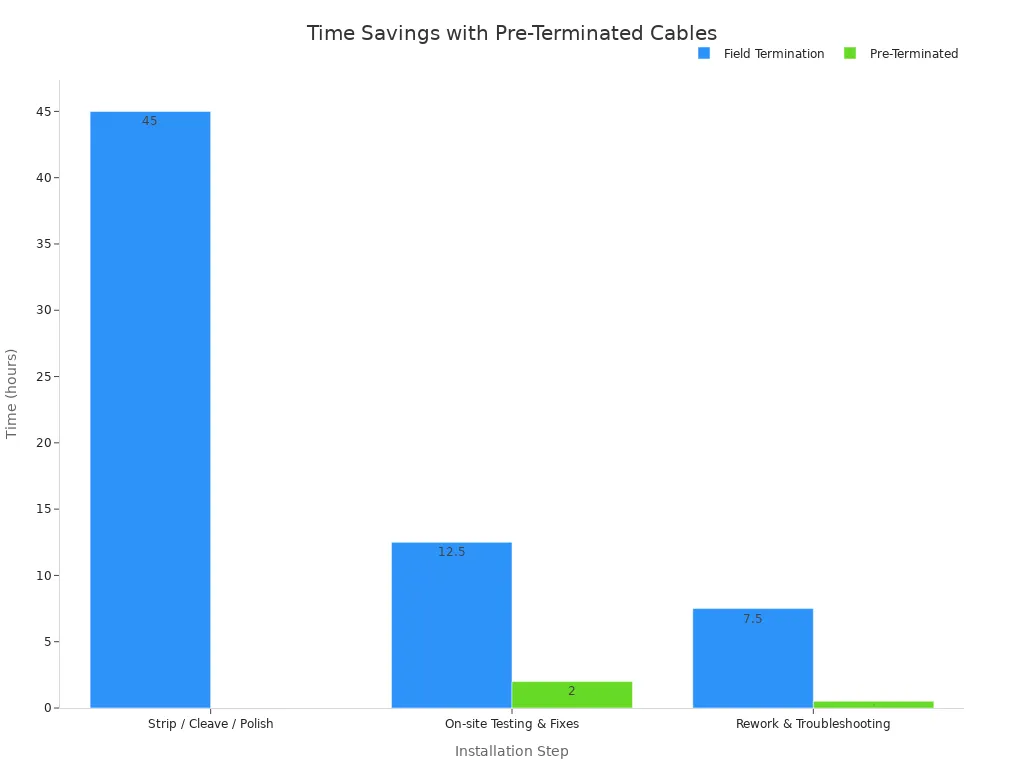
設置とトラブルシューティングにかかる労働時間が大幅に削減されたことで、運用効率が向上しました。これにより、ネットワークの再構成が大幅に高速化され、エラーが発生しにくくなります。
MPO ブレークアウト ケーブル ソリューションの実際の応用
MPO ブレークアウト ケーブル ソリューション さまざまなネットワークセグメントにわたって多用途のアプリケーションを提供します。これらは、最新のデータセンターや企業ネットワークに不可欠な接続を提供します。
高速スイッチをサーバーに接続する
MPO ブレークアウト ケーブル 高速スイッチを個々のサーバーにリンクする上で重要な役割を果たします。この接続方法により、ネットワークのパフォーマンスとリソースの使用率が最適化されます。
トップオブラック (ToR) 接続
トップオブラック (ToR) 接続の場合、 MTP-LC ブレークアウト パッチ パネル より高速な 40/100G ネットワークへの効果的な移行パスを提供します。ネットワーク管理者は、MTP ケーブルを使用して 40/100Gb スイッチをパネルの背面ポートに接続します。次に、二重 LC ケーブルを使用して 10 Gb デバイスをパネルの前面ポートに接続します。これらのパネルには、多くの場合、取り外し可能なケーブル管理プレートが含まれています。この設計により、トランク ケーブルの整理が簡素化され、設置が容易になり、ケーブルの乱雑さが軽減されます。
サーバーアップリンク
MTP/MPO ブレークアウト ケーブル (ファンアウト ケーブルとも呼ばれます)、一方の端に MTP/MPO コネクタがあり、もう一方の端にデュプレックス コネクタ (LC、SN、MDC など) が付いています。この構成により、ブレイクアウト アプリケーションが可能になります。単一の高速 MTP/MPO スイッチ ポートは、複数の低速デュプレックス スイッチまたはサーバー ポートに接続できます。たとえば、8 ファイバ MTP/MPO インターフェイスを備えた 100、200、または 400 Gig スイッチ ポートは、4 つの二重 25、50、または 100 Gig サーバー接続にブレークアウトできます。このアプローチにより、スイッチ ポートの密度と使用率が最大化され、全体的なコストの削減につながります。これらのケーブルは両端で機器に直接接続でき、チャネル全体を形成します。あるいは、MTP/MPO トランク ケーブルやパッチ パネルと並んで機器コードとして構造化ケーブルに統合されます。 MPO ケーブルはブレークアウト構成を容易にし、単一の高速スイッチ ポートを複数の低速スイッチまたはサーバーに接続できるようにします。ブレークアウト ケーブルは、MPO ファイバーをいくつかの個別の接続に分割します。たとえば、 800ギガ (800GBASE-SR8) スイッチ ポートは、2 台の 400 ギガ サーバー (2X400GBASE-SR4)、4 台の 200 ギガ サーバー (4X200GBASE-SR2)、または 8 台の 100 ギガ サーバー (8X100GBASE-SR1) に接続できます。 MPO ブレークアウト ハーネス ケーブルはケーブル管理の簡素化に貢献します 特に短距離アプリケーションにおいて、乱雑さを軽減し、複雑なパッチパネルの必要性を最小限に抑えることによって。
コア層とアクセス層の相互接続
MPO ブレークアウト ケーブルは、データセンター ネットワーク内のコア層とアクセス層を相互接続するためにも不可欠です。
データセンターのスパイン/リーフ アーキテクチャ
スパイン/リーフ アーキテクチャでは、MPO ケーブルはスパイン スイッチとリーフ スイッチ間に高密度のリンクを提供します。この設定により、効率的なデータ フローとスケーラビリティが保証されます。
アグリゲーション層接続
MPO ケーブルは、アグリゲーション レイヤ接続に大きな利点をもたらします。
- スイッチポートの分散が容易になり、帯域幅効率が向上します。: Base-8 および Base-16 MPO ケーブルは、一般的な 8 チャネル スイッチ ポート構成 (40G、100G、400G) に正確に適合します。これにより、繊維リソースの利用が最適化され、無駄が防止されます。この設計は、GPU サーバー クラスターや AI モデルのトレーニングなどの高スループット環境に最適です。効率的でスケーラブルなネットワーク アーキテクチャをサポートします。
- ケーブル配線スペースの削減、最適化された冷却、メンテナンス: そのコンパクトな設計は、特にスペースに制約のある AI コンピューティング環境における高密度の導入に適しています。ケーブルの数が少ないと、経路が明確になり、空気抵抗が減り、熱放散が改善され、エネルギー消費が削減されます。複数のチャネルを単一の光モジュール (SR4、SR8 など) に統合すると、単一チャネルのソリューションと比較して消費電力も低くなります。
- コスト削減と効率化: Base-8 アーキテクチャにより、ケーブル配線とモジュール インターフェイス構成が簡素化されます。これにより、中間スイッチング装置への依存が軽減されます。これにより、直接のポイントツーポイント接続が可能になり、システム全体のコストとエネルギー消費が削減されます。これは、高度なコンピューティング センターでコストとパフォーマンスのバランスを取るための実証済みのソリューションです。
- 将来のレート進化をサポート: Base-8 設計と Base-16 設計は両方とも IEEE 標準に準拠しています。現在の 400G アプリケーションをサポートし、800G または 1.6T へのスムーズなアップグレードを可能にします。互換性のある接続構造により、大規模なケーブルの再接続を行わずにネットワーク速度をアップグレードできます。これにより、冗長な投資が回避され、長期的な拡張に対する柔軟性が提供されます。
MPO ブレークアウト ハーネス ケーブルは、40G/100G ネットワーク移行を成功させるための基礎です。これらは本質的な利点を提供します。これらには以下が含まれます:
- コスト削減
- インフラの最大化
- 導入の簡素化
- 将来への備え
これらのケーブルは、高速化が進む現代のデータセンターや企業ネットワークにとって不可欠です。これらは、進化するネットワーク需要に対応する実用的なソリューションを提供します。
よくある質問
MPO ブレークアウト ケーブルとは何ですか?
An MPO ブレークアウト ケーブル 高密度 MPO ポートを複数の低速 LC ポートに接続します。複数の個別の LC コネクタに分割される 1 つの MPO コネクタが特徴です。この設計は、多くのファイバー接続を効率的に管理するのに役立ちます。
MPO ブレークアウト ケーブルが 40G/100G 移行に不可欠なのはなぜですか?
これにより、新しい高速 MPO 機器を既存の低速 LC デバイスに接続できるようになります。これにより、シームレスな統合が可能になり、現在のインフラストラクチャを最大限に活用できます。これらは、柔軟で効率的かつコスト効率の高いアップグレード パスを提供します。
MPO ブレークアウト ケーブルはどのようにコストを削減しますか?
これらは、組織が既存の 10G/25G 機器を再利用するのに役立ちます。これにより、インフラストラクチャの全面的な見直しが遅れ、資本支出が削減されます。また、在庫管理も合理化され、運用コストも削減されます。
MPO ブレークアウト ケーブルは、異なるネットワーク速度を接続できますか?
はい、40G QSFP+ から 10G SFP+、100G QSFP28 から 25G SFP28 などの接続が可能になります。互換性を確保するために、高速 MPO 信号を複数の低速信号に変換します。
MPO ブレークアウト ケーブルは将来も安心なネットワークに役立ちますか?
絶対に。適応性のあるネットワーク設計を提供し、再構成を簡素化します。これにより、企業はデータ需要の増大に応じてネットワークを簡単に拡張およびアップグレードでき、800G などの将来のテクノロジーをサポートできます。
MPO ブレークアウト ケーブルは一般的にどこで使用されますか?
データセンターで広く使用されています。特にトップオブラック接続とサーバーのアップリンクのために、高速スイッチをサーバーに接続します。また、スパイン/リーフ アーキテクチャのコア層とアクセス層を相互接続します。
スペース効率における MPO ブレークアウト ケーブルの主な利点は何ですか?
MPO ケーブルは、多数のファイバーのより線を 1 つのコネクタに統合します。これにより、ケーブル配線スペースが大幅に削減され、ラック スペースが最適化されます。また、データセンター内の空気の流れと冷却効率も向上します。
 Japanese
  English
  Russian
  Spanish
  Portuguese
  Korean