

MPO trunk ケーブルは高密度の光ファイバー ソリューションを提供します。これらは現代のデータセンターのバックボーンです。これらのケーブルは、帯域幅と接続に対する増大する需要に対応します。世界の MPO トランク ケーブル市場は大幅な拡大を示しており、 推定$18億 予測期間の終わりまでに。この成長は、複利年率 8.5% で発生します。この市場傾向は、現在および将来のデータセンター インフラストラクチャにおけるそれらの不可欠な役割を浮き彫りにしています。
キーテイクアウト
- MPOトランクケーブル 最新のデータセンターには不可欠です。高帯域幅と接続のニーズに対応します。
- MPO ケーブルは高密度接続を提供します。データセンター内のスペースを節約し、ケーブルの乱雑さを軽減します。
- MPO ケーブルは事前に終端処理されています。これにより、インストールが迅速かつ簡単になります。ミスも減ります。
- MTPコネクタ より優れたタイプの MPO コネクタです。パフォーマンスが向上し、信号損失が少なくなります。
- MPO ケーブルは高速イーサネットをサポートします。 400G および 800G ネットワークで動作します。将来のスピードに対応する準備ができています。
- MPO ケーブルは AI データセンターにとって不可欠です。 GPU に高速かつ低遅延の接続を提供します。
- MPO ケーブルは長期的なメリットをもたらします。設置コストを削減し、ケーブル管理を簡素化します。また、長持ちします。
MPO トランク ケーブルを理解する: 基礎
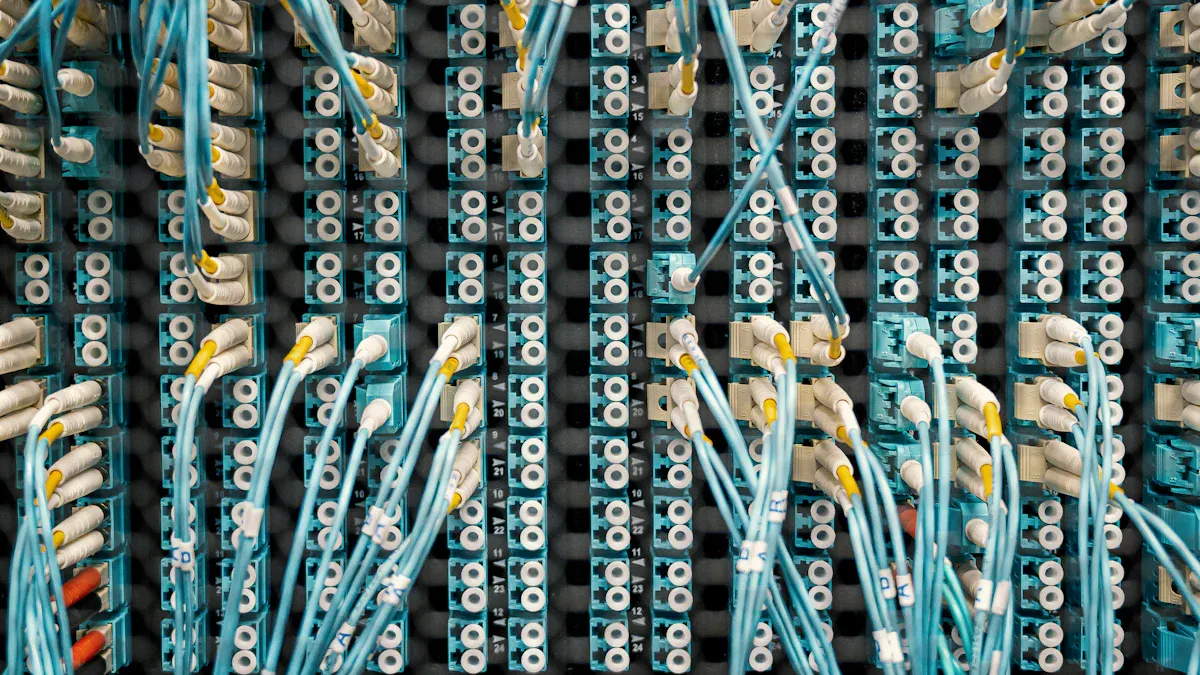
データセンターは堅牢なケーブル配線ソリューションに依存しています。 MPOトランクケーブル この基盤の重要な部分を形成します。これらは、現代のネットワークに要求される高密度の接続を提供します。それらのコアコンポーネントとバリエーションを理解することは、効率的なインフラストラクチャを設計するのに役立ちます。
MPO トランク ケーブルの定義は何ですか?
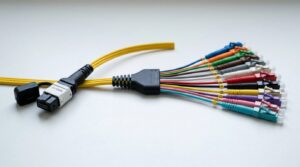
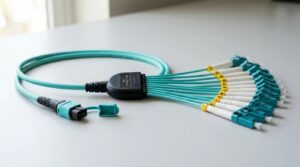
MPO トランク ケーブルは、特殊な光ファイバー アセンブリです。単一のジャケット内に複数の光ファイバーを組み合わせています。この設計は、高密度環境に大きな利点をもたらします。
マルチファイバコネクタ
MPOはマルチファイバープッシュオンの略です。このコネクタ タイプは、複数の光ファイバを 1 つのフェルールに収容します。標準的な MPO コネクタには、通常、8、12、16、または 24 本のファイバーが含まれています。多数のファイバーを一度に素早く接続できます。この設計により、ケーブル配線に必要な物理スペースが削減されます。
事前に終端処理されたアセンブリ
MPO トランク ケーブルは、終端処理済みのアセンブリとして納品されます。メーカーはこれらのケーブルを工場で終端し、テストします。このプロセスにより、高品質と一貫したパフォーマンスが保証されます。技術者はそれらを所定の位置に差し込むだけです。この「プラグアンドプレイ」の性質により、インストールが高速化されます。また、展開中の潜在的なエラーも最小限に抑えられます。
繊維の数と種類
MPO トランク ケーブルにはさまざまな心線数があります。この柔軟性により、さまざまなネットワーク要件がサポートされます。一般的な MPO トランク ケーブルのファイバー数には、12 ファイバー、24 ファイバー、48 ファイバー、72 ファイバー、および 144 ファイバー構成が含まれます。 MPO バンドルの評価は次のとおりです。 12 および 144 ファイバー。メーカーは、2 心からの範囲の心線数で MPO トランク ケーブルをカスタマイズすることもできます。 最大 288 ファイバー。多くの場合、特定の構成には以下が含まれます。:
- 12 ファイバー光トランク ケーブル (各端に 1 つの MPO コネクタ)
- 24 光ファイバ トランク ケーブル (両端ごとに 2 つの MPO コネクタ)
- 48 光ファイバ トランク ケーブル (各端に 4 つの MPO コネクタ)
- 72 光ファイバ トランク ケーブル (各端に 6 MPO コネクタ)
- 96 光ファイバー トランク ケーブル (各端に 8 個の MPO コネクタ)
- 144 ファイバー光トランク ケーブル (各端に 12 MPO コネクタ)
これらのケーブルは、シングルモード ファイバーまたはマルチモード ファイバーを使用します。シングルモード ファイバーは、長距離にわたってデータを送信します。マルチモード ファイバーは、データセンター内の短距離に適しています。
MPO コネクタと MTP コネクタ
MPO と MTP という用語は同じ意味で使用されることがよくあります。ただし、それらの間には重要な違いが存在します。
主な特徴
MPO は多心コネクタの総称です。一方、MTP は、特定の種類の MPO コネクタのブランド名です。 MTP コネクタは米国 Conec が製造しています。これは、MPO コネクタの高性能バージョンを表します。 MTP コネクタは設計が強化されています。これらの機能強化により、機械的および光学的性能が向上します。
パフォーマンス上の利点
MTP コネクタは、一般的な MPO コネクタと比較して優れた光学性能を提供します。メーカーは、より厳しい公差に合わせて MTP コネクタを製造しています。この精度により、信号の完全性が向上します。
| メトリック | MPOコネクタ | MTPコネクタ |
|---|---|---|
| 挿入損失 | 許容差が緩やかで構造が単純なため、通常は 0.3 dB ~ 0.75 dB と高くなります。 | より厳しい製造公差、楕円フェルール、高品質ガイド ピンにより、通常は 0.1 dB ~ 0.35 dB と低くなります。 |
| 返品損失 | 一般にパフォーマンスが低下します。 | 反射光を低減するより洗練された設計により、より高いパフォーマンスを実現します。 |
MTP コネクタは、より低い挿入損失とより高いリターンロスを実現します。これにより、信号の完全性と全体的なネットワーク パフォーマンスが向上します。その設計には、楕円形のフェルールと高品質のガイド ピンが含まれています。これらの機能は、ファイバーの整列と接触の向上に貢献します。これにより信号の劣化が軽減されます。
MPO トランク ケーブルの Base-8 および Base-16 アーキテクチャ
MPO トランク ケーブルは、さまざまなファイバー アーキテクチャを利用しています。 Base-8 と Base-16 の 2 つの一般的なタイプです。さまざまなイーサネット速度に合わせてファイバーの使用を最適化します。
40G および 100G の Base-8
Base-8 アーキテクチャでは、次のグループが使用されます。 8本のファイバー。この設計は、40G および 100G イーサネット規格のファイバー要件に完全に適合しています。
- 40GBASE-SR4: この規格は 10Gb/s の 4 レーンを使用します。 8 本のファイバー (送信 4 本と受信 4 本) が必要です。 Base-8 ケーブル配線は、この 8 ファイバ構成を直接サポートします。未使用の繊維を避けます。古い 12 ファイバ MPO システムでは 4 つのファイバが暗いままとなり、非効率につながります。
- 100GBASE-SR4: この規格は 25Gb/s の 4 レーンを利用します。また、Base-8 の 8 ファイバ構成にも完全に一致します。この直接調整により、Base-8 MPO コネクタ内のすべてのファイバがアクティブに使用されるようになります。
Base-8 は繊維の無駄を排除します。これらの一般的なデータセンター速度に対する効率的なソリューションを提供します。
400G および 800G の Base-16
Base-16 アーキテクチャでは、16 個のファイバーのグループが使用されます。この設計は、次世代のイーサネット速度をサポートするために重要です。 Base-16 MTP/MPO ファイバーには 16 個のファイバー コアが含まれています。より小さなスペースで高い伝送容量を実現します。これにより、ファイバーの利用率が効果的に向上します。通常、400G-SR8 などの 8 チャネル伝送をサポートする光モジュールと組み合わせます。これにより、接続密度が大幅に増加します。
Base-16 MTP/MPO ファイバーはシームレスに移行できます。 800G または 1.6T の速度。これにより、大規模な配線の見直しが回避されます。これにより、データセンターが何年にもわたって技術的に進歩した状態を維持できるようになります。 MPO ソリューションは、従来の単一光ファイバーの帯域幅のボトルネックを打破します。マルチコアパラレル伝送を採用しています。 Base-16 ファイバーは 400G/800G の高速伝送要求を満たします。従来の LC 単芯配線と比較して、3 ~ 5 倍高い並列伝送効率を実現します。
Base-16 接続ソリューションはコンパクトな設計が特徴です。これは、高密度導入要件に適合します。に最適です。 AIコンピューティング環境 キャビネットのスペースが限られているため。ケーブルの数が少ないほど、ケーブル経路がより明確になり、空気抵抗が低くなります。これにより、より効果的な放熱とエネルギー消費の制御が容易になります。 MTP-16/MPO-16 コネクタは、主に高帯域幅の伝送要件向けに設計されています。これらには、400G-SR8 および 800G-DR8 アプリケーションが含まれます。データ チャネルの使用率が効果的に向上し、未使用のファイバー リソースの無駄が削減されます。各 MTP-16/MPO-16 インターフェイスは 16 本のファイバーに対応できます。これにより、単位スペースあたりの接続密度が大幅に増加します。これは、データセンターや高速伝送ネットワークにとって特に重要です。急速な導入 800G 光学系 Base-16 接続への移行を推進します。トランシーバーには 2 つの MPO-8 コネクタまたは 1 つの MPO-16 コネクタが必要です。
データセンターにおける MPO トランク ケーブルの技術的利点
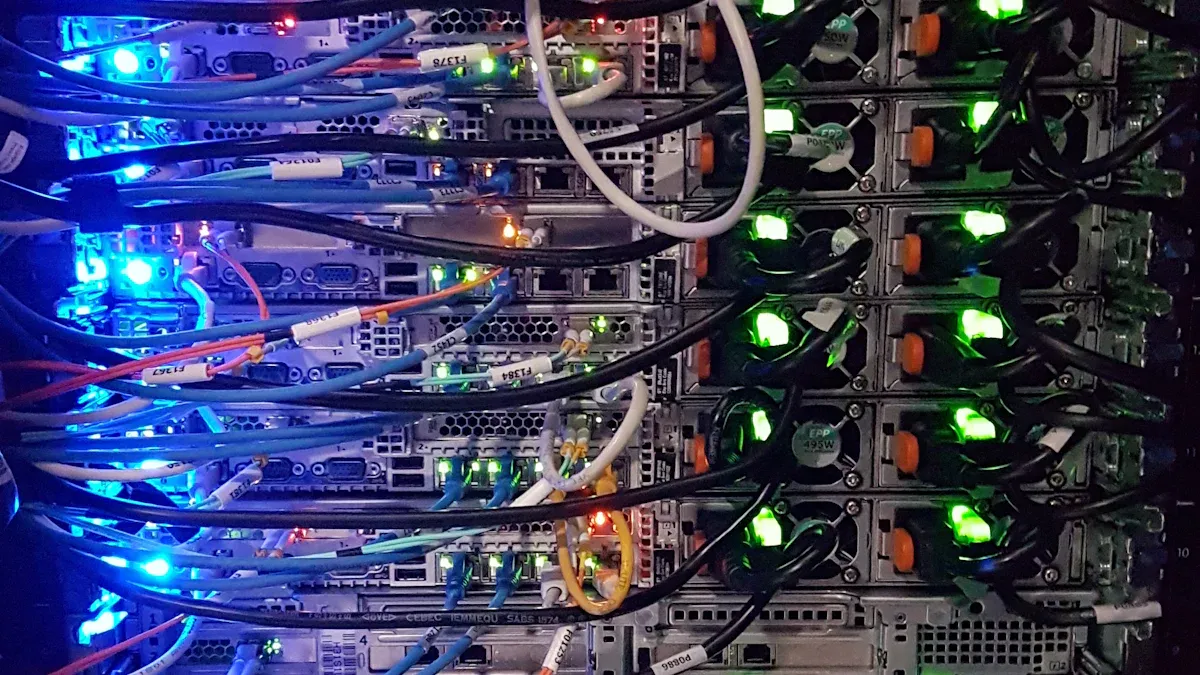
MPOトランクケーブル 重要な技術的利点を提供します。これらの利点により、最新のデータセンター運用には不可欠なものとなっています。効率を向上させ、管理を簡素化し、高速ネットワークをサポートします。
高密度接続
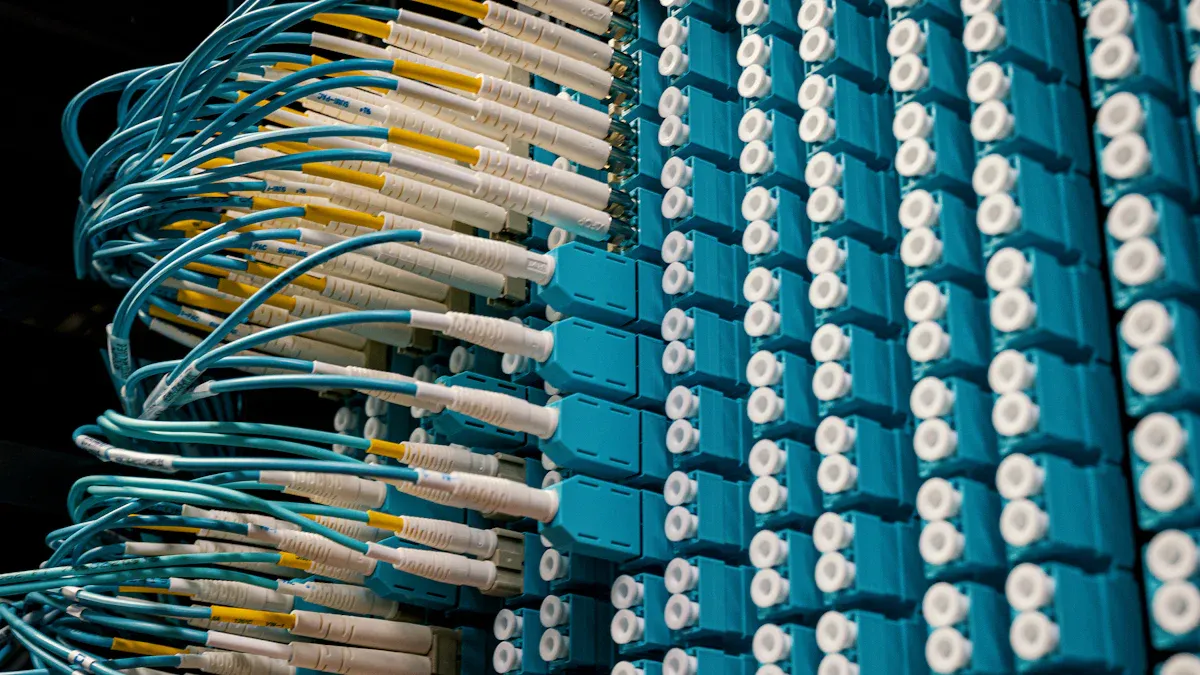
MPOトランクケーブル 高密度環境で優れた性能を発揮します。多くのファイバーが 1 つのケーブルに統合されます。このデザインにより、スペースが最適化され、乱雑さが軽減されます。
ラックスペースの最大化
データセンターは常にラックスペースの最大化を追求しています。 MPO トランク ケーブルが解決策を提供します。 MTP ファイバー システムは、従来のケーブル配線と比較して、ケーブル配線スペースを 50% 以上節約できます。一般的な実装では、288 LC 二重ケーブルが 24 MTP トランクに削減されます。これにより、約 85-90% 省スペース化 ケーブル管理経路内。同じ構成で 12 ファイバ MTP 接続を使用すると、水平方向のスペース消費が 87% だけ削減されます。
ケーブル混雑の軽減
ケーブルが混雑すると通気が妨げられ、メンテナンスが複雑になります。 MPO幹線ケーブル 複数のリンクを 1 つのアセンブリに統合する。これにより、ケーブルの乱雑さが大幅に軽減されます。直径が小さいため、サーバー ラック内の通気とケーブル管理が向上します。 縮径 MicroCore® ケーブルを備えた DENALI™ MPO トランク アセンブリ 狭い通路のスペース利用と通気を強化します。 MPO トランク ケーブル ケーブルの体積を減らし、エアフローの状態を改善します。。これは、建物内または建物間の基幹ケーブル配線に特に当てはまります。
スケーラビリティとモジュール性
データセンターには、成長可能なインフラストラクチャが必要です。 MPO トランク ケーブルは、優れた拡張性とモジュール性を提供します。
将来性のあるインフラストラクチャ
MPO ケーブルは、将来も安心なデータセンター インフラストラクチャに役立ちます。これらは、データセンターがネットワーク容量を段階的に拡張できる機能を提供します。これにより、大規模な再配線を行わずに将来のアップグレードに対応できるようになります。帯域幅の需要が増加しても、MPO ソリューションは容易に適応できます。
簡素化された拡張
MPO ケーブルを使用すると、ネットワークの拡張が簡単になります。高密度接続、 1 つのコネクタに 12 ~ 144 本のファイバを搭載、物理的なスペースが減ります。これにより、ネットワーク接続が簡素化されます。 MPO コネクタのプッシュプル結合機構により、ファイバーの嵌合が高速化されます。これにより、インストールと拡張が容易になります。カスタマイズ可能なケーブル長により過剰なケーブルが削減され、ケーブル管理が向上します。これにより、メンテナンスとアップグレードが容易になります。適切なジャケット タイプにより、さまざまなデータセンター環境でも安全性と操作性が確保されます。
迅速な展開とインストール
データセンターの運用では時間は非常に重要です。 MPO トランク ケーブルには、迅速な導入の利点があります。
プラグアンドプレイの効率性
MPO トランク ケーブルは事前に終端処理され、工場でテストされています。これにより、「プラグアンドプレイ」が可能になります。技術者はそれらを接続するだけです。この効率により、現場での終了が最小限に抑えられます。また、インストールエラーが発生する可能性も低くなります。
インストール時間の短縮
MPO/MTP システムは、設置時間を大幅に短縮します。通常、ファイバーの設置時間を次のように短縮します。 75-80% 従来のフィールド終端方式と比較して。この大幅な削減により、プロジェクトが変革される可能性があります。通常は数週間かかるプロジェクトが、1 日以内に完了できるようになりました。
信頼性とパフォーマンスの向上
MPO トランク ケーブルは、ネットワークの信頼性とパフォーマンスを大幅に向上させます。その設計と製造プロセスは、安定した効率的なデータ伝送に貢献します。これにより、データセンターは中断を最小限に抑えて稼働することが保証されます。
工場でテストされた品質
メーカーは、管理された条件下で MPO トランク ケーブルを製造します。これらのケーブルを出荷する前に、厳格なテストを実施しています。この工場テストにより、各ケーブルが厳格な性能基準を満たしていることが確認されます。すべてのアセンブリにわたって一貫した品質が保証されます。このプロセスにより、フィールド終端に伴うばらつきが解消されます。工場で研磨された端面は通常、0.35 dB 以上の挿入損失を達成します。これは、現場技術者が困難な環境で得られる結果が変動することとは対照的です。 以下の表は、一般的な挿入損失の値を示しています。 さまざまな MPO コネクタ タイプに対応:
| MPOコネクタタイプ | 代表的な挿入損失 (dB) |
|---|---|
| 標準 MPO (メーカー仕様による) | 0.20 – 0.75 |
| エリート/低損失 MPO | 0.20 |
| MTP Elite (maximum random mated loss) | 0.35 |
| MTP Elite (typical values) | 0.15 – 0.20 |
| Factory-polished end faces | 0.35 or better |
| Field technicians (variable results) | Variable |
This pre-testing ensures high reliability from the moment of installation. It reduces the need for on-site troubleshooting and re-work.
Minimized Signal Loss
Minimizing signal loss is crucial for high-speed data transmission. MPO trunk cables achieve this through precision engineering. Their multi-fiber connectors ensure accurate fiber alignment. This precise alignment reduces light dispersion and signal degradation. The use of high-quality optical fibers also contributes to lower attenuation. Lower insertion loss values, especially with MTP Elite connectors, mean more signal power reaches its destination. This directly translates to better network performance. It supports higher bandwidth applications without compromising data integrity. Data centers benefit from stable connections and fewer transmission errors. This optimized performance is vital for demanding applications like AI and cloud computing. The robust construction of these cables also protects the fibers from physical damage. This further contributes to long-term reliability and consistent signal quality.
MPO Trunk Cables for High-Speed Ethernet
MPOトランクケーブル are fundamental for achieving the high speeds required by modern Ethernet standards. They provide the necessary bandwidth and density for 400G, 800G, and future network generations.
Supporting 400G Ethernet with MPO Trunk Cables
Data centers increasingly deploy 400G Ethernet to meet growing bandwidth demands. MPO trunk cables are crucial for these deployments.
ブレークアウト構成
MPO connectors facilitate breakout cabling schemes, especially for OSFP and QSFP-DD transceivers. These configurations allow a single high-speed port to connect to multiple lower-speed ports. For example, a 16-fiber MPO connector supports 200G and 400G Ethernet. A 16-fiber MPO trunk can break out a 400G-SR4.2 transceiver into two independent 200G-SR4 links. This design doubles the fiber count within the same physical connector space as a 12-fiber single-row MPO. This enhances rack density and provides efficient paths for splitting high-speed links. The PanMPO Connector offers flexibility to change polarity and gender in the field, easing migration from lower to higher speed Ethernet. For 400G single-mode connectivity, a ‘Male to Male, Method B’ PanMPO trunk cable assembly (OS2) is a specific configuration.
Parallel Optics
Parallel optics transmission schemes utilize MPO trunk cables to achieve 400G Ethernet speeds. A 400G-SR8 transceiver uses 8 fibers for transmission (Tx) and 8 for reception (Rx). A 16-fiber MPO trunk cable provides a direct 1:1 connection without unused fibers. MPO trunk cables, with their multi-core structure, are crucial for high-bandwidth density interconnection in 400G networks. Common configurations include 8-core, 12-core, and 16-core MTP/MPO cables. For short-distance single-mode scenarios, 8-core or 12-core MTP/MPO single-mode cables connect two 400G-DR4 optical modules.
Enabling 800G and Beyond
The evolution of Ethernet continues towards 800G and even higher speeds. MPO trunk cables are at the forefront of this advancement.
Emerging Standards
Several standards bodies define the specifications for MPO technology. IEC 61754-5 defines MT ferrules, and IEC 61754-7 specifies MPO formats. TIA-604-5 and -18 define critical connectors. For higher speeds, 16-fiber solutions are strategic for efficient 200G/400G SR8 deployments. Furthermore, 24-fiber cables are the high-density champion for 400G/800G and hyperscale data centers. They maximize port density and minimize cable bulk.
Future-Ready Infrastructure
Data centers require infrastructure ready for future demands. Higher density solutions like Fiber Ribbon Stacking increase fiber count within the same connector size. Angled Physical Contact (APC) reduces back-reflection and lowers connection loss. Fiber-Ferrule Optimization refines ferrule shape and dimensions for better fiber alignment. Pitch Reduction and Miniaturization accommodate more connectors in the same space. Preparing for 800GbE and beyond requires parallel single-mode multi-fiber connectors aligned to DR8 transmission. MTP® & MPO are at the core of fiber infrastructure for AI-scale compute, supporting high-performance interconnects across thousands of GPUs.
Migration Paths and Strategies
Upgrading existing infrastructure to higher speeds requires careful planning. MPO trunk cables offer flexible migration paths.
Seamless Upgrades
Organizations can leverage existing 8-, 12-, or 24-fiber subunit MPO trunks, even though 400G and 800G applications optimize for 16 fibers. Breakout array cables facilitate transition to network ports if fiber counts align with 16- or 8-fiber groupings. For example, a 144-fiber trunk can support nine array cables of eight duplex LC connectors to MPO16. MPO16 to 2x MPO8 array assemblies are useful for 400G and 800G applications that split eight lanes into 2 x 4 lane applications, especially with legacy MPO8 trunks. Conversion assemblies can fully utilize existing fiber by terminating trunk cables to inline adapter packs.
Cost-Effective Transitions
Cost-effective transitions involve careful assessment of existing infrastructure. Testing and documenting Insertion Loss (IL) and Return Loss (RL) ensures compliance with application requirements. Organizations must ensure sufficient fiber counts for new octal applications. They also consider existing fiber types (SM, OM4, OM5), polarity, and MPO trunk cable lengths and gender. Verifying channel performance with tools like the SYSTIMAX Fiber Performance Calculator provides a starting point for planning.
The Indispensable Role of MPO Trunk Cables in AI Data Centers
Artificial intelligence (AI) workloads demand immense computational power and data transfer capabilities. MPO cables are fundamental to building the high-performance infrastructure AI data centers require. They provide the necessary bandwidth, low latency, and density for advanced AI applications.
Powering GPU Interconnects
AI models, especially large language models (LLMs), rely heavily on Graphics Processing Units (GPUs) working in parallel. Efficient communication between these GPUs is paramount.
High-Bandwidth Communication
MPO cables handle the massive data throughput AI workloads generate. They support speeds of 100G、400G、さらにそれ以上, often utilizing PAM4 signaling for increased efficiency. MPO cables, particularly those with Angled Physical Contact (APC) connectors, improve signal integrity for PAM4 modulation. This enables higher data rates like 400G/800G with minimal interference. These cables offer ultra-high bandwidth, facilitating rapid and efficient transfer of massive datasets for AI training and inference. This ensures seamless GPU communication and minimizes latency. Modern MPO cables, using single-mode fiber and PAM4 modulation, achieve hundreds of Gigabits per second per fiber. They aggregate bandwidths in the Terabits per second range. They enable fast and efficient communication between GPUs for large-scale AI training. This reduces training times and supports larger, more complex models. For example, Meta’s RSC-2024 AI SuperCluster uses 16,384 MPO-16 cables to interconnect 24,576 NVIDIA GB200 GPUs. This demonstrates their high-density and efficiency benefits. MPO cabling supports parallel transmission and high fiber counts. This is crucial for massive GPU-to-GPU communication and the terabit speeds AI workloads require. Parallel optics enable simultaneous multi-lane data transfer, a key benefit for AI infrastructure. This ensures low-latency, high-bandwidth connectivity for training large AI models.
Low-Latency Data Transfer
Low latency is crucial for AI models to train efficiently. It prevents processing bottlenecks, idle GPUs, and extended training times, which increases operational costs. MPO cables contribute to reduced latency due to the low signal loss of fiber optics. This is critical for real-time AI applications and faster GPU communication. AI networks often utilize shorter cabling runs, with many SuperPods under 50 meters. Over these distances, light propagation delay remains below 250 nanoseconds. This is negligible compared to delays from switching and signal processing. Properly designed structured cabling, including MPO cables, does not negatively impact latency-sensitive AI workloads. This counters the misconception that it introduces excessive latency. In cabling, the primary factor for latency is the overall length of the optical channel. Light propagates at approximately 1メートルあたり5ナノ秒.
Massive Data Throughput Requirements
AI data centers face unprecedented demands for data throughput. MPO cables are specifically designed to meet these challenges.
Handling AI Workloads
AI performance is highly sensitive to latency, especially when scaling to 10,000+ GPUs. Cabling infrastructure must evolve rapidly to keep pace with AI scale. AI-ready data center cabling requires native support for Base-8 and Base-16 parallel fiber. It needs compatibility with current 400G/800G SR optics and the ability to migrate to 1.6T without stranded fiber. Standards like IEEE P802.3dj are already defining 200G/400G/800G/1.6T standards for the coming wave of AI hardware. This emphasizes the need for flexible, forward-looking structured cabling. Large-scale AI training models, especially those involving deep learning and large language models (LLMs), necessitate massive GPU-to-GPU communication. Data moves at terabit speeds. MPO cables are crucial for meeting these demands by providing high-speed, low-latency interconnects. They support parallel optics and large-scale fiber counts. This enables simultaneous multi-lane data transfer and high-density connections. These are vital for training large AI models and powering next-gen AI workloads.
Distributed Computing Needs
MPO cabling, including Base-8 and Base-16 configurations, matches switch port distributions. This improves bandwidth efficiency and fiber resource utilization for high-throughput applications like GPU server clusters and AI model training. These compact designs reduce cabling space and optimize cooling. They support future rate evolutions up to 800G or even 1.6T. This ensures scalability and avoids redundant investments for long-term expansion of AI centers.
Optimizing AI Infrastructure
MPO cables play a vital role in optimizing AI infrastructure. They reduce bottlenecks and ensure efficient resource utilization.
Performance Bottleneck Reduction
Low latency is crucial for AI models to train efficiently. It prevents processing bottlenecks, idle GPUs, and extended training times. MPO cables help meet these stringent latency demands. Training large language models (LLMs) and other AI workloads necessitates massive parallel data transfers at speeds of 100G, 400G, and even higher. Data centers adopt PAM4 signaling to meet these demands. PAM4 doubles efficiency but is highly sensitive to signal degradation from reflections. MPO cables, particularly those with APC connectors, are crucial for supporting these rates. APC connectors reduce reflections by redirecting reflected light into the cladding. This improves signal integrity for PAM4 modulation and enables higher data rates like 400G/800G with minimal interference. MPO cables significantly reduce the amount of cabling and pathway congestion compared to using individual patch cords. A single 72-fiber MPO/MTP cable can replace up to 36 traditional duplex fiber patch cords. This drastically cuts down cable congestion. This efficient use of space results in better organization and management of cable systems. It leads to less congestion in the work area and improved maintenance. This indirectly supports better airflow by reducing physical obstructions.
Efficient Resource Utilization
Structured cabling ensures unimpeded airflow. This allows CRAH units to maintain consistent cold-air delivery. This is especially crucial for high-density air-cooled halls. Enhanced cooling efficiency enables operators to raise chiller set points. This leads to a PUE が 10 ~ 20% 削減 電気代も安くなります。 MTP/MPO cables simplify cable management. Their high-density connectors reduce clutter, leading to faster installation times and easier troubleshooting. This simplification directly minimizes downtime during AI data center expansion or upgrades. The ease of maintenance allows network administrators to quickly address issues, implement upgrades, and perform routine maintenance with minimal disruption. MPO cables offer superior scalability and flexibility. They support multiple fiber strands in a single connector for higher density cabling and easier upgrades. This capability is crucial for hyperscale data centers. It enables quick network expansion and reconfiguration without extensive re-cabling. This future-proofs the infrastructure against increasing bandwidth demands. The MPO ソリューションのモジュール設計 directly contributes to cost savings and faster expansion cycles. This supports a ‘pay-as-you-grow’ strategy. AI infrastructure adapts to rising demands from AI clusters, cloud computing, and video streaming without incurring prohibitive costs associated with extensive overhauls. MPO cables, while potentially more expensive initially, offer significant long-term cost savings in AI infrastructure. They avoid frequent upgrades and replacements, leading to better overall value and performance over time. This ‘pay-as-you-grow’ approach allows for easier expansion and reduces reconfiguration work. It justifies the higher initial investment through reduced operational costs and future-proofing against increasing bandwidth demands. Even with emerging technologies like co-packaged optics (CPO) and on-board optics moving closer to or directly onto the switch ASIC, the need for high-density fiber cabling like MPO for rack-to-rack connections is unlikely to be eliminated.
MPO トランク ケーブルの運用上の利点とコスト効率
MPOトランクケーブル offer significant operational benefits. They also provide substantial cost efficiencies for data centers. These advantages stem from their design and deployment methodology.
Reduced Installation Costs
MPO trunk cables significantly lower the expenses associated with setting up network infrastructure.
Labor Savings
Pre-terminated MPO cables arrive ready for use. This eliminates the need for on-site fiber termination. Technicians simply plug them into place. This "plug-and-play" approach drastically reduces the labor hours required for installation. It allows teams to complete projects faster. This efficiency translates directly into lower labor costs for data center operators.
Error Minimization
Factory testing ensures MPO cables meet high performance standards. This process minimizes the risk of installation errors. On-site termination often introduces variability and potential faults. MPO cables bypass these issues. Fewer errors mean less rework and troubleshooting. This saves both time and money during deployment.
簡略化されたケーブル管理
MPO trunk cables streamline the organization and maintenance of data center cabling.
Easier Troubleshooting
MPO cables consolidate many fibers into a single assembly. This reduces cable clutter. A cleaner cabling environment makes it easier for technicians to identify and trace connections. This simplifies troubleshooting when network issues arise. Faster problem resolution minimizes downtime.
Improved Airflow
Dense cable bundles can obstruct airflow within server racks. MPO cables, with their compact design, reduce cable volume. This improves air circulation. Better airflow helps cooling systems operate more efficiently. It prevents hot spots and maintains optimal temperatures for equipment.
Long-Term Return on Investment
Investing in MPO trunk cables yields substantial long-term returns for data centers.
Durability and Longevity
Fiber optic cabling systems, including MPO/MTP, can last 15年以上. This requires proper installation and maintenance. This extended lifespan means data centers avoid frequent cable replacements. The durability of MPO cables contributes to a stable and reliable network foundation. This reduces future capital expenditures.
Lower Maintenance
MPO cables require less ongoing maintenance. Their robust construction and simplified management reduce the likelihood of physical damage or connection issues. The return on investment for structured cabling, including MPO/MTP, manifests through reduced downtime, lower energy consumption, faster maintenance, easier compliance audits, and flexibility for new technologies. Operational savings and avoided disruptions typically surpass the initial investment significantly over a decade. For example, a B2B SaaS company deployed MTP cabling for 400G links. This added $3,400 to their infrastructure budget. This strategic investment allowed them to avoid leasing a second rack. That would have cost $4,800 per month. This resulted in an ROI achieved in just 26 days.
Future Trends for MPO Trunk Cables in 2025
MPO trunk cables continue evolving. They adapt to the increasing demands of data centers. Several key trends will shape their development by 2025. These trends focus on higher density, advanced technology, and integration with new computing paradigms.
Higher Fiber Counts and Density
Data centers constantly seek to maximize space and connectivity. MPO cables will offer even greater fiber counts and density.
Increased Connectivity
MPO-16 connectors consolidate 16 fibers. This significantly increases connection density compared to 8 or 12 fiber connectors. By 2025, the MPO-16 fiber optic connector is anticipated to become the primary standard for high-speed transmissions. This includes 800G and 1.6T, with future capabilities for 3.2T. This advancement is driven by the need for higher port density. It offers 33% more density than 12-fiber MPOs. This is crucial for AI and cloud computing applications. MPO 16 cables are particularly advanced for AI infrastructure. They pack 16 fibers into a single connector. For instance, Meta’s RSC-2024 AI SuperCluster utilizes 16,384 MPO 16 cables. These cables interconnect 24,576 NVIDIA GB200 GPUs. This demonstrates their capacity for massive fiber counts in compact spaces. It also reduces cabling mass by 28 tons compared to MPO-12 solutions.
| 特徴 | 説明 |
|---|---|
| 繊維数 | MPO-16 connectors consolidate 16 fibers, significantly increasing connection density compared to 8 or 12 fiber connectors. |
| イーサネットプロトコル | MPO-16 cables (including MMC-16) are fundamental for ultra-high-speed Ethernet, supporting 400G Ethernet, 400GBASE-SR8, 800G, and 1.6 Terabit applications. Future capabilities include 3.2 Terabit with 200 Gb/s lane rates. |
New Connector Designs
New connector designs will support these higher fiber counts. Engineers focus on miniaturization and improved alignment mechanisms. This ensures reliable performance in extremely dense environments.
Advanced Connector Technology
Connector technology will see further advancements. These improvements enhance both performance and durability.
Improved Performance
Future MPO connectors will feature even lower insertion loss. They will also offer higher return loss. This ensures optimal signal integrity for next-generation speeds. Precision manufacturing processes will become standard.
Enhanced Durability
Engineers will design connectors for increased robustness. This protects against physical stress and environmental factors. Enhanced durability reduces maintenance needs and extends cable lifespan.
Integration with Emerging Technologies
MPO cables will play a critical role in supporting new computing paradigms.
Quantum Computing
MPO trunk cables are integrating with quantum computing infrastructure. Innovations include embedding Quantum Key Distribution (QKD) channels within MPO ribbons. Researchers at Toshiba Europe successfully enabled 256-fiber MPO cables. These cables simultaneously carry both classical and quantum data. This breakthrough has been trialed in BT’s London network. It demonstrates a practical application for quantum-secure MPO links. MPO-16 cables are specifically designed to meet the demands of quantum computing infrastructure. IBM’s VP of Cloud Infrastructure, Dr. Sarah Aerni, notes MPO-16 serves as the foundation for rearchitecting exascale systems with photonic determinism. This indicates its crucial role in advanced computing environments like quantum computing.
Advanced AI Architectures
MPO systems offer a high-density, future-ready cabling infrastructure. This infrastructure supports current and future transceiver generations. It minimizes the need for "rip-and-replace" upgrades. It also simplifies migration to higher speeds (400 Gb, 800 Gb, even 1.6 Tb).
- High-Performance Interconnects: MPO cables support high-performance interconnects across thousands of GPUs. This is crucial for real-time inference, distributed training, and scalable model deployment in advanced AI architectures.
- Flexible Topologies: They enable flexible topologies for AI fabrics like NVLink, InfiniBand NDR, and Ethernet-based systems. This occurs through breakout configurations (e.g., 1×4, 1×8, 1×12).
- 迅速な展開: Pre-terminated trunk assemblies and polarity-managed cabling reduce installation time and error rates. This is vital for phased rollouts and dynamic scaling of AI environments.
MPO trunk cables are essential for data center evolution. They provide the high-density, scalable, and efficient connectivity modern infrastructure demands. Data centers rely on these cables to support increasing bandwidth needs and advanced technologies like AI. The future of data center connectivity clearly relies on MPO trunk cables. They enable seamless upgrades and robust performance.
よくある質問
What is an MPO trunk cable?
An MPOトランクケーブル is a fiber optic assembly. It contains multiple optical fibers within a single jacket. This design offers high-density connectivity. Manufacturers pre-terminate and test these cables. This ensures quick, reliable installation in data centers.
What is the difference between MPO and MTP connectors?
MPO is a generic term for multi-fiber connectors. MTP is a specific brand name for a high-performance MPO connector. US Conec manufactures MTP connectors. They feature design enhancements for better mechanical and optical performance. MTP connectors offer lower insertion loss.
Why are MPO trunk cables crucial for modern data centers?
MPO trunk cables provide high-density connectivity. They maximize rack space and reduce cable congestion. They also support rapid deployment and offer enhanced reliability. These features are essential for managing increasing bandwidth demands in data centers.
How do MPO cables support high-speed Ethernet?
MPO cables use Base-8 and Base-16 architectures. These architectures align with fiber requirements for 40G, 100G, 400G, and 800G Ethernet. They enable parallel optics transmission. This supports the massive data throughput needed for high-speed networks.
Do MPO cables reduce installation time and costs?
Yes, MPO cables significantly reduce installation time. They are pre-terminated and factory-tested, offering "plug-and-play" efficiency. This minimizes on-site labor and reduces potential errors. These factors lead to lower overall installation costs for data centers.
Are MPO trunk cables suitable for AI data centers?
Absolutely. MPO cables are indispensable for AI data centers. They power GPU interconnects with high-bandwidth and low-latency communication. They handle massive data throughput requirements. This optimizes AI infrastructure by reducing performance bottlenecks and ensuring efficient resource utilization.
What long-term benefits do MPO trunk cables offer?
MPO trunk cables provide a strong long-term return on investment. They offer durability and longevity, lasting 15 years or more. Their simplified cable management leads to lower maintenance needs. This results in reduced downtime and significant operational savings over time.
 Japanese
  English
  Russian
  Spanish
  Portuguese
  Korean